You’ve learned the basics of prompt engineering.
You know how to structure a clear prompt with role, task, and context.
But here’s where most people plateau:
They use the same prompting approach for every task.
That’s like using a hammer for every job.
Sometimes you need a screwdriver.
Today you’ll learn three fundamental prompting methods that professionals use:
- Zero-Shot Prompting (direct instructions)
- Few-Shot Prompting (learning by example)
- Chain-of-Thought Prompting (step-by-step reasoning)
More importantly, you’ll learn WHEN to use each one.
By the end of this article, you’ll know exactly which method fits your task. And your AI outputs will improve dramatically.
Understanding the Three Methods
Before we compare them, let’s define what each method actually is.
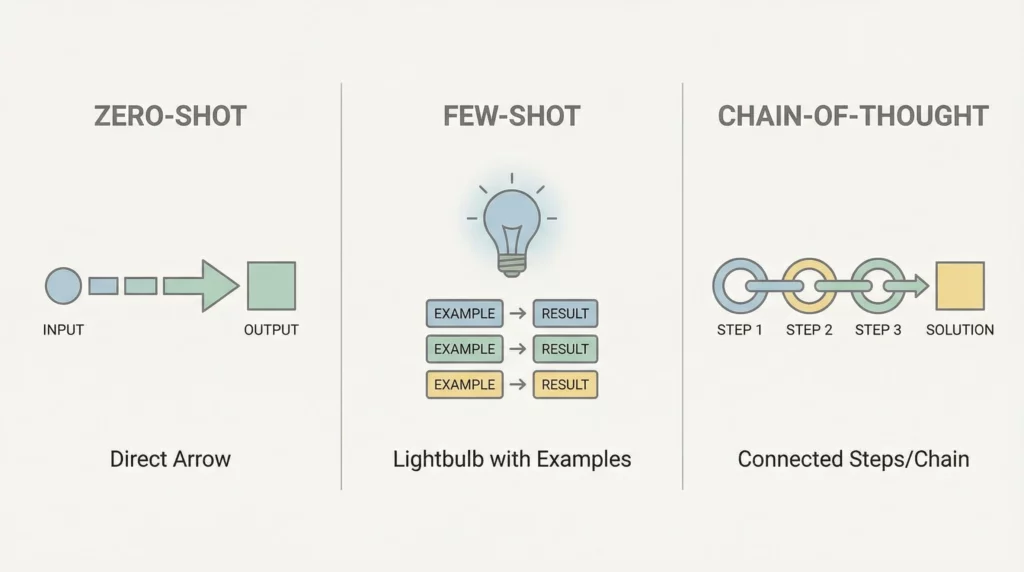
Zero-Shot Prompting: Direct Instructions
Zero-shot means giving AI a task with no examples.
You describe what you want. The AI figures it out based on its training.
Example:
"Write a professional email declining a meeting invitation."That’s it. No examples. No demonstrations. Just clear instructions.
When it works well:
- Common, straightforward tasks
- Tasks the AI has seen many times during training
- When you need quick results
- When the task doesn’t require specific formatting or style
Few-Shot Prompting: Learning by Example
Few-shot means providing one or more examples before asking for what you want.
You show the AI the pattern. Then it follows that pattern.
Example:
"Write product descriptions following this style:

Example 1:
Product: Wireless Mouse
Description: Smooth precision meets ergonomic comfort. This wireless mouse glides effortlessly across any surface, keeping your hand relaxed during long work sessions.

Example 2:
Product: Desk Lamp
Description: Bright ideas deserve bright lighting. This adjustable desk lamp provides focused illumination exactly where you need it, reducing eye strain during late-night productivity.

Now write one for:
Product: Noise-Canceling Headphones"
The AI learns your style, tone, and structure from the examples.
When it works well:
- Specific formatting or style requirements
- Unusual or unique patterns
- Consistency across multiple outputs
- When you have a “signature” approach
Chain-of-Thought Prompting: Step-by-Step Reasoning
Chain-of-thought means asking AI to show its reasoning process before giving the final answer.
You explicitly request the thinking steps that lead to the conclusion.
Example:
"Should I invest in paid ads or organic content first for my new affiliate site?

Think through this step-by-step:
1. Consider my current budget
2. Evaluate time vs money tradeoffs
3. Assess long-term vs short-term benefits
4. Factor in my experience level
5. Then provide your recommendation with reasoning"
The AI walks through the logic before answering.
When it works well:
- Complex decisions or analysis
- Problems requiring multi-step reasoning
- When you need to verify the logic
- Strategic planning and problem-solving

The Same Task, Three Different Methods
Let’s see all three methods in action with the same task.
The Task: Create email subject lines for a product launch announcement.
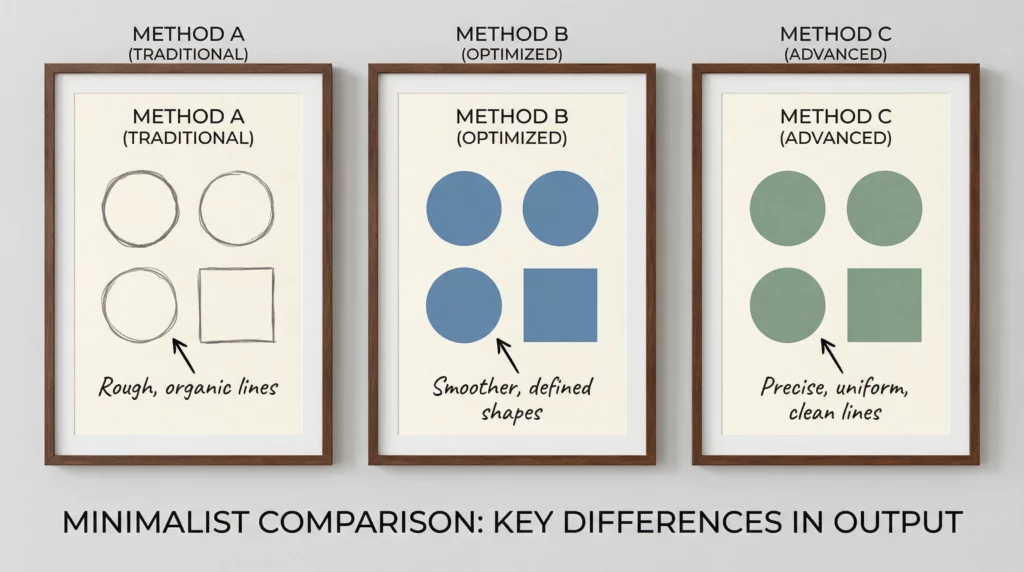
Method 1: Zero-Shot Approach
Prompt:
"Generate 5 email subject lines for announcing the launch of a new project management tool for small teams. Make them compelling and click-worthy."Result:
- Introducing [Product Name]: Simpler Project Management for Small Teams
- New Tool Alert: Streamline Your Team’s Workflow Today
- Say Goodbye to Project Chaos – Meet [Product Name]
- The Project Management Solution Small Teams Have Been Waiting For
- Transform How Your Team Works Together – Launch Special Inside
Analysis:
- Quick and easy
- Generic but functional
- No specific style or pattern
- Good starting point
When this works: When you need quick ideas and don’t have a specific style in mind.
Method 2: Few-Shot Approach
Prompt:
"Generate 5 email subject lines following these examples:

Example 1: "The inbox hack that saved me 2 hours daily ⏰"
Example 2: "Why 10,000+ marketers switched to [Tool] (and never looked back) 💡"
Example 3: "Your meetings just got 50% shorter—here's how ⚡"

Notice the pattern:
- Benefit-focused
- Includes specific numbers/stats
- Uses relevant emoji
- Creates curiosity

Now create 5 subject lines for announcing a new project management tool for small teams."
Result:
- The workflow trick that cut our project time by 40% 📊
- Why 5,000+ small teams ditched their old PM tools (true story) ✨
- Your team meetings just became actually productive—here’s the secret 🎯
- The 3-click project setup that changed everything ⚡
- How we helped 500+ teams finish projects 2x faster 🚀
Analysis:
- Follows the exact style pattern
- Consistent voice and structure
- Includes numbers and emojis as demonstrated
- Much more specific to your brand voice
When this works: When you have a proven style and want consistency.
Method 3: Chain-of-Thought Approach
Prompt:
"I need 5 email subject lines for announcing a new project management tool for small teams.

Before generating them, think through:
1. What pain points do small teams have with project management?
2. What emotional triggers drive email opens (curiosity, fear of missing out, benefit)?
3. What makes a subject line stand out in a crowded inbox?
4. What's the right balance between information and intrigue?

Walk through your reasoning, then provide 5 subject lines based on that analysis."
Result (AI shows reasoning first):
Thinking process: “Small teams struggle with: overcomplicated tools, time wasted on coordination, lack of visibility, everyone using different systems.
Emotional triggers that work: fear of wasting time, desire for simplicity, proof that others succeeded, curiosity about a solution.
Standing out: specific numbers, addressing pain directly, promise of quick results, social proof.
Balance: enough info to know what it’s about, enough mystery to want to learn more.”
Then provides subject lines:
- Stop losing projects in email threads (we found a better way)
- 43% less time in status meetings—small teams are loving this
- The anti-bloat project tool built for teams of 5-15
- “Finally, a PM tool we actually use” – 200+ small team reviews
- Your team’s next project: Organized in under 5 minutes
Analysis:
- Strategically crafted based on reasoning
- Addresses actual pain points identified
- Each line has a specific purpose
- More thoughtful and targeted
When this works: When you want strategic, well-reasoned outputs that solve specific problems.
Decision Framework: Which Method Should You Use?
Here’s how to choose the right method for your task.
Use Zero-Shot When:
✅ The task is common and straightforward
- Writing basic emails
- Summarizing text
- Simple translations
- Answering factual questions
- Quick brainstorming
✅ You don’t have a specific style requirement
- Generic content is acceptable
- Standard professional tone works
- No special formatting needed
✅ Speed matters more than precision
- Need multiple quick drafts
- Exploring ideas rapidly
- Time-sensitive tasks
✅ You’ll heavily edit anyway
- Just need a starting point
- Want raw material to work with
- Planning to personalize significantly
Example scenarios:
- “Summarize this article in 3 sentences”
- “Translate this email to Spanish”
- “List 10 blog post ideas about productivity”
- “Write a thank you email to a client”
Pros:
- Fastest approach
- Simplest to execute
- Good for exploration
- Less prompt engineering needed
Cons:
- Less control over style
- May be generic
- Inconsistent results
- Might miss nuances
Use Few-Shot When:
✅ You need a specific style or format
- Brand voice consistency
- Particular tone or personality
- Specific structural pattern
- Unique formatting requirements
✅ The task is unusual or specialized
- Industry-specific content
- Niche formats
- Uncommon approaches
- Creative patterns
✅ You’re creating multiple similar items
- Product descriptions (same style for 20 products)
- Social media posts (consistent brand voice)
- Email sequences (matching tone across series)
- Content templates
✅ You have proven examples to share
- Past content that performed well
- Competitor examples you like
- Your own best work
- Industry standards
Example scenarios:
- Writing product reviews in your signature style
- Creating social posts matching your brand voice
- Generating ads similar to your best performers
- Building content with specific structural patterns
Pros:
- Consistent style and format
- Better matches your brand voice
- More predictable results
- Great for scaling content
Cons:
- Requires good examples
- Takes longer to set up
- Limited to patterns you can demonstrate
- Longer prompts
Use Chain-of-Thought When:
✅ The task requires complex reasoning
- Strategic decisions
- Multi-factor analysis
- Problem diagnosis
- Planning and prioritization
✅ You need to verify the logic
- Important business decisions
- Content requiring accuracy
- Situations where “why” matters
- When you need to explain to others
✅ Multiple steps are involved
- Research and synthesis
- Comparative analysis
- Cause and effect relationships
- Sequential processes
✅ The stakes are high
- Financial decisions
- Strategic planning
- Client-facing recommendations
- Long-term commitments
Example scenarios:
- “Should I focus on SEO or paid ads first?”
- “Analyze why my conversion rate dropped”
- “Help me prioritize these 10 projects”
- “Evaluate if I should expand into a new niche”
Pros:
- More thoughtful outputs
- You can verify reasoning
- Better for complex tasks
- Produces strategic insights
Cons:
- Slower process
- Longer responses
- May be overkill for simple tasks
- Requires more tokens/processing
Real-World Applications for Affiliate Marketers
Let’s get practical with affiliate marketing scenarios.
Scenario 1: Product Descriptions
Zero-Shot:
"Write a 150-word product description for a standing desk converter."Result: Generic, functional description. Use when: You need quick descriptions and will heavily edit anyway.
Few-Shot:
"Write product descriptions matching this style:

Example: 'Meet your new productivity partner. This wireless keyboard doesn't just type—it transforms your workspace into a command center. Whisper-quiet keys let you work anywhere without disturbing others, while the 6-month battery life means one less thing to worry about.'

Now write one for a standing desk converter."
Result: Matches your established brand voice perfectly. Use when: You have 50 products to describe in a consistent style.
Chain-of-Thought:
"I need a product description for a standing desk converter.

First, analyze:
1. What are the main objections to standing desks? (cost, space, commitment)
2. What benefits matter most to office workers? (health, energy, flexibility)
3. How can I address objections while highlighting benefits?

Then write a 150-word description based on this analysis."
Result: Strategically crafted to overcome specific objections. Use when: This is a flagship product requiring a well-reasoned approach.
Scenario 2: Email Sequence Planning
Zero-Shot:
"Create a 5-email welcome sequence for new subscribers to my fitness affiliate site."Result: Basic sequence structure, generic content. Use when: You just need a starting framework.
Few-Shot:
"Create a 5-email sequence following this approach:

Email 1 (Day 1): Welcome + deliver promised freebie + set expectations
Example: 'Welcome! Here's your [freebie]. Over the next week, I'll share [preview of value].'

Email 2 (Day 3): Quick win + build trust
Example: 'Try this one thing today: [actionable tip]. It takes 5 minutes.'

[Continue pattern...]

Now create a sequence for fitness affiliate site subscribers."
Result: Follows your proven email structure and tone. Use when: You have a successful email pattern to replicate.
Chain-of-Thought:
"I need a 5-email welcome sequence for fitness affiliate site subscribers.

First, think through:
1. What's their mindset when they first subscribe? (motivated but overwhelmed)
2. What objections prevent people from taking action? (time, complexity, cost)
3. How quickly should I introduce affiliate products? (build trust first vs show value)
4. What progression builds trust while moving toward a sale?

Walk through the strategy, then create the sequence."
Result: Strategically designed sequence based on subscriber psychology. Use when: You’re building a critical sequence that needs to convert well.
Scenario 3: Content Topic Ideation
Zero-Shot:
"Generate 20 blog post ideas for a tech affiliate site."Result: Broad mix of generic tech topics. Use when: Initial brainstorming, exploring directions.
Few-Shot:
"Generate blog post ideas following these patterns:

Pattern 1: '[Product] vs [Product]: Which is Better for [Specific Use Case]?'
Example: 'MacBook Air vs MacBook Pro: Which is Better for Content Creators?'

Pattern 2: '[Number] [Product Category] That Actually [Specific Benefit]'
Example: '7 Budget Laptops That Actually Handle Video Editing'

[Show 2-3 more patterns]

Now generate 20 ideas for a tech affiliate site using these patterns."
Result: Ideas matching your proven content formats. Use when: You know what formats work and want more of them.
Chain-of-Thought:
"I need 20 blog post ideas for a tech affiliate site.

Before generating ideas, analyze:
1. What tech topics have high search volume but low competition?
2. What questions do buyers ask before purchasing tech products?
3. What seasonal or trending tech topics are emerging?
4. What content gaps exist in my niche?

Think through these factors, then generate 20 strategic topic ideas."
Result: Well-researched, strategic topics with clear reasoning. Use when: Planning quarterly content strategy, not just filling a calendar.
Combining Methods for Better Results
Here’s a pro tip: You don’t have to pick just one method.
The best results often come from combining approaches.
Hybrid Approach Example:
Step 1: Chain-of-Thought for Strategy
"I need to write a comparison article between Product A and Product B.

Think through:
1. What do buyers really care about when choosing between these?
2. What objections does each product face?
3. How can I structure this to help people make the right decision?

Provide your strategic analysis."
Step 2: Few-Shot for Execution
"Now write the article following this structure and style:

[Paste example of your proven comparison article structure]

Apply the strategic insights from your analysis above."
This combines strategic thinking with consistent execution.
Result: Thoughtful content in your signature style.
Common Mistakes to Avoid
Mistake 1: Using Few-Shot with Poor Examples
If your examples are weak, the AI will replicate weakness.
Bad:
"Follow this example:
Example: 'This product is good and you should buy it.'

Now write more like this."
The AI will copy the vague, unconvincing style.
Fix: Only use examples that represent your best work.
Mistake 2: Overusing Chain-of-Thought
Not every task needs deep reasoning.
Overkill:
"Write a simple thank you email. First, analyze the psychology of gratitude, the optimal email length based on recipient attention spans, cultural considerations..."Better: Just use zero-shot for simple tasks.
Rule of thumb: If you can clearly visualize the output, you probably don’t need chain-of-thought.
Mistake 3: Zero-Shot for Complex Tasks
Some tasks genuinely need examples or reasoning.
Won’t work well:
"Write content exactly matching my unique brand voice."AI can’t guess your specific voice without examples.
Better: Use few-shot with actual examples of your voice.
Mistake 4: Not Iterating
No method is perfect on the first try.
All three methods work better with iteration:
- Review the output
- Tell AI what to adjust
- Refine until it’s right
Example iteration: “This is good, but make it more conversational and add a specific example in the second paragraph.”
Quick Reference Guide
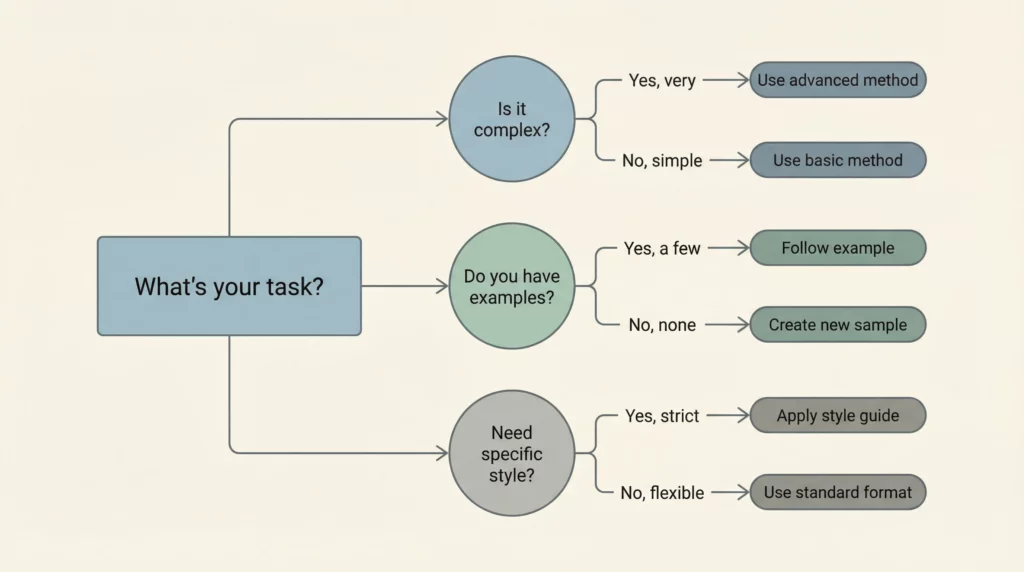
When you’re stuck deciding which method to use, ask yourself these questions:
Question 1: Is this task straightforward and common?
- YES → Try zero-shot first
- NO → Consider few-shot or chain-of-thought
Question 2: Do I have good examples to share?
- YES → Few-shot will give you consistency
- NO → Stick with zero-shot or chain-of-thought
Question 3: Does this require strategic thinking?
- YES → Use chain-of-thought
- NO → Zero-shot or few-shot is fine
Question 4: Will I heavily edit anyway?
- YES → Zero-shot saves time
- NO → Use few-shot or chain-of-thought for better initial quality
Question 5: Am I creating multiple similar items?
- YES → Few-shot ensures consistency
- NO → Zero-shot or chain-of-thought depending on complexity
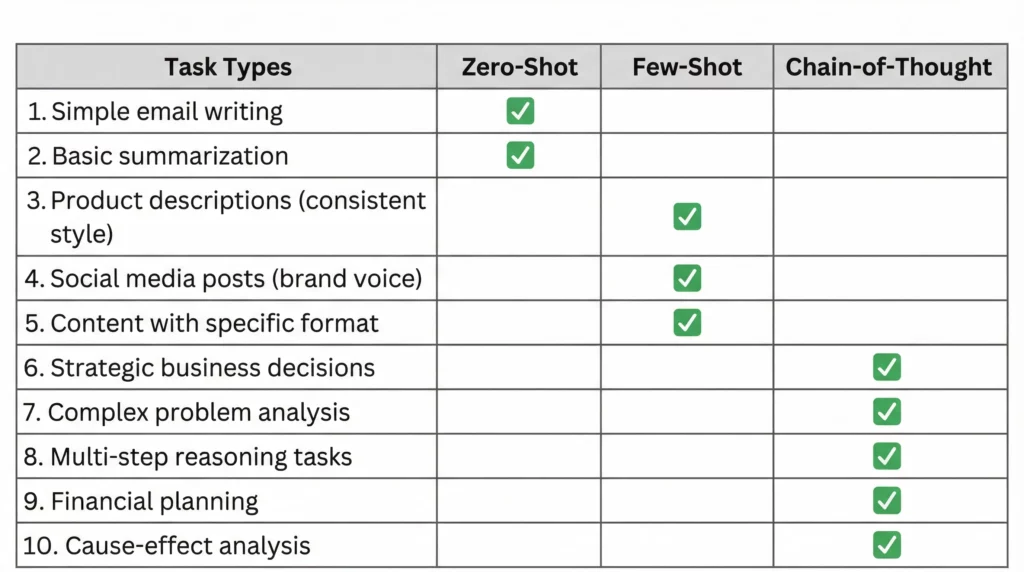
| Task Type | Zero-Shot | Few-Shot | Chain-of-Thought |
|---|---|---|---|
| Simple email writing | ✓ | ||
| Basic summarization | ✓ | ||
| Product descriptions (consistent style) | ✓ | ||
| Social media posts (brand voice) | ✓ | ||
| Content with specific format | ✓ | ||
| Strategic business decisions | ✓ | ||
| Complex problem analysis | ✓ | ||
| Multi-step reasoning tasks | ✓ | ||
| Financial planning | ✓ | ||
| Cause-effect analysis | ✓ |
Practical Exercise: Try All Three
Here’s how to develop your instinct for which method to use.
Pick a task you do regularly. Let’s say: writing social media posts.
Try all three methods:
Zero-Shot:
"Write 5 Twitter posts about productivity tips."Few-Shot:
"Write Twitter posts matching this style:

Example 1: 'Your 3pm energy crash isn't about willpower. It's about lunch. Heavy carbs → blood sugar spike → crash. Try: protein + veggies at lunch. Same calories, steady energy. 🔋'

Example 2: 'Stop trying to "find time" for important work. You won't find it. You have to MAKE it. Block your calendar first thing Monday. Protect that time like a meeting with your CEO (yourself). ⏰'

Now write 5 posts about productivity tips in this style."
Chain-of-Thought:
"I need 5 Twitter posts about productivity tips.

First, analyze:
1. What productivity problems frustrate people most?
2. What's the gap between advice people hear and advice they can actually implement?
3. What makes a productivity tip go viral vs get ignored?

Think through these questions, then write 5 posts based on your insights."
Compare the results.
Notice the differences in:
- Quality
- Consistency
- Strategic thinking
- Match to your needs
This hands-on experience will teach you more than any article.
When to Level Up Your Prompting
You’ve learned three powerful methods.
Here’s when each one becomes essential:
Master Zero-Shot first (Week 1-2)
- Get comfortable with basic prompting
- Learn to write clear instructions
- Understand what AI can/can’t do
Add Few-Shot next (Week 3-4)
- When you need consistency
- When you have proven examples
- When scaling content production
Incorporate Chain-of-Thought (Month 2+)
- For strategic decisions
- For complex analysis
- When reasoning matters
Combine all three (Month 3+)
- Use strategically based on task
- Mix methods for optimal results
- Develop your own hybrid approaches
What’s Next
You now understand three fundamental prompting methods:
- Zero-Shot: Direct instructions for straightforward tasks
- Few-Shot: Examples to teach specific styles and patterns
- Chain-of-Thought: Step-by-step reasoning for complex problems
More importantly, you know WHEN to use each.
The best prompt engineers don’t use the same approach for every task.
They choose the right tool for the job.
Start by practicing zero-shot for your daily tasks. When you need consistency, experiment with few-shot. When facing complex decisions, try chain-of-thought.
Over time, you’ll develop an instinct for which method fits which situation.
That’s when AI transforms from a helpful tool to a productivity multiplier.
Want to build better prompts faster?
Our free AI Prompt Builder helps you create structured prompts that work with all three methods. Just fill in a few fields and get a ready-to-use prompt that matches your task needs.
Quick Practice Challenge:
Take one task you’re working on today.
Try it three ways:
- Zero-shot (just clear instructions)
- Few-shot (with 1-2 examples)
- Chain-of-thought (ask for reasoning first)
See which gives you the best result.
That hands-on experience will teach you more than any theory.
Start experimenting.
Start improving.
Start getting better results.
The methods are simple. The impact is huge.