You may also like:
- Context Windows Explained (How Much Information Can AI Actually Remember)
- How to Refine AI Content
- AI Prompt Builder
You’ve tried creating complex content with AI.
A complete blog post. An entire email sequence. A full product comparison guide.
And the result? A mess.
AI either misses key details, loses focus halfway through, or produces generic fluff.
Here’s why: you’re asking too much at once.
Complex tasks need a different approach.
Enter prompt chaining: the strategy that breaks big projects into manageable, sequential steps.
Today, you’ll learn how to chain prompts together to create sophisticated content that actually works.
This isn’t beginner stuff. This is the strategic method used by experienced marketers.
Let’s break it down.
What Is Prompt Chaining?
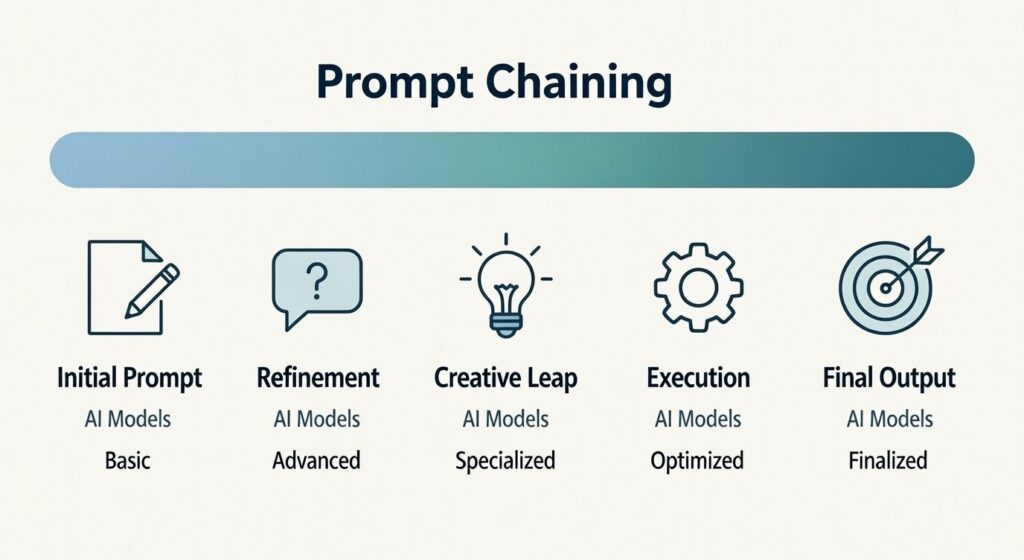
Prompt chaining is a multi-step approach to AI content creation.
Instead of one massive prompt, you use a series of smaller, connected prompts.
Each prompt builds on the previous output.
Think of it like cooking a complex meal.
You don’t throw all ingredients in a pot at once.
You prep vegetables. Cook proteins. Make sauce. Combine strategically.
Each step depends on the one before it.
That’s prompt chaining.
Single Prompt Approach: “Create a complete 2000-word comparison guide for 5 project management tools including features, pricing, use cases, and recommendations.”
Prompt Chaining Approach:
- Prompt 1: Research and list key comparison criteria
- Prompt 2: Create structured outline based on criteria
- Prompt 3: Write detailed analysis for each tool
- Prompt 4: Add use cases and recommendations
- Prompt 5: Write introduction and conclusion
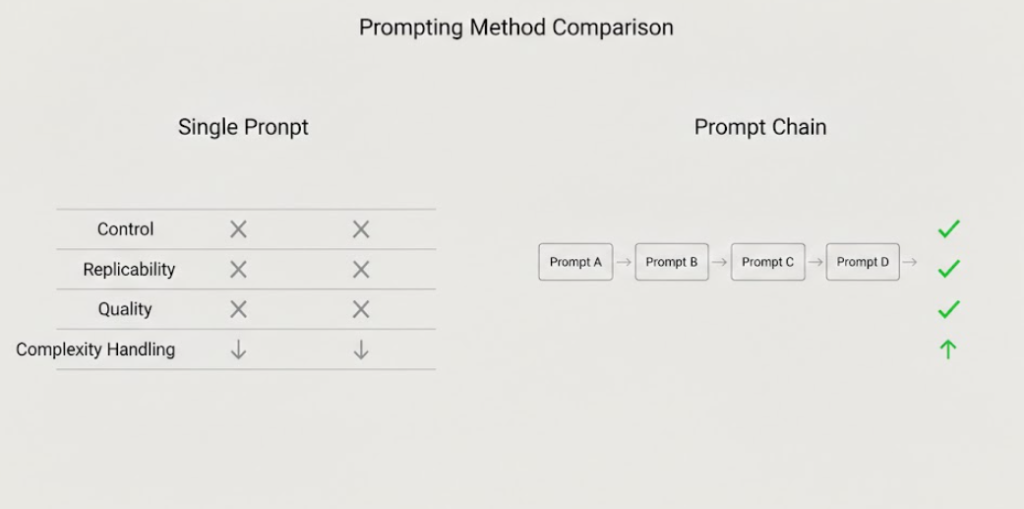
See the difference?
The chained approach gives you control at every stage.
[Image suggestion: Visual diagram showing single massive prompt (messy output) vs. chain of connected prompts (clean, structured output)]
Why Prompt Chaining Outperforms Single Prompts
Let’s get strategic about this.
Reason 1: AI Has Context Limits
AI can handle a lot, but not everything at once.
When you pile too many requirements into one prompt, quality suffers.
Some instructions get lost. Others get half-implemented.
Chaining breaks complexity into digestible chunks.
Each prompt focuses AI’s full attention on one specific task.
Reason 2: You Maintain Quality Control
With single prompts, you get one output.
Love it or hate it, you’re stuck with it.
With chaining, you review and adjust between steps.
Catch problems early. Redirect before too much work is done.
Reason 3: Easier to Replicate Success
When a single complex prompt works, great.
But can you recreate that success consistently?
With chains, you document each step.
You build repeatable workflows.
You create systems, not one-offs.
Reason 4: Better for Complex Logic
Some tasks require sequential thinking.
You need output A to inform input B.
You need to analyze before you write.
You need to plan before you efxecute.
Single prompts can’t handle this conditional logic well.
Chains can.
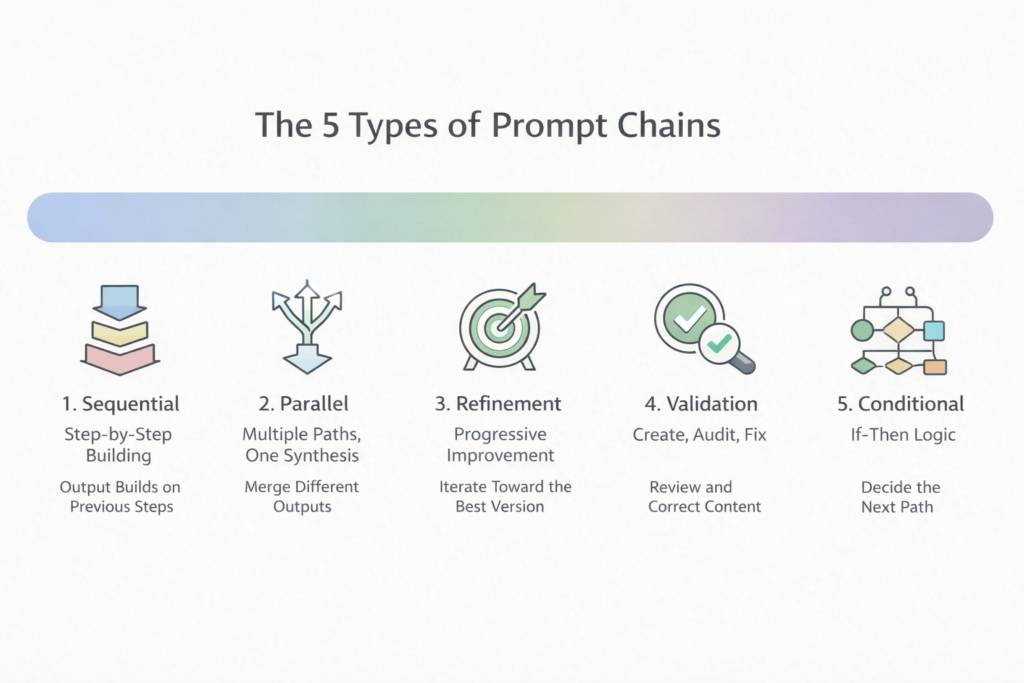
The 5 Types of Prompt Chains
Not all chains are created equal.
Here are the five types you’ll use most.
Type 1: Sequential Chains (Build Upon Previous Output)
Each prompt uses the exact output from the previous step.
Example: Creating a Product Review
Prompt 1: "List the 10 most important features someone should know about [product name]."

Prompt 2: "Take this feature list: [paste output]. For each feature, write one sentence explaining the real-world benefit to users."

Prompt 3: "Using these features and benefits: [paste output]. Write a 150-word introduction that highlights the top 3 benefits."

Prompt 4: "Now write the main body: 400 words covering all features and benefits from our list. Organize by importance."

Prompt 5: "Finally, write a 100-word conclusion with a recommendation. Reference the specific benefits we've discussed."
Each step builds directly on previous work.
Type 2: Parallel Chains (Multiple Paths, Then Combine)
Create several outputs independently, then merge them.
Example: Comprehensive Buyer’s Guide
Chain A - Research:
Prompt 1A: "List all common questions beginners ask about [product category]."
Prompt 2A: "Identify the top 5 buying criteria for [product category]."

Chain B - Product Analysis:
Prompt 1B: "Analyze [Product 1] focusing on the 5 criteria: [paste criteria]."
Prompt 2B: "Analyze [Product 2] focusing on the same criteria."
Prompt 3B: "Analyze [Product 3] focusing on the same criteria."

Chain C - Synthesis:
Prompt 1C: "Using the questions [paste from 1A], criteria [paste from 2A], and analyses [paste all B outputs], create a comparison table."
Prompt 2C: "Now write a buyer's guide that addresses each question using insights from our analyses."
Multiple parallel chains feed into final synthesis.
Type 3: Refinement Chains (Progressive Improvement)
Each prompt refines the same content.
Example: Email Subject Line Optimization
Prompt 1: "Write 10 subject lines for an email about [topic]."

Prompt 2: "Take these subject lines: [paste output]. Identify the 3 with the strongest hooks."

Prompt 3: "For each of these 3: [paste selections]. Create 2 variations that increase urgency."

Prompt 4: "Now we have 6 subject lines: [paste all]. Test each against this criteria: clear benefit, under 50 characters, creates curiosity. Rank them."

Prompt 5: "Take the top 2 ranked subject lines and create A/B test variations that change only one element each."
You progressively refine toward the optimal output.
Type 4: Validation Chains (Check Your Work)
Create content, then validate it through systematic checking.
Example: Landing Page Copy
Prompt 1: "Write landing page copy for [product] targeting [audience]."

Prompt 2: "Review this copy: [paste output]. Identify any claims that need supporting evidence or stats."

Prompt 3: "Check the copy against these conversion elements: clear value prop, social proof, objection handling, strong CTA. List what's missing."

Prompt 4: "Revise the copy to address the missing elements: [paste list]. Keep the same overall structure and tone."

Prompt 5: "Final check: Does this copy speak directly to [audience's main pain point]? Suggest any final adjustments."
You systematically validate and improve.
Type 5: Conditional Chains (If-Then Logic)
Chain direction changes based on previous outputs.
Example: Content Strategy Development
Prompt 1: "Analyze this niche: [description]. Is it content-saturated or underserved?"

[If saturated → Branch A]
Prompt 2A: "It's saturated. Identify 5 specific sub-niches with less competition."
Prompt 3A: "For sub-niche [selection], create a differentiation strategy."

[If underserved → Branch B]
Prompt 2B: "It's underserved. What are the top content gaps?"
Prompt 3B: "Create a content calendar addressing these gaps."
Your chain adapts based on AI analysis.
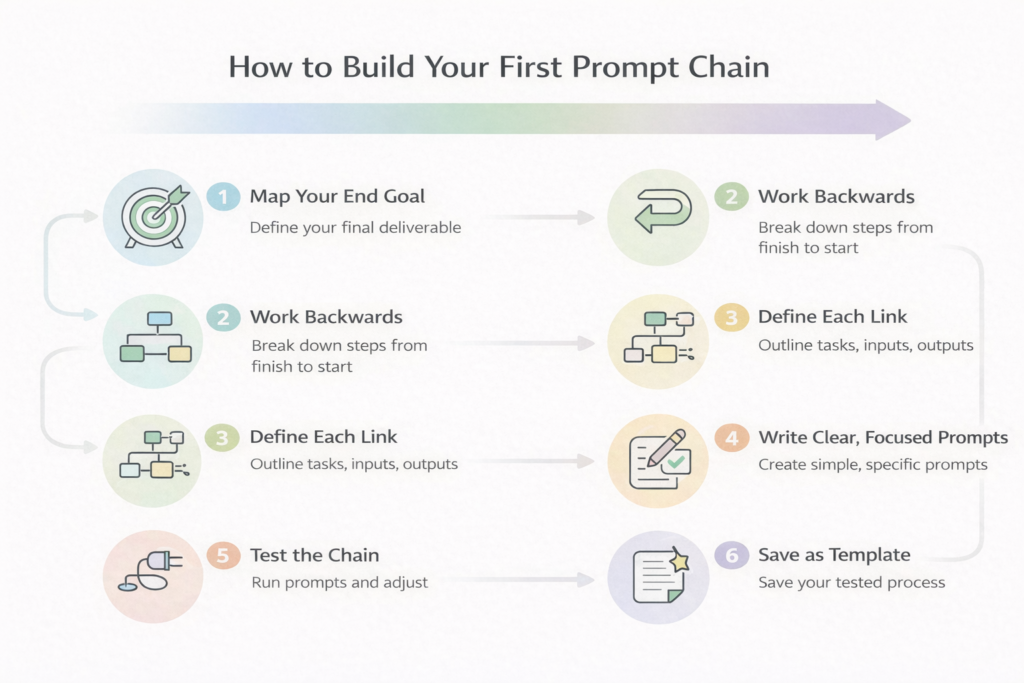
How to Build Your First Prompt Chain
Let’s walk through the process step-by-step.
Step 1: Map Your End Goal
What’s the final deliverable?
Be specific.
Not “a blog post” but “an 800-word comparison article ranking 5 email tools with pros, cons, pricing, and recommendations.”
Write this down.
Step 2: Work Backwards
What’s the last step before completion?
What comes before that?
Keep going until you reach the beginning.
Example:
- Final: Complete article
- Before that: Introduction and conclusion
- Before that: Individual tool reviews
- Before that: Comparison criteria
- Start: Research on target audience needs
Step 3: Define Each Link
For each step, write:
- Input needed
- Specific task
- Expected output
- How it connects to next step
Example for Step 3:
LINK 3: Individual Tool Reviews
Input: Comparison criteria from Link 2, list of 5 tools
Task: Write 150-word analysis of each tool against criteria
Output: 5 separate tool reviews
Connects to: These reviews will be organized into comparison sections
Step 4: Write Clear, Focused Prompts
Each prompt should be simple and focused.
Avoid putting multiple tasks in one prompt.
Bad: “Analyze the tool and write about it and explain the pricing.”
Good: “Analyze [tool name] against these 5 criteria: [list]. Write 2 sentences per criterion.”
Step 5: Test the Chain
Run through all prompts with real content.
Document what works and what needs adjustment.
Refine the chain for future use.
Step 6: Save as Template
Once your chain works, save it.
Create a template with placeholders.
Example Template:
CHAIN: Product Comparison Article

Prompt 1: "List 5 key criteria for comparing [PRODUCT CATEGORY]."

Prompt 2: "Using these criteria: [PASTE OUTPUT], identify which matter most to [TARGET AUDIENCE]."

Prompt 3: "Analyze [PRODUCT 1] against these priority criteria: [PASTE PRIORITIZED LIST]."

[Repeat Prompt 3 for each product]

Prompt 4: "Using all analyses: [PASTE ALL], create a comparison table."

Prompt 5: "Write an 800-word article using this table: [PASTE]. Structure: intro (100 words), comparison by criteria (500 words), recommendations (200 words)."
Now you can reuse this chain for any product comparison.
[Image suggestion: Step-by-step infographic showing the 6-step process with icons]
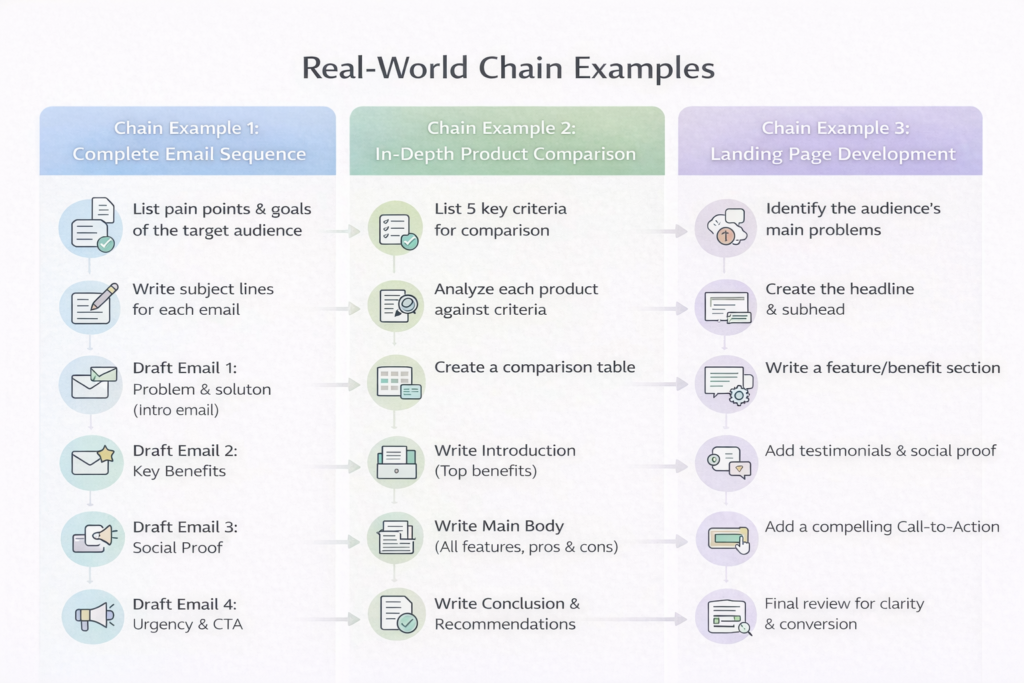
Real-World Chain Examples
Let’s look at complete chains for common affiliate tasks.
Chain Example 1: Complete Email Sequence
Goal: 5-email welcome sequence for new subscribers
Prompt 1: "What are the 5 key objectives for a welcome email sequence in [niche]?"

Prompt 2: "For each objective: [paste list], write a one-sentence email concept."

Prompt 3: "Take concept 1: [paste]. Write a full email: subject line, 200-word body, CTA. Tone: friendly, helpful."

[Repeat Prompt 3 for emails 2-5]

Prompt 4: "Review this sequence: [paste all 5 emails]. Check for: consistent tone, logical progression, non-repetitive CTAs. Suggest improvements."

Prompt 5: "Revise email 3 based on suggestions: [paste specific feedback]."

Prompt 6: "Create a timing schedule: when to send each email relative to signup."
Total time: 20 minutes Result: Complete, tested email sequence
Chain Example 2: In-Depth Product Comparison
Goal: Comprehensive comparison of 3 competing products
Prompt 1: "I'm comparing [Product A], [Product B], and [Product C] for [audience]. What comparison criteria matter most to this audience?"

Prompt 2: "Prioritize these criteria: [paste list]. Give me the top 7."

Prompt 3: "Create a research template with these 7 criteria as rows and the 3 products as columns."

Prompt 4: "Fill in the template for [Product A]. For each criterion, provide: factual data, user feedback summary, and rating (1-5)."

[Repeat Prompt 4 for Products B and C]

Prompt 5: "Based on this completed template: [paste], identify the winner in each criterion category."

Prompt 6: "Write a 300-word analysis explaining which product wins overall and why. Include specific scenarios where each product is best."

Prompt 7: "Create an executive summary: 100 words, bullet points, includes quick comparison table."

Prompt 8: "Write the full article: intro (150 words), detailed comparison by criteria (800 words), scenario recommendations (300 words), conclusion (150 words)."
Total time: 35 minutes Result: Publication-ready comparison article with data backing
Chain Example 3: Landing Page Development
Goal: High-converting landing page for affiliate product
Prompt 1: "What are the top 3 objections people have about [product category]?"

Prompt 2: "For each objection: [paste], write a benefit statement that addresses it."

Prompt 3: "Using these benefits: [paste], write 5 headline options. Each under 10 words."

Prompt 4: "Evaluate these headlines: [paste]. Which best combines clarity + curiosity? Explain your choice."

Prompt 5: "Using the chosen headline approach, write 3 sections: Problem (100 words), Solution (150 words), Proof (100 words)."

Prompt 6: "Review sections: [paste]. Do they flow logically? Does each section lead naturally to the next? Suggest transitions."

Prompt 7: "Add these elements: 3 bullet-point benefits, 2 testimonial placeholders with context, FAQ section with 5 questions."

Prompt 8: "Write 3 CTA variations. Each with different psychology: urgency, social proof, risk reversal."

Prompt 9: "Compile everything into structured landing page copy with [SECTION] markers showing where each element goes."
Total time: 30 minutes Result: Complete landing page with strategic psychology built in
Advanced Chaining Strategies
Ready to level up? Try these.
Strategy 1: Fork and Merge
Create multiple versions at one stage, then select and merge the best.
Prompt 1: "Create 3 different angles for this product review: value-focused, feature-focused, results-focused."

Prompt 2: "Evaluate each angle: [paste all 3]. Which resonates best with [specific audience]?"

Prompt 3: "Take the winning angle. Now create 3 opening paragraph variations."

Prompt 4: "Merge: Use opening variation 2, but incorporate the hook from variation 1."
Strategy 2: Iterative Deepening
Start shallow, progressively add depth.
Prompt 1: "Write a 100-word overview of [topic]."

Prompt 2: "Expand the most important point from that overview into 300 words."

Prompt 3: "That section mentions [concept]. Explain that concept in depth: 200 words."

Prompt 4: "Add 3 real-world examples illustrating that concept."

Prompt 5: "Now reorganize all content into a logical, flowing article."
Strategy 3: Cross-Validation
Use multiple chains to validate the same content from different angles.
Chain A - Write content → Review for accuracy → Revise

Chain B - Research best practices → Score content against practices → Suggest improvements

Chain C - Analyze competitor content → Identify gaps in your content → Add missing elements

Final: Merge all improvements into final version
Strategy 4: Feedback Loops
Build self-correction into your chain.
Prompt 1: "Create [content]."

Prompt 2: "Act as a critical editor. What are 3 weaknesses in this: [paste content]?"

Prompt 3: "Fix weakness 1: [paste specific issue]."

Prompt 4: "Re-evaluate: Is weakness 1 now resolved? If not, what's still wrong?"

Prompt 5: "Apply final correction to fully resolve the issue."
This creates chains that self-improve.
[Image suggestion: Diagram showing advanced strategies with arrows indicating flow and decision points]
Common Prompt Chaining Mistakes
Avoid these pitfalls.
Mistake 1: Chains That Are Too Long
More steps ≠ better results.
If your chain has 15+ prompts, you’re overcomplicating.
Aim for 5-8 prompts for most tasks.
Mistake 2: Unclear Handoffs
Each prompt needs to clearly state what to do with previous output.
Bad: “Now write the next section.”
Good: “Using the criteria identified in the previous output: [paste], write a 200-word analysis.”
Mistake 3: Not Saving Intermediate Outputs
Don’t rely on AI’s memory of the conversation.
Explicitly paste relevant outputs into each new prompt.
This ensures consistency and accuracy.
Mistake 4: Rigid Chains
Build flexibility into your chains.
Some steps might reveal the need to skip ahead or loop back.
That’s fine. Adapt as you go.
Mistake 5: No Chain Documentation
If you don’t document your successful chains, you’ll forget them.
Keep a running library of:
- Chain purpose
- Number of steps
- Approximate time required
- Success rate
- Sample outputs
Building Your Chain Library
Create reusable chains for your most common tasks.
Start with these five:
Chain 1: Product Review (Basic) 5 steps, 15 minutes, 800 words
Chain 2: Comparison Article (Advanced) 8 steps, 35 minutes, 1500 words
Chain 3: Email Sequence 6 steps, 20 minutes, 5 emails
Chain 4: Social Media Content 4 steps, 10 minutes, 10 posts
Chain 5: Landing Page Copy 9 steps, 30 minutes, complete page
Document each chain using this template:
CHAIN NAME: [Descriptive name]
PURPOSE: [What it creates]
BEST FOR: [When to use it]
TIME: [Approximate duration]
DIFFICULTY: [Beginner/Intermediate/Advanced]

STEPS:
1. [Prompt with placeholders]
2. [Prompt with placeholders]
[etc.]

NOTES:
- [Any special considerations]
- [Common adjustments needed]
- [Success tips]
Measuring Chain Effectiveness
Track these metrics for your chains:
Time Efficiency
- How long does the chain take vs. doing it manually?
- Goal: 50%+ time savings
Output Quality
- What percentage of chained content is publication-ready?
- Goal: 80%+
Consistency
- Do you get similar quality each time you use the chain?
- Goal: Predictable results
Versatility
- Can you adapt the chain for different products/topics?
- Goal: Works across your niche
Review your chains monthly.
Refine what works. Replace what doesn’t.
Combining Chains with Other Techniques
Prompt chaining isn’t isolated.
Combine it with techniques you’ve learned.
Chaining + Constraints:
Prompt 1: "List key features of [product]."

Prompt 2: "Write a review using this feature list: [paste]. CONSTRAINTS: 500 words, casual tone, include 2 personal anecdotes, no jargon."
Chaining + Personas:
Prompt 1: "Define: What would a skeptical buyer want to know about [product]?"

Prompt 2: "You are a skeptical buyer asking those questions: [paste]. Write an FAQ addressing each concern honestly."
Chaining + Iteration:
Prompt 1: "Create initial draft of [content]."

Prompt 2: "Review and identify weak areas."

Prompt 3: "Strengthen area 1: [paste specific section]."

[Iterate through remaining areas]
The techniques amplify each other.
Your Action Plan
Here’s how to implement prompt chaining this week.
Day 1-2: Learn
- Pick one chain example from this article
- Run it with your own content
- Document what happens at each step
Day 3-4: Adapt
- Modify the chain for your specific needs
- Test adjustments
- Note what improves results
Day 5-6: Create
- Build one original chain for a task you do regularly
- Test it 3 times with different topics
- Refine based on results
Day 7: Document
- Write up your successful chain
- Add it to your chain library
- Plan which chain to build next
Start small. Build systematically.
Within a month, you’ll have a library of chains that 10x your content production.
The Bottom Line
Prompt chaining transforms how you create complex content.
Single prompts are for simple tasks.
Chains are for sophisticated, professional output.
The strategic approach is:
- Break big tasks into sequential steps
- Maintain quality control between steps
- Build reusable workflows
- Document what works
- Refine over time
This isn’t just a technique.
It’s a system.
A system that gives you predictable, high-quality results.
Stop throwing everything into one massive prompt.
Start chaining your way to better content.
Your affiliate business deserves strategic, systematic content creation.
Prompt chaining delivers exactly that.