You may also like:
- Advanced Prompt Techniques
- Prompt Chaining (Break Complex AI Tasks Into Simple Steps)
- AI Prompt Builder
You’re telling AI what you want.
But are you telling it what you DON’T want?
Most marketers skip this step.
They focus entirely on positive instructions.
“Write this.” “Include that.” “Make it sound like this.”
Then they wonder why the output is filled with fluff, clichés, and marketing speak.
Here’s the thing: what you exclude is just as important as what you include.
Welcome to negative prompting—the tactical technique that eliminates unwanted elements before they appear.
Today, you’ll learn exactly what to exclude and why it transforms your content quality.
Let’s get tactical.
What Is Negative Prompting?
Negative prompting is simple.
You explicitly tell AI what NOT to do, include, or say.
Instead of hoping AI avoids certain patterns, you forbid them upfront.
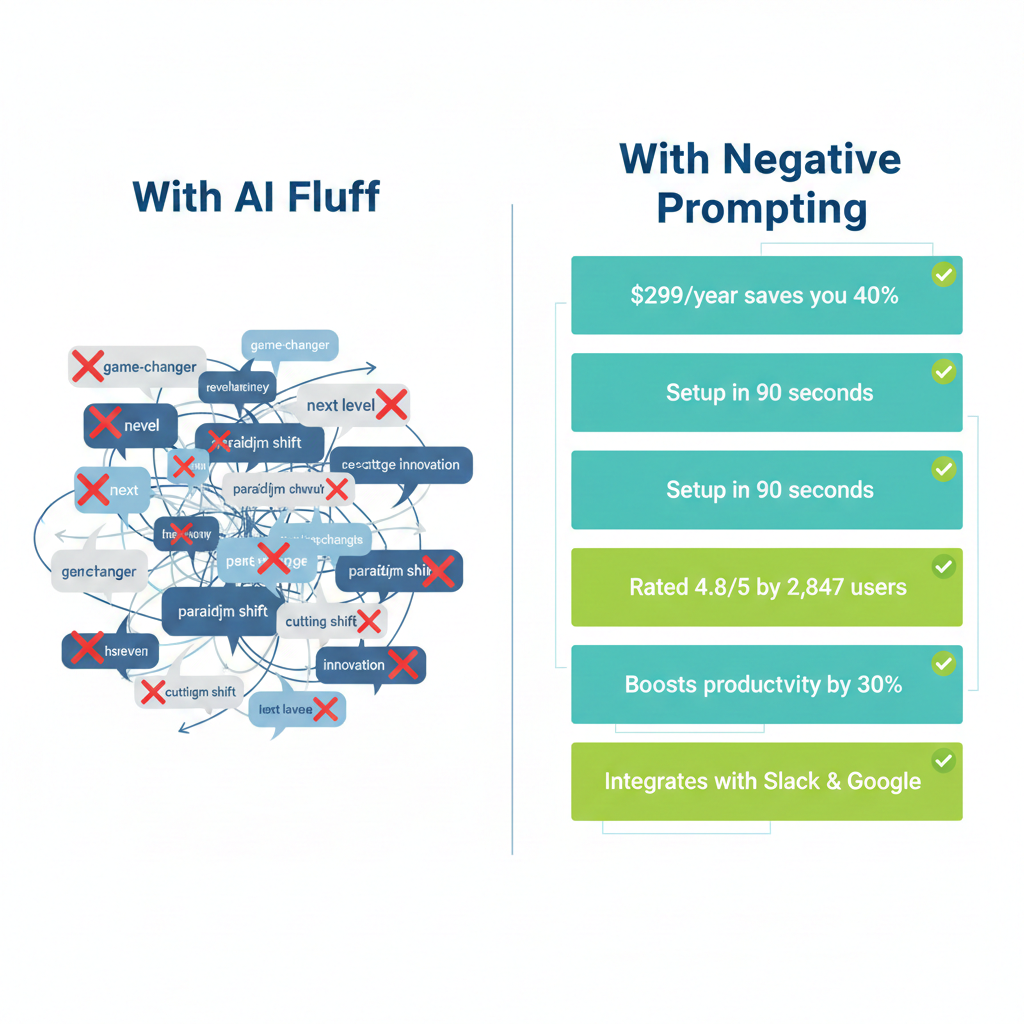
Standard Prompt: “Write a product review for noise-canceling headphones.”
Negative Prompt Added: “Write a product review for noise-canceling headphones. Do NOT use marketing jargon, superlatives like ‘amazing’ or ‘incredible,’ or generic phrases like ‘game-changer.’ Do NOT include company history or technical specifications beyond what a regular user needs.”
See the difference?
The second prompt creates guardrails.
It prevents common AI tendencies that make content sound robotic or salesy.
Why AI Needs Negative Instructions
Here’s what most people don’t understand.
AI is trained on massive amounts of internet content.
A lot of that content? Marketing fluff. Corporate speak. Generic advice.
So AI defaults to these patterns unless you stop it.
The Default AI Writing Patterns
Without negative prompting, AI tends to:
Use excessive superlatives “Amazing,” “incredible,” “revolutionary,” “game-changing”
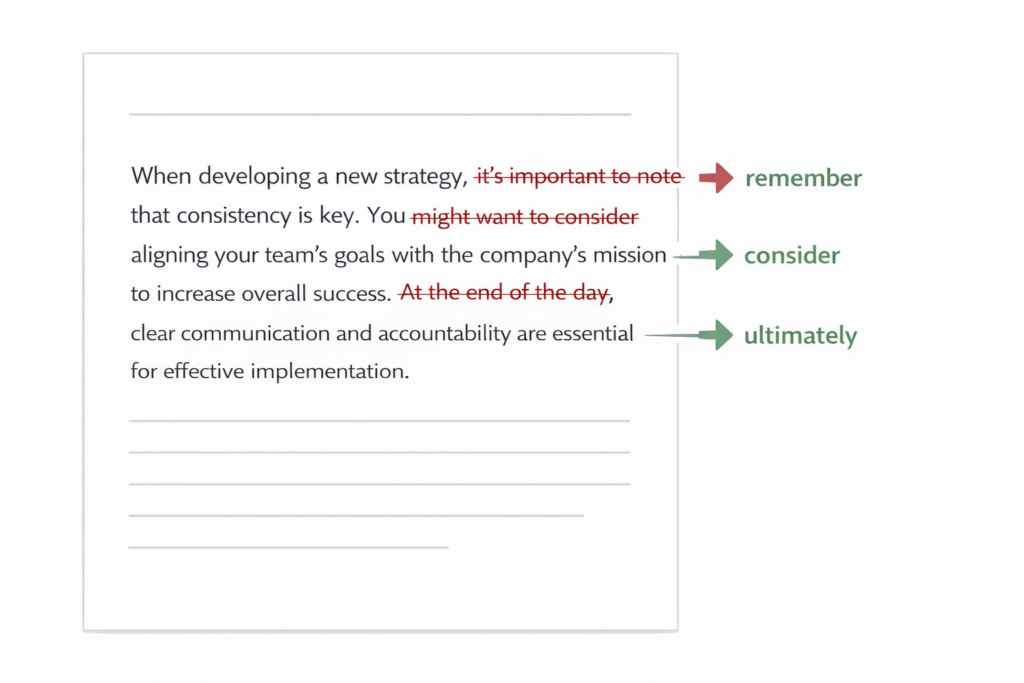
Deploy vague phrases “At the end of the day,” “it’s important to note,” “you might want to consider”
Add unnecessary introductions Long wind-ups before getting to the point
Include obvious statements “Communication is key in business” (no kidding)
Repeat marketing clichés “Take your [X] to the next level,” “unlock your potential”
Over-explain simple concepts Three paragraphs to say what takes one sentence
Use corporate jargon “Leverage,” “synergy,” “paradigm shift,” “scalable solutions”
These patterns dilute your message.
They make content sound like every other AI-generated piece on the web.
Negative prompting eliminates them.
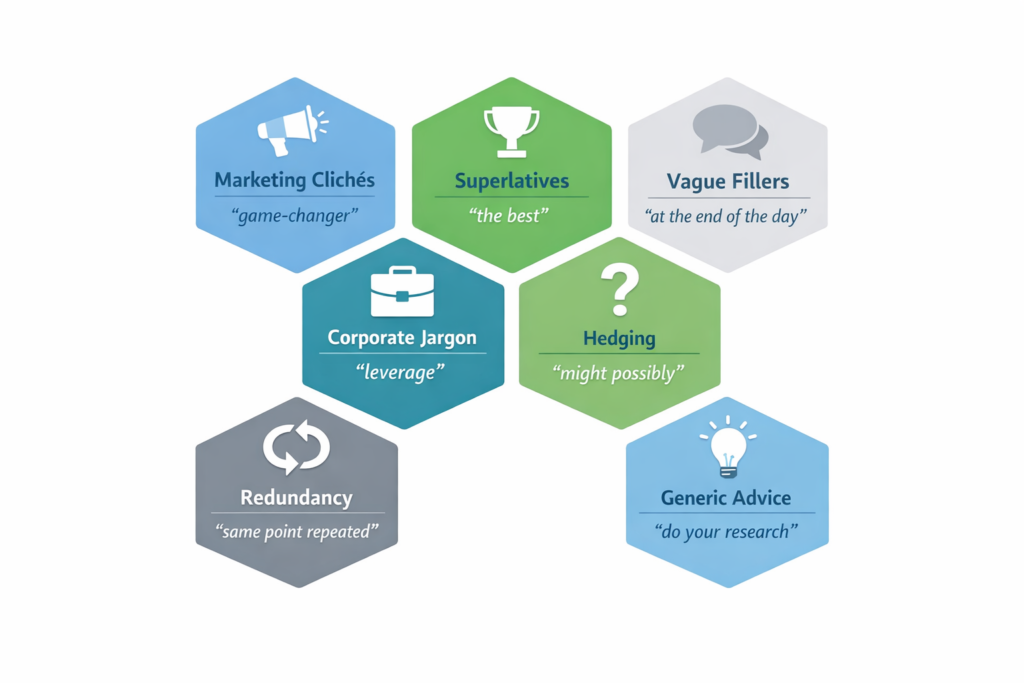
The 7 Categories to Exclude
Let’s break down what to exclude and why.
Category 1: Marketing Clichés and Buzzwords
These phrases sound “professional” but say nothing.
Exclude:
- “Take it to the next level”
- “Game-changer”
- “Cutting-edge”
- “Industry-leading”
- “Best-in-class”
- “Revolutionary”
- “Unlock your potential”
- “Seamless integration”
Why it matters: These phrases are overused and meaningless. Your audience has heard them a thousand times. They trigger skepticism, not interest.
Negative prompt example: “Do NOT use any of these phrases: game-changer, next level, revolutionary, cutting-edge, industry-leading, seamless, unlock.”
Category 2: Superlatives Without Evidence
Claims without backing destroy credibility.
Exclude:
- “The best”
- “Amazing”
- “Incredible”
- “Perfect”
- “Ultimate”
- “Flawless”
- “Unbeatable”
Why it matters: Superlatives without proof sound like hype. Readers ignore them. Worse, they make you seem untrustworthy.
Negative prompt example: “Avoid superlatives (best, amazing, incredible, perfect) unless supported by specific data or examples. If you can’t prove it, don’t claim it.”
Category 3: Vague Filler Phrases
These add words without adding value.
Exclude:
- “It’s important to note that”
- “You might want to consider”
- “At the end of the day”
- “When all is said and done”
- “The fact of the matter is”
- “It goes without saying”
- “In today’s world”
Why it matters: These phrases waste reader attention. They delay getting to the point. Every unnecessary word increases bounce rate.
Negative prompt example: “Eliminate filler phrases like ‘it’s important to note,’ ‘you might want to consider,’ ‘at the end of the day.’ Get straight to the point.”
Category 4: Corporate Jargon
Business buzzwords alienate normal readers.
Exclude:
- “Leverage”
- “Synergy”
- “Paradigm shift”
- “Moving forward”
- “Circle back”
- “Touch base”
- “Deep dive”
- “Low-hanging fruit”
Why it matters: Unless you’re writing for corporate executives, jargon creates distance. It makes you sound like a consultant, not a helpful guide.
Negative prompt example: “Use plain English. Replace business jargon (leverage, synergy, paradigm, moving forward) with simple, conversational language.”
Category 5: Unnecessary Disclaimers and Hedging
Over-qualifying weakens your authority.
Exclude:
- “In my opinion”
- “I think that maybe”
- “This might possibly”
- “Some people say”
- “It could be argued”
- “Generally speaking”
Why it matters: Constant hedging makes you sound unsure. Readers want confident guidance, not wishy-washy suggestions.
Negative prompt example: “Write with confidence. Remove hedging language like ‘in my opinion,’ ‘might possibly,’ ‘could be argued.’ State facts and insights directly.”
Category 6: Redundant Explanations
Repeating the same point in different words.
Exclude:
- Saying the same thing three ways
- Over-explaining simple concepts
- Restating what was just said
- Circular definitions
Why it matters: Repetition annoys readers. They’re smart. They got it the first time. Respect their intelligence.
Negative prompt example: “Make each point once clearly. Do NOT repeat the same idea in different words. Avoid over-explaining simple concepts.”
Category 7: Generic Advice and Obvious Statements
Content that applies to everything applies to nothing.
Exclude:
- “Make sure to do your research”
- “Quality matters”
- “Results may vary”
- “Success takes time and effort”
- “Everyone’s situation is different”
Why it matters: Obvious statements waste space. Readers already know this. Give them specific, actionable insights instead.
Negative prompt example: “Skip obvious advice everyone already knows. Provide specific, tactical information they can’t find elsewhere.”
Tactical Negative Prompting Formulas
Here are proven formulas you can use immediately.
Formula 1: The Exclusion List
Most direct approach.
Write [content type] about [topic].

DO NOT include:
- [specific word/phrase 1]
- [specific word/phrase 2]
- [specific word/phrase 3]
- [pattern to avoid]
Example:
Write a landing page for project management software.

DO NOT include:
- The words "game-changer," "revolutionary," or "innovative"
- Any mention of "synergy" or "paradigm"
- Generic benefits like "save time" without specific numbers
- Comparison to competitors
Formula 2: The Replacement Method
Tell AI what to use instead.
Write [content] about [topic].

AVOID: [unwanted pattern]
USE INSTEAD: [desired pattern]
Example:
Write an email about the new course.

AVOID: Superlatives (amazing, incredible, best)
USE INSTEAD: Specific student results (Jane increased revenue by 40%)

AVOID: Vague benefits (improve your skills)
USE INSTEAD: Concrete outcomes (write 5 product reviews per hour)
Formula 3: The Voice Exclusion
Define what your voice is NOT.
Write [content] in a voice that is:
- [positive trait 1]
- [positive trait 2]

But is NOT:
- [negative trait to avoid]
- [negative trait to avoid]
Example:
Write a product review in a voice that is:
- Honest and direct
- Conversational and friendly

But is NOT:
- Salesy or pushy
- Overly enthusiastic or hype-driven
- Corporate or formal
Formula 4: The Length Constraint with Negative
Combine length limits with content exclusions.
Write [content] in [X] words.

To stay within this limit, do NOT include:
- [unnecessary element 1]
- [unnecessary element 2]
Example:
Write a product description in 150 words.

To stay within this limit, do NOT include:
- Company history or background
- Technical specifications users don't care about
- Generic benefits that apply to all similar products
Formula 5: The Audience-Based Negative
Exclude what doesn’t serve your specific audience.
Write for [specific audience].

This audience does NOT need:
- [irrelevant information 1]
- [irrelevant information 2]

This audience does NOT respond to:
- [ineffective approach 1]
- [ineffective approach 2]
Example:
Write for complete beginners to affiliate marketing.

This audience does NOT need:
- Advanced tracking pixel setup
- Complex funnel automation strategies

This audience does NOT respond to:
- Technical jargon
- Assumptions they know basic terms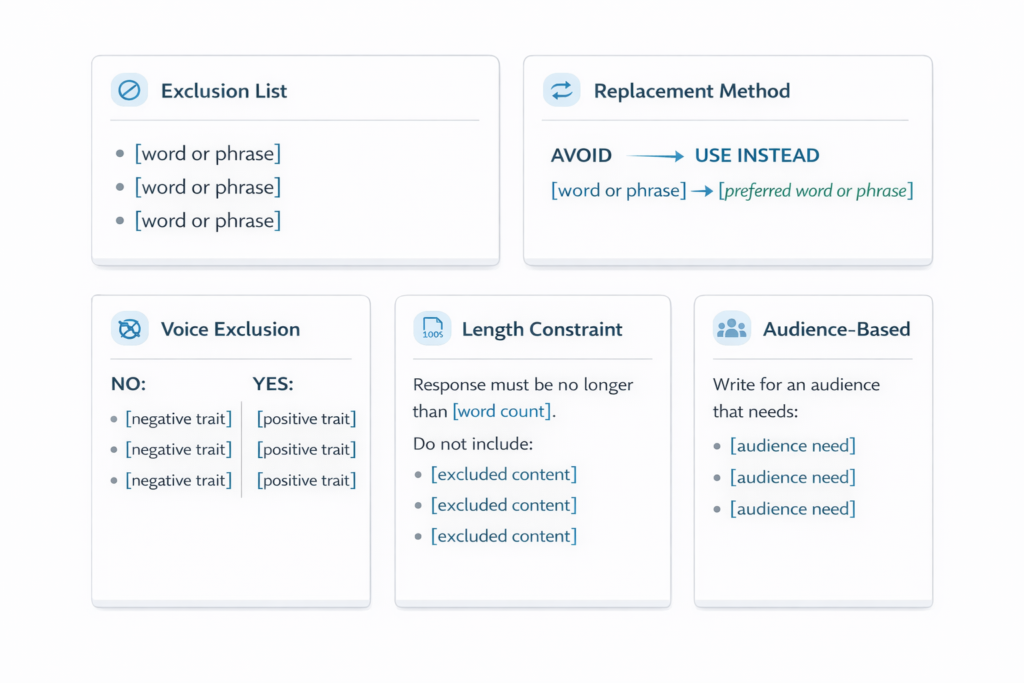
Real-World Negative Prompting Examples
Let’s see negative prompting in action.
Example 1: Product Review
Without Negative Prompting: “Write a 500-word review of the Sony WH-1000XM5 headphones.”
Result: Generic review filled with “amazing sound quality,” “industry-leading noise cancellation,” “game-changing technology.”
With Negative Prompting:
Write a 500-word review of the Sony WH-1000XM5 headphones.

DO NOT use:
- Superlatives without specific examples (amazing, incredible, best)
- Marketing phrases (game-changer, industry-leading)
- Technical specs beyond what matters for actual use

DO include:
- Specific use cases (commuting, working from home)
- Honest limitations or drawbacks
- Comparisons to similarly priced alternatives
Result: Practical, honest review that readers trust.
Example 2: Email Subject Lines
Without Negative Prompting: “Write 5 email subject lines for a productivity course.”
Result: “Unlock Your Potential,” “Revolutionary Time Management,” “Transform Your Life Today”
With Negative Prompting:
Write 5 email subject lines for a productivity course.

EXCLUDE:
- Words: unlock, transform, revolutionary, secret
- Vague promises (change your life, be more productive)
- All caps or excessive punctuation

INCLUDE:
- Specific outcomes (save 10 hours per week)
- Curiosity without clickbait
- Under 50 characters
Result: “Save 10 Hours Weekly (Here’s My System),” “The 3-Task Focus Method”—specific and compelling.
Example 3: Landing Page Copy
Without Negative Prompting: “Create landing page copy for an email marketing tool.”
Result: “Take your email marketing to the next level with our innovative, best-in-class platform designed to revolutionize your campaigns.”
With Negative Prompting:
Create landing page copy for an email marketing tool targeting small business owners.

FORBIDDEN phrases:
- Next level, revolutionize, innovative, best-in-class
- Game-changer, cutting-edge, seamless

FORBIDDEN patterns:
- Starting with "Imagine if..."
- Using "we help you" more than once
- Generic benefits without numbers

REQUIRED:
- Specific metrics (open rates, time saved)
- Address specific pain point (complicated tools)
- Show, don't tell
Result: Clear, benefit-driven copy that converts.
Common Negative Prompting Mistakes
Avoid these errors.
Mistake 1: Too Many Exclusions
Don’t create a novel of don’ts.
Keep exclusion lists to 5-7 items maximum.
More than that overwhelms the prompt and confuses AI.
Bad: “Don’t use amazing, incredible, fantastic, wonderful, great, excellent, outstanding, remarkable, extraordinary, exceptional, spectacular, impressive, phenomenal, magnificent, superb…”
Good: “Avoid superlatives (amazing, incredible, fantastic) unless backed by specific data.”
Mistake 2: Vague Negatives
Be specific about what you’re excluding.
Bad: “Don’t be boring.”
Good: “Don’t use filler phrases like ‘it’s important to note’ or ‘you might want to consider.’ Get straight to the point.”
Mistake 3: Contradictory Instructions
Don’t ask for what you’re excluding.
Contradictory: “Write enthusiastically but don’t use excitement words like amazing or incredible.”
Clear: “Show enthusiasm through specific examples and results, not through superlatives.”
Mistake 4: Only Negatives, No Positives
Always balance what NOT to do with what TO do.
Incomplete: “Don’t use jargon or buzzwords.”
Complete: “Don’t use jargon (leverage, synergy). Instead, use simple terms anyone can understand.”
Advanced Tactical Applications
Ready to level up? Try these.
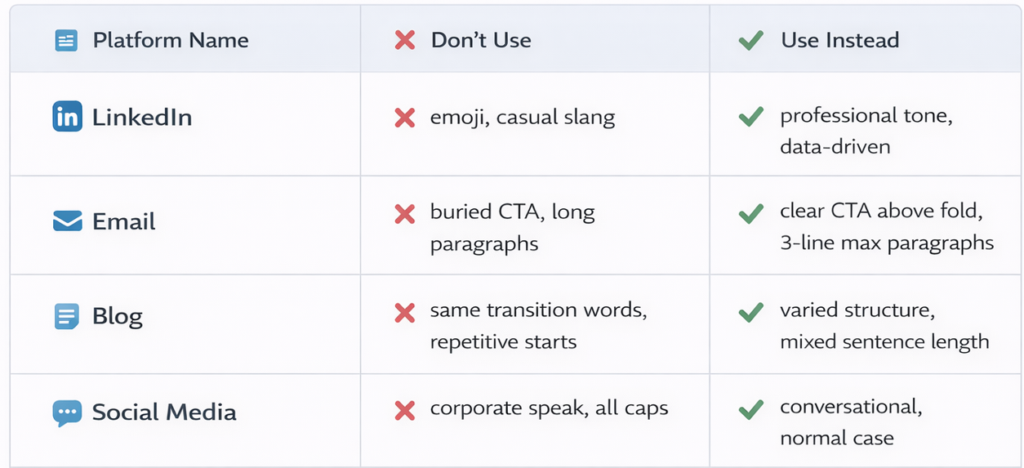
Tactic 1: Platform-Specific Negatives
Different platforms have different no-nos.
LinkedIn: “Don’t use casual slang or emoji. Don’t write in first person unless sharing personal experience.”
Email: “Don’t bury the CTA. Don’t use ‘Dear Sir/Madam.’ Don’t write paragraphs longer than 3 sentences.”
Blog Posts: “Don’t start every paragraph with ‘Additionally,’ ‘Furthermore,’ or ‘Moreover.’ Vary sentence structure.”
Tactic 2: Brand Voice Negatives
Define your brand by what it’s NOT.
Our brand voice is NOT:
- Corporate or stuffy
- Overly casual or unprofessional
- Aggressive or pushy
- Apologetic or uncertain

Write accordingly.
Tactic 3: Competitor Differentiation
Exclude what competitors overuse.
Our competitors all say "easy to use" and "save time."

Do NOT use these phrases.

Instead, specify: "Set up in 90 seconds" and "Cut reporting time from 2 hours to 10 minutes."
Tactic 4: Niche-Specific Exclusions
Every niche has overused patterns.
Fitness: Exclude: “Get the body you’ve always wanted,” “Transform your life”
Finance: Exclude: “Make money while you sleep,” “Passive income secrets”
Marketing: Exclude: “Grow your business,” “Scale to 7 figures”
Learn your niche’s clichés and ban them.
Building Your Negative Prompt Library
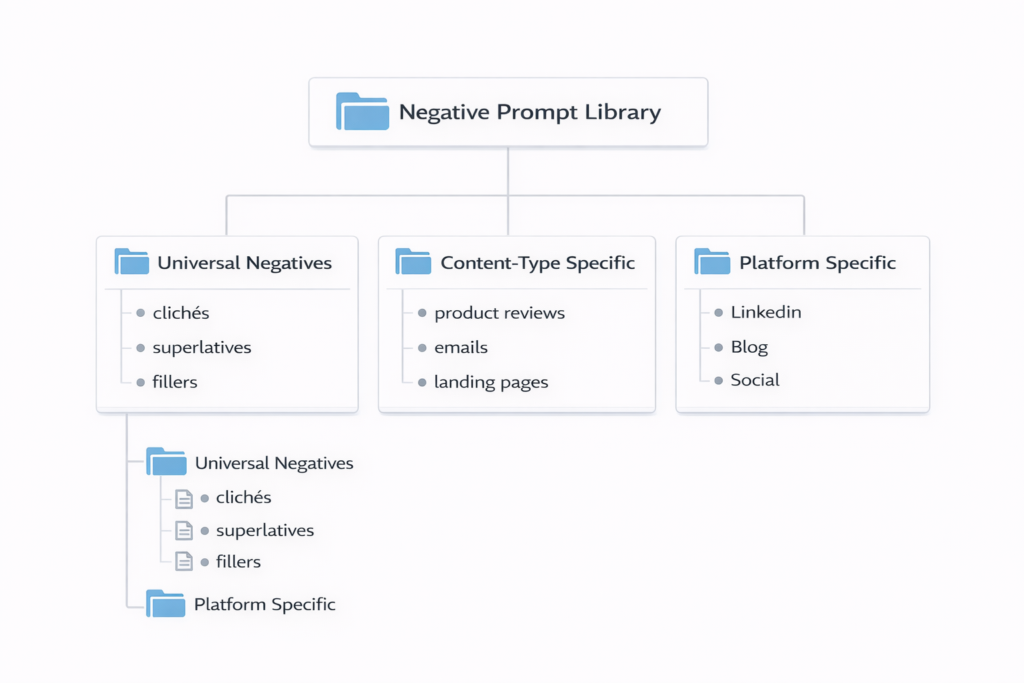
Create reusable negative prompts for common tasks.
Universal Negatives (Use on everything):
- No marketing clichés (game-changer, next level, revolutionary)
- No superlatives without proof (best, amazing, incredible)
- No filler phrases (it's important to note, you might want to)
- Get to the point quickly
Content-Type Specific Negatives:
Product Reviews:
- No company history or founding stories
- No spec lists without explaining why they matter
- No "this product is for everyone"
Email Marketing:
- No "I hope this email finds you well"
- No CTAs below the fold
- No multiple asks in one email
Landing Pages:
- No walls of text
- No navigation away from the page
- No vague "learn more" CTAs
Save these in a document you can reference.
Measuring Negative Prompting Effectiveness
Track these metrics:
Before vs. After Comparison:
- How much editing did content need before?
- How much editing does it need now?
- Goal: 50% less editing time
Cliché Count:
- Run content through a word counter
- Flag marketing buzzwords
- Goal: Zero flagged terms
Reader Engagement:
- Time on page
- Scroll depth
- Bounce rate
- Goal: Improvement in all three
Conversion Rate:
- Do cleaner, more specific prompts convert better?
- A/B test negative-prompted copy vs. standard
- Goal: Measurable lift
The Bottom Line
What you exclude shapes your content as much as what you include.
Negative prompting isn’t optional for serious affiliate marketers.
It’s the tactical technique that separates amateur AI content from professional output.
The strategy is simple:
- Identify patterns that weaken content
- Explicitly forbid them in prompts
- Replace them with specific alternatives
- Build a library of negatives
- Measure the improvement
Stop accepting AI’s default patterns.
Start excluding what doesn’t serve your audience.
Your content will be clearer, more specific, and more trustworthy.
That’s what negative prompting delivers.
Use it tactically. Use it consistently.
Your conversion rates will prove it works.