You need landing page copy that sells.
AI gives you generic marketing fluff.
“Unlock your potential.” “Transform your business.” “Get results fast.”
Nobody clicks that.
Here’s the truth: landing pages aren’t about writing well.
They’re about converting visitors into buyers.
And conversion requires a specific framework.
Today, you’ll learn the C.O.N.V.E.R.T framework—seven strategic elements that turn landing page visitors into customers.
Plus the exact prompts to generate each element with AI.
This isn’t creative writing. It’s conversion engineering.
Let’s build pages that sell.
Why Generic Landing Page Prompts Fail
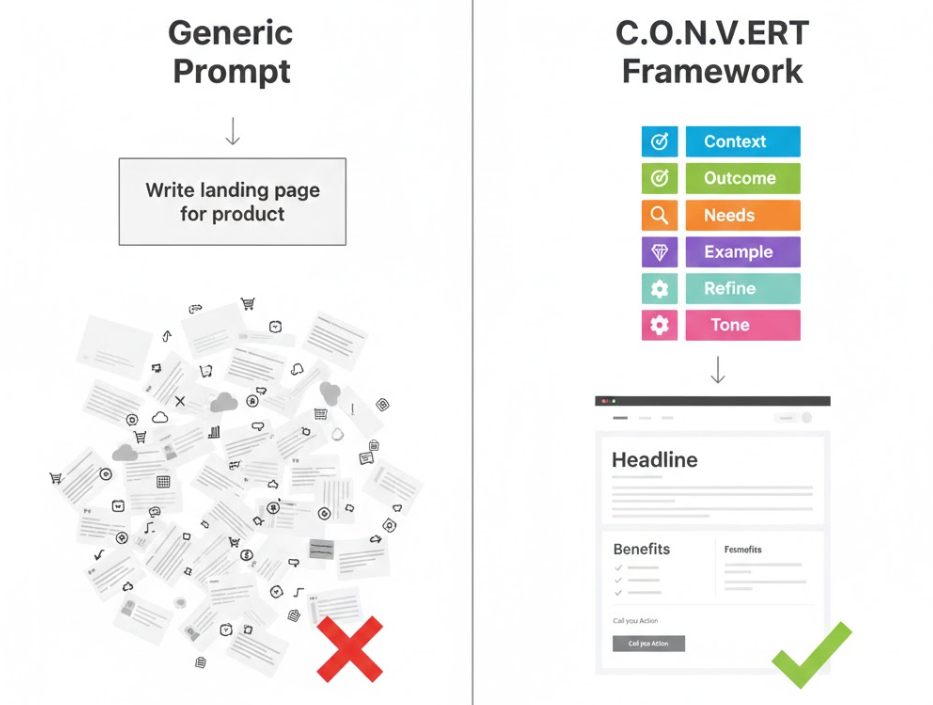
Most people prompt AI like this:
“Write landing page copy for [product].”
AI produces something that looks like a landing page.
Headlines. Bullet points. A call-to-action.
But it doesn’t convert.
Why?
Because AI doesn’t know:
- What objection to handle first
- Which benefit matters most to your audience
- What proof will actually convince skeptics
- How to structure the conversion path
Generic prompts produce generic pages.
Generic pages get generic results.
The C.O.N.V.E.R.T framework changes this completely.
The C.O.N.V.E.R.T Framework Explained
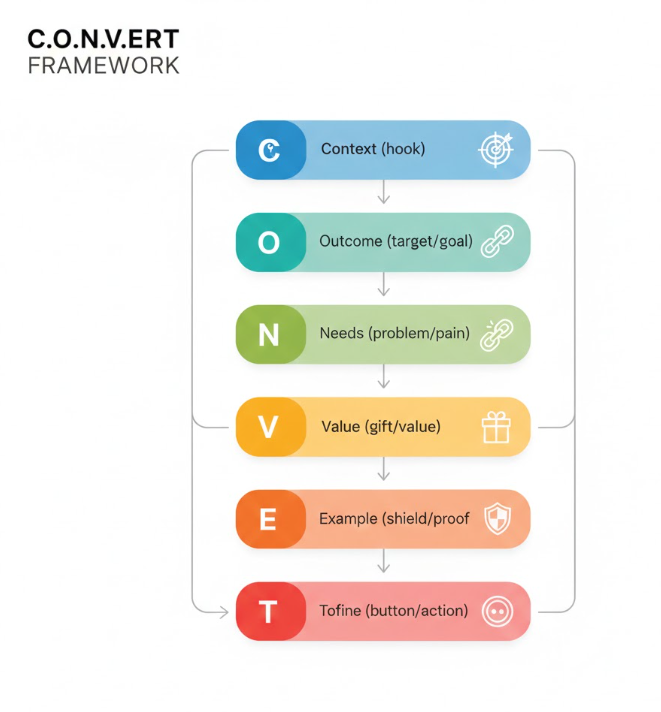
Each letter represents a strategic element your landing page needs.
C – Compelling Hook O – Outcome Promise N – Need Identification V – Value Demonstration E – Evidence & Proof R – Risk Reversal T – Triggering Action
Build all seven elements, and you have a complete conversion system.
Skip one, and your conversion rate suffers.
Let’s break down each element with exact prompts.
C – Compelling Hook
The first element visitors see.
It must stop them from bouncing immediately.
Your hook has one job: make them want to read the next line.
The Hook Prompt
Write 5 compelling headline options for a landing page selling [product/service].

AUDIENCE: [Specific audience description]
MAIN PAIN POINT: [Their biggest frustration]

HOOK REQUIREMENTS:
- Under 12 words
- Lead with the outcome, not the product
- Address the pain or desire directly
- Create curiosity without being clickbait
- Avoid generic phrases like "unlock," "transform," "revolutionary"

For each headline, also write a supporting subheadline (15-20 words) that:
- Expands on the promise
- Adds specificity (numbers, timeframes, or concrete details)
- Bridges to the next section

Format:
Headline 1: [text]
Subheadline: [text]
Why it works: [brief explanation]
Example Output:
Headline: Stop Losing Sales to Cart Abandonment Subheadline: Recover 35% of abandoned carts with automated follow-up emails that arrive at the exact right moment. Why it works: Specific outcome (35%), addresses pain directly, implies a system.
Hook Testing Method
Generate 5 options.
Test them by asking: “Would I keep reading if I saw only this headline?”
If the answer isn’t an immediate “yes,” that hook doesn’t make the cut.
Pick the strongest. That’s your C.
O – Outcome Promise
After the hook, visitors need to know exactly what they’ll get.
Not features. Outcomes.
“What will my life look like after I buy this?”
The Outcome Prompt
Write an outcome-focused opening section for a landing page.

PRODUCT: [Product/service name]
AUDIENCE: [Who they are]
TRANSFORMATION: [Before state → After state]

STRUCTURE:
- Opening paragraph (50-75 words): Paint the "after" picture
- Focus on the END RESULT, not the process
- Use sensory, concrete language (not abstract benefits)
- Include a specific timeframe if possible

AVOID:
- Listing features
- Saying "you'll learn how to..."
- Generic benefits that apply to any product

Make them see their life after the transformation.
Example Output:
“Imagine opening your dashboard on Monday morning and seeing 47 new qualified leads that came in while you slept. No more cold calling. No more wondering where the next sale comes from. Just a consistent flow of people who already want what you’re selling, asking how to get started.”
Notice: No features mentioned. Pure outcome visualization.
That’s your O.
N – Need Identification
Now that they see the outcome, they need to understand WHY they don’t have it yet.
This section deepens the problem.
It’s not about creating pain. It’s about recognition.
“Yes, that’s exactly my situation.”
The Need Prompt
Write a problem identification section for a landing page.

AUDIENCE: [Specific audience]
PROBLEM: [What's not working for them]
HIDDEN CAUSE: [Why the obvious solutions fail]

STRUCTURE:
- 3 paragraphs, 75-100 words total
- Paragraph 1: Describe the surface problem (what they're experiencing)
- Paragraph 2: Explain why common solutions don't work
- Paragraph 3: Reveal the real cause they haven't considered

TONE:
- Understanding, not judging
- "I've been there" not "You're doing it wrong"
- Build to an insight, not just complain about the problem

End with a transition that hints at the solution without revealing it yet.
Example Output:
“You’re running Facebook ads, posting consistently, even tried that expensive course. But leads stay unpredictable. Some weeks you get 10. Other weeks, zero.
Here’s why: You’re focused on getting MORE traffic when the real problem is what happens AFTER someone clicks. 95% of visitors leave without converting because there’s no follow-up system.
The issue isn’t your traffic. It’s that you’re losing the traffic you already have.”
They now understand their real problem.
That’s your N.
V – Value Demonstration
This is where you present your solution.
But NOT as a feature list.
As value delivery.
The Value Prompt
Write a value demonstration section for a landing page.

PRODUCT: [Product/service name]
CORE MECHANISM: [How it actually works]
KEY BENEFITS: [3-4 main benefits]

STRUCTURE:
- Brief introduction of the solution (2 sentences)
- 3-4 benefit blocks, each containing:
  * Benefit headline (outcome-focused)
  * 2-3 sentences explaining how it delivers this benefit
  * Specific example or use case

REQUIREMENTS:
- Focus on WHAT IT DOES FOR THEM, not what it is
- Connect each benefit back to the problem from section N
- Use concrete language (hours saved, percentage increase, specific outcomes)
- No generic marketing language

Format as scannable blocks with clear headlines.
Example Output:
“Our automated follow-up system captures visitors before they disappear.
Recover Lost Sales While You Sleep When someone abandons their cart, they get a personalized email 4 hours later with their exact items and a limited-time discount. We’ve seen stores recover 35% of abandoned carts with this alone.
Know Exactly Who to Follow Up With Every visitor gets tagged based on what they viewed. High-intent visitors who looked at pricing get different follow-ups than browsers. You focus on the hottest leads first.
Set It Once, Run It Forever Build your sequence in 30 minutes. It runs automatically from that point forward. No daily management required.”
Each block demonstrates value through outcomes and specifics.
That’s your V.
E – Evidence & Proof
Now they understand the value.
But do they believe it?
Proof makes believers out of skeptics.
The Evidence Prompt
Write a proof section for a landing page.

PRODUCT: [Product name]
PROOF AVAILABLE: [What you actually have: testimonials, case studies, data, credentials]

STRUCTURE:
Select the 3 strongest proof elements from what's available:
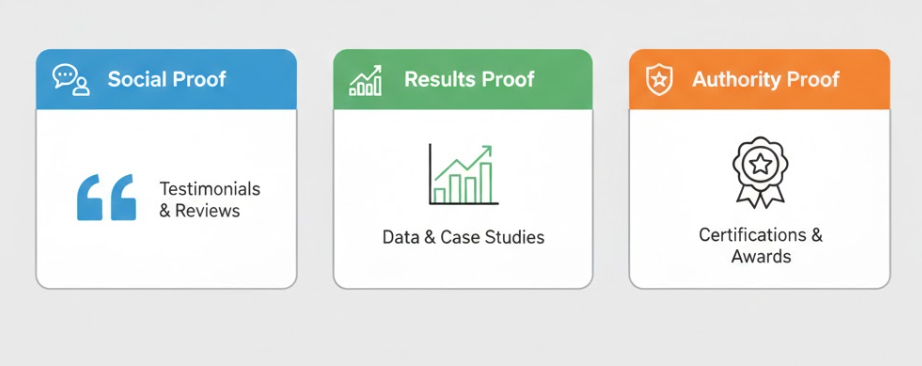
- Social proof (testimonial quotes)
- Results proof (case studies with numbers)
- Authority proof (credentials, certifications, media mentions)
- Data proof (user statistics, success rates)

For each proof element:
1. Lead with the most impressive number or quote
2. Provide context (who, when, starting point)
3. Explain what made the difference
4. Keep each proof block to 50-75 words

CRITICAL:
- Use real specifics (names, numbers, timeframes)
- Don't manufacture or exaggerate
- One powerful proof element beats three weak ones
Example Output:
“‘We recovered $47,000 in lost sales in the first 90 days.’ — Sarah Chen, owner of GreenLife Organics
Sarah was losing 200+ abandoned carts monthly. After implementing our system, she recovered 38% of them. The automated follow-ups run while she focuses on product development.”
Notice: Specific person, specific numbers, specific timeframe, specific result.
That’s credible evidence.
That’s your E.
R – Risk Reversal
They’re convinced it works.
But they’re still hesitant.
“What if it doesn’t work for ME?”
Risk reversal removes that final hesitation.
The Risk Reversal Prompt
Write a risk reversal section for a landing page.

PRODUCT: [Product name]
GUARANTEE/POLICY: [Your actual guarantee]
MAIN OBJECTION: [Why people hesitate to buy]

STRUCTURE:
- State the guarantee clearly (headline format)
- Explain exactly how it works (2-3 sentences)
- Address the specific fear or objection
- Flip the risk: "The only risk is NOT trying it"

TONE:
- Confident, not defensive
- Matter-of-fact about the guarantee
- Acknowledge their hesitation as reasonable

Keep it under 100 words total.
Example Output:
“Try it risk-free for 60 days. If you don’t recover at least 25% of your abandoned carts, we’ll refund every penny—and you keep the system.
We’re this confident because we’ve seen it work for 2,847 stores. The only real risk is continuing to lose sales you’ve already earned.
Set it up, let it run for 60 days, and decide based on your actual results.”
The risk is now on you (the seller), not them.
That’s your R.
T – Triggering Action
They’re ready to buy.
Now make it dead simple to do so.
Your call-to-action needs clarity, urgency, and simplicity.
The Trigger Prompt
Write a call-to-action section for a landing page.

PRODUCT: [Product name]
OFFER: [What they get when they click]
URGENCY ELEMENT: [Limited time, limited quantity, bonus expires, etc.]

STRUCTURE:
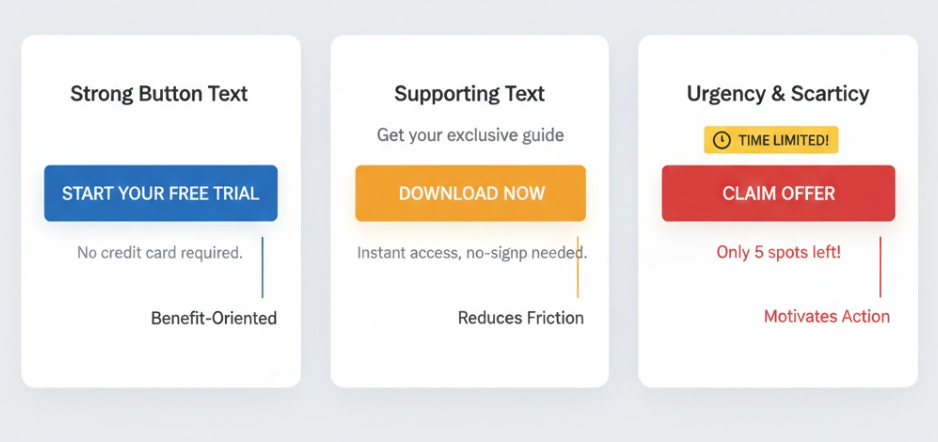
1. Primary CTA button text (2-4 words, action-oriented)
2. Supporting text above button (one line explaining what happens when they click)
3. Supporting text below button (addressing final micro-objection)
4. Urgency statement (if applicable, under 15 words)

REQUIREMENTS:
- Button text must be specific, not "Submit" or "Click Here"
- No fake scarcity (only use real urgency)
- Make the next step crystal clear
- Reduce friction (no surprises about what happens next)

Provide 3 CTA variations to test.
Example Output:
Variation 1: Button: “Start Recovering Lost Sales” Above: Get instant access to your dashboard and start building your first sequence Below: No credit card required for the 14-day trial Urgency: Trial includes free setup consultation—available for the next 47 customers only
Variation 2: Button: “Set Up My Follow-Up System” Above: Your automated sequences can be running within 30 minutes Below: Cancel anytime during your 60-day guarantee period
Variation 3: Button: “Claim My 60-Day Trial” Above: Join 2,847 stores already recovering abandoned sales on autopilot Below: Setup support included—we’ll help you launch your first sequence
Each variation is clear, specific, and reduces friction.
That’s your T.
Putting the Framework Together
Now you have all seven elements.
Here’s how to assemble them into a complete landing page.
The Complete Page Structure
[C – COMPELLING HOOK]
Headline
Subheadline

[O – OUTCOME PROMISE]
Opening section painting the "after" picture

[N – NEED IDENTIFICATION]
Problem description and why common solutions fail

[V – VALUE DEMONSTRATION]
Your solution with 3-4 benefit blocks

[E – EVIDENCE & PROOF]
3 proof elements (testimonials, case studies, data)

[R – RISK REVERSAL]
Guarantee and risk removal

[T – TRIGGERING ACTION]
Clear call-to-action with urgency

[Optional: FAQ section addressing remaining objections]
[Optional: Final CTA repeat]
The Assembly Prompt
Once you’ve generated all seven elements, use this:
I've created the seven elements of my landing page using the C.O.N.V.E.R.T framework:

C (Hook): [paste]
O (Outcome): [paste]
N (Need): [paste]
V (Value): [paste]
E (Evidence): [paste]
R (Risk Reversal): [paste]
T (Trigger): [paste]

Now assemble these into a complete, flowing landing page.

REQUIREMENTS:
- Smooth transitions between sections
- Consistent tone throughout
- Scannable formatting (headlines, short paragraphs, bullet points where appropriate)
- Logical flow that builds conviction step by step
- No repetitive language between sections

Add section breaks where natural, but maintain momentum toward the CTA.
This gives you a complete, strategically structured landing page.
Framework Variations for Different Goals
The C.O.N.V.E.R.T framework adapts to different products and audiences.
For High-Ticket Products
Emphasis shifts:
- Spend more on N (problem) and E (proof)
- Use case studies over testimonials
- Add authority proof (credentials, certifications)
- Extend R (risk reversal) with money-back + success guarantees
For Impulse Purchases
Emphasis shifts:
- Shorter C (hook) and O (outcome)
- Minimal N (problem)—they already know they want it
- Focus on V (value) with clear benefits
- Strong T (urgency) with limited-time offers
For Complex/Technical Products
Emphasis shifts:
- Simplify V (value) with analogies and examples
- Expand E (proof) with detailed case studies
- Add FAQ section between R and T
- Use comparison charts in V section
For Subscription/SaaS
Emphasis shifts:
- Add “cancel anytime” to R (risk reversal)
- Show monthly cost breakdown in V (value)
- Use dashboard screenshots as E (proof)
- Offer free trial in T (trigger) instead of purchase
| Product Type | C | O | N | V | E | R | T |
|---|---|---|---|---|---|---|---|
| High-Ticket | ⭐⭐⭐ | ⭐⭐⭐ | ⭐⭐ | ⭐⭐ | ⭐⭐⭐ | ⭐⭐⭐ | ⭐⭐ |
| Impulse | ⭐⭐ | ⭐⭐ | ⭐ | ⭐⭐⭐ | ⭐ | ⭐ | ⭐⭐⭐ |
| Technical | ⭐⭐ | ⭐⭐ | ⭐⭐⭐ | ⭐⭐ | ⭐⭐⭐ | ⭐⭐ | ⭐ |
| SaaS | ⭐⭐ | ⭐⭐ | ⭐⭐ | ⭐⭐⭐ | ⭐⭐⭐ | ⭐⭐ | ⭐⭐⭐ |
⭐ = Low emphasis
⭐⭐ = Medium emphasis
⭐⭐⭐ = High emphasis
Testing and Optimization
Your first C.O.N.V.E.R.T page won’t be perfect.
Test systematically.
What to Test First
Test 1: The Hook (C) Generate 3 different headline variations. Test for 7 days each. Measure: Time on page and scroll depth
Test 2: The Trigger (T) Test different CTA button text. Measure: Click-through rate on the CTA
Test 3: The Evidence (E) Test different proof elements. Measure: Conversion rate after the proof section
Test 4: The Value (V) Test different benefit orders. Measure: Full page conversion rate
The A/B Testing Prompt
I want to A/B test the [element] on my landing page.

CURRENT VERSION: [paste current element]
GOAL: [What you're trying to improve - clicks, conversions, time on page]

Create 2 alternative versions that:
- Test a different approach or angle
- Maintain the same voice and brand
- Address the same core need
- Are substantially different (not minor word changes)

For each alternative, explain what hypothesis it's testing.
This gives you strategic variations to test, not random changes.
Common Landing Page Mistakes
Even with the framework, avoid these.
Mistake 1: Starting with Features
V (Value) should be outcomes, not features.
Wrong: “Cloud-based dashboard with real-time analytics” Right: “See exactly which marketing channels drive sales—updated every 15 minutes”
Mistake 2: Weak or Generic Proof
E (Evidence) needs specifics.
Wrong: “Our customers love us!” Right: “Our customers recovered $2.3M in lost sales last quarter”
Mistake 3: No Real Urgency
T (Trigger) shouldn’t use fake scarcity.
Wrong: “Only 3 spots left!” (when it’s not true) Right: “Bonus consultation available for next 50 signups” (when it is true)
Mistake 4: Skipping Risk Reversal
R is where you close skeptics.
Don’t skip it just because you have a standard return policy.
Make the guarantee visible, specific, and confidence-building.
Mistake 5: Too Many CTAs
One primary action per page.
Don’t ask them to “Sign up” and “Watch demo” and “Download guide” and “Schedule call.”
Pick one. Make it clear. Repeat it twice maximum.
The Bottom Line
Landing pages convert when they follow a strategic structure.
The C.O.N.V.E.R.T framework gives you that structure:
C – Hook them immediately O – Show the outcome N – Identify the need V – Demonstrate value E – Provide evidence R – Reverse the risk T – Trigger the action
Use the prompts in this article to generate each element.
Assemble them into a complete page.
Test and optimize systematically.
Your conversion rate will prove the framework works.
Stop writing landing pages.
Start engineering conversions.