You may also like:
- Prompt Anatomy 101: The 7 Essential Components Every Prompt Needs
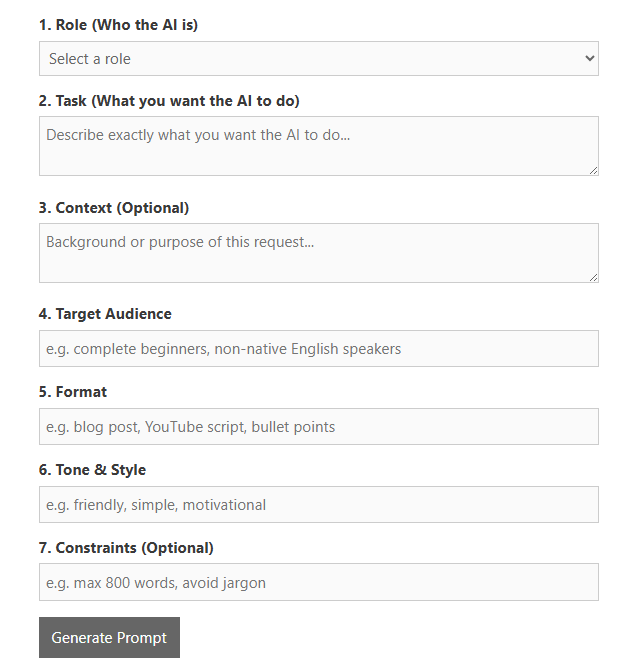
- AI Prompt Builder
- Negative Prompting (What NOT to Include And Why It Matters)
You’ve tried using AI to write product reviews.
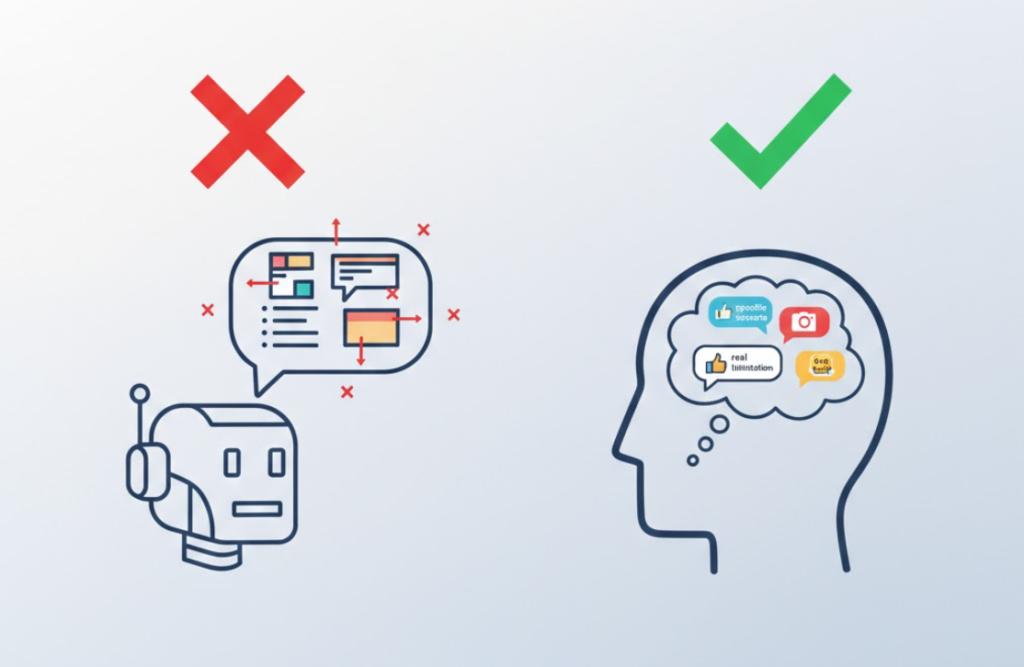
The output? Technically correct but completely lifeless.
It reads like a robot describing features from a spec sheet.
No personality. No trust. Definitely no conversions.
Here’s the thing: AI can write excellent product reviews.
But you need to know how to prompt it properly.
Today, you’ll learn the exact tactical approach to get natural, trustworthy, conversion-friendly product reviews from AI.
No more robotic nonsense.
Let’s fix this.
Why Most AI Product Reviews Sound Like Robots
Before we fix it, understand what’s going wrong.
AI defaults to certain patterns when you ask it to write product reviews.
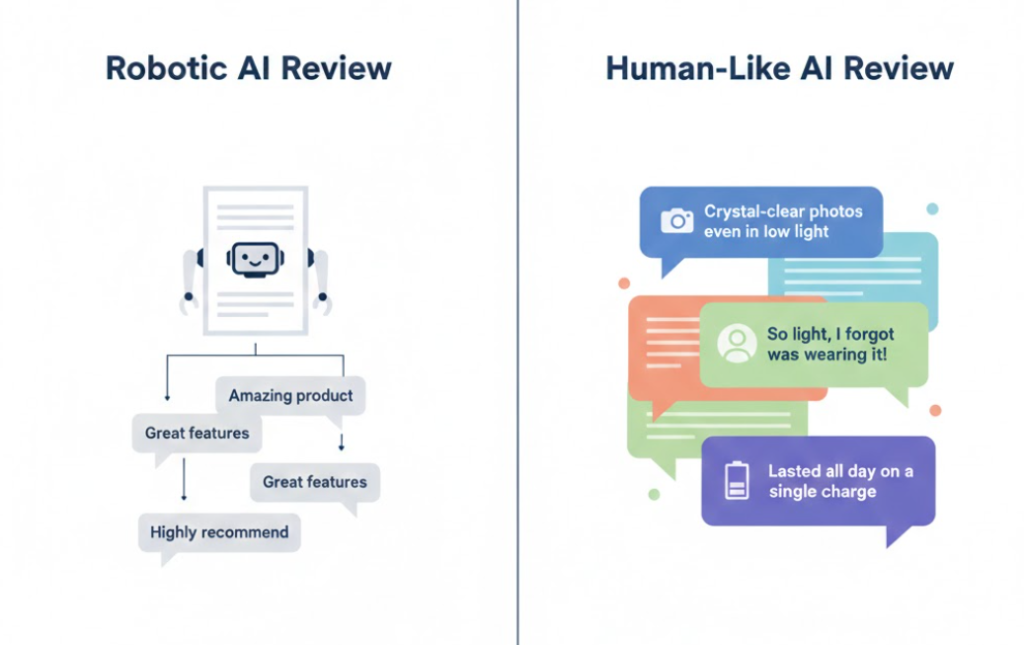
Pattern 1: Feature Lists AI loves listing specifications. Battery life. Dimensions. Materials. Technical details.
That’s useful information. But it’s not a review. It’s a manual.
Pattern 2: Generic Praise “This product is amazing.” “Incredible value.” “Revolutionary design.”
These phrases sound fake because they say nothing specific.
Pattern 3: Balanced Structure Three pros. Three cons. Conclusion. Every single time.
It’s predictable. Readers recognize AI wrote it immediately.
Pattern 4: No Real User Perspective AI describes what the product does. It doesn’t describe what using it actually feels like.
Real reviews come from real use. AI reviews feel hypothetical.
The good news?
Every one of these problems has a simple fix.
The 5-Part Tactical Framework
Here’s the framework that produces natural-sounding reviews every time.
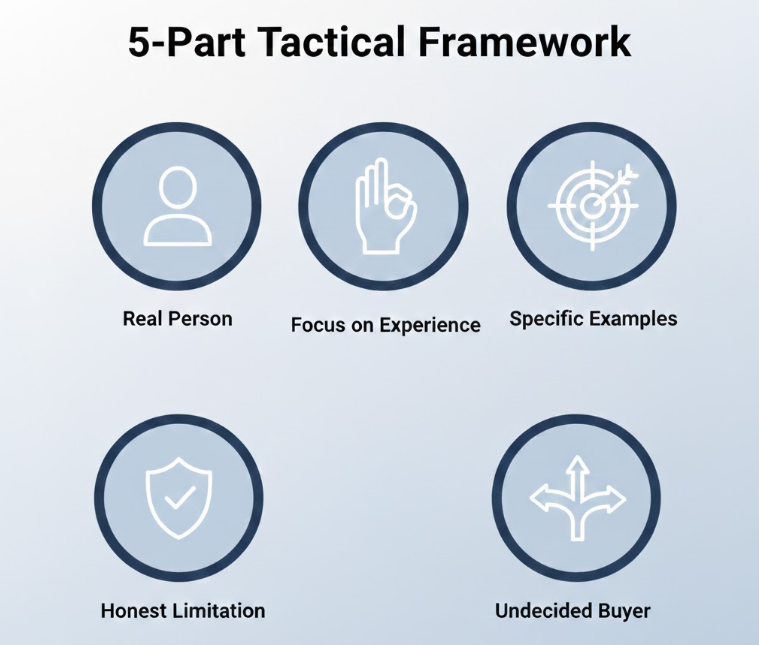
Part 1: Give AI a Real Person to Write As
Don’t let AI write as “a reviewer.”
Give it a specific person with specific experiences.
Bad prompt: “Write a product review for these wireless headphones.”
Good prompt:
You are a 35-year-old remote worker who bought these wireless
headphones after getting tired of hearing your neighbor's lawn
mower during Zoom calls. You've owned them for 3 weeks. You
previously used cheap Amazon basics earbuds.

Write a review from this perspective.
AI now has context. It knows who’s reviewing, why they bought the product, and what they’re comparing it to.
That context creates authenticity.
Part 2: Focus on the Experience, Not the Specs
Real people don’t review specifications. They review experiences.
Tell AI to focus on how the product performs in real situations.
Add to your prompt:
Focus on actual daily use scenarios, not technical specifications.
Instead of "30-hour battery life," describe what that means in
practice. Instead of "noise cancellation technology," describe
what you can and can't hear while wearing them.

Write about the experience of using the product, not the features list.
This single instruction eliminates 80% of robotic-sounding content.
Part 3: Require Specific Examples
Vague reviews sound fake. Specific reviews sound real.
Force AI to be specific by requiring examples.
Add to your prompt:
Include at least 2 specific examples of situations where you used
this product. Be detailed: where you were, what you were doing,
what happened.

Example: "During my 9 AM standup meeting, my neighbor started
using a leaf blower right outside my window. I couldn't hear it
at all through these headphones — the person I was talking to
didn't even know it was happening."
When AI has to create specific scenarios, it writes like a real person would.
Part 4: Demand One Honest Limitation
Nothing kills trust faster than all-positive reviews.
Real products have real limitations. Your review should too.
Add to your prompt:
Include exactly one genuine limitation or drawback of this product.
Be honest and specific. This isn't nitpicking — it's something a
potential buyer should genuinely consider.

Don't soften it. State it plainly.
This creates trust. Readers know you’re not just selling.
Part 5: Write for the Undecided Buyer
AI often writes reviews for people who already decided to buy.
That’s backwards. Reviews are for people on the fence.
Add to your prompt:
This review is for someone who's comparing this product to 2-3
alternatives and hasn't decided yet. They're concerned about
[specific concern]. Address that concern directly based on your
experience.

Your goal: help them make a confident decision, not convince
them this is perfect.
This frames the entire review correctly.
The Complete Prompt Template
Here’s everything combined into one ready-to-use template.
PERSONA:
You are a [age] [occupation/situation] who bought [product name]
because [specific reason/problem]. You've owned it for [timeframe].
You previously used [previous product for comparison].

FOCUS:
Write about the actual experience of using this product in daily
life. Focus on real scenarios, not technical specifications. When
you mention features, explain what they mean in practice.

SPECIFIC EXAMPLES:
Include 2 detailed examples of situations where you used this
product. Be specific about where you were, what you were doing,
and what happened.

HONEST LIMITATION:
Include exactly one genuine drawback or limitation. State it
plainly without softening it. This is something a potential buyer
should know.

AUDIENCE:
Write for someone comparing this to alternatives and concerned
about [specific concern]. Your goal is helping them decide
confidently, not selling them on perfection.

LENGTH: 600-700 words
TONE: Conversational, like talking to a friend
STRUCTURE: Natural flow, not rigid pros/cons format

Product details: [paste relevant info about the product]
Copy this template. Fill in the brackets. Use it for every product review.
Results improve immediately.
Real Example: Before and After
Let’s see this framework in action.
Product: Noise-canceling wireless headphones
Before (Generic AI Review)
“The Sony WH-1000XM5 headphones are an amazing product that delivers incredible sound quality and industry-leading noise cancellation. With 30 hours of battery life and premium build quality, these headphones represent excellent value.
Pros:
- Outstanding noise cancellation
- Long battery life
- Comfortable design
Cons:
- Premium price point
- Slightly heavy
- No IP rating
Overall, these are great headphones for anyone looking for top-tier audio quality and noise cancellation. Highly recommended.”
What’s wrong? Generic praise. Feature list. No real experiences. No specific examples. Doesn’t help an actual buyer decide.
After (Framework-Based Review)
“I bought these after three months of my neighbor mowing his lawn during every single morning Zoom call. My cheap earbuds weren’t cutting it.
Three weeks in, here’s what actually matters.
The noise cancellation is legitimately impressive. During yesterday’s 9 AM standup, that same lawn mower fired up right outside my window. The person I was talking to had no idea. I couldn’t hear it at all. Same with airplane engine noise on my flight to Denver last week — completely gone. Street traffic, coffee shop conversations, office chatter — all erased.
But here’s the specific limitation you should know: They’re noticeably heavy after wearing them for 2+ hours. By the end of a 4-hour focus session, the top of my head feels the pressure. I need to take them off for 10 minutes. If you’re planning 8-hour workdays in these without breaks, that’s something to consider.
Battery life is ridiculous. I charge them once a week. Maybe. I’ve never had them die mid-use. I honestly don’t think about it anymore.
The sound quality is excellent for someone like me (not an audiophile, just wants clear audio for calls and music). Podcasts sound crisp. Music has more depth than my old earbuds, though I can’t speak to how they compare to $500 studio headphones.
Setup was actually simple — paired with my MacBook and iPhone instantly. Switching between devices works without thinking about it.
Are they worth $350? If you’re working from home in a noisy environment or traveling regularly, yes. The noise cancellation alone justifies it. If you’re in a quiet home office and mostly listen to podcasts, probably not — you can get 80% of this for $100.
I’m keeping them. The lawn mower situation alone made them worth it.”
What’s better? Real person. Specific situations. Honest limitation stated clearly. Helps undecided buyers. Conversational tone. No generic praise.
That’s what the framework produces.

Common Mistakes to Avoid
Even with the framework, people make these errors.
Mistake 1: Too Much Product Info in Your Prompt
Don’t paste the entire product description into your prompt.
AI will just rewrite marketing copy.
Instead: Give AI 3-5 key facts about the product, then let it focus on the experience.
Mistake 2: Making Up a Fake Person
“You are John Smith, a 42-year-old accountant from Ohio who loves hiking.”
That level of detail doesn’t help. It just creates noise.
Instead: Focus on the situation and need, not backstory details.
“You’re a remote worker in a noisy neighborhood” is enough.
Mistake 3: Asking for Too Many Examples
“Include 5 specific examples of when you used this product.”
Too many. The review becomes a story collection.
Stick to: 2 specific examples maximum. Quality over quantity.
Mistake 4: No Actual Product Information
AI needs something real to work with.
Give it the actual product name, category, price point, and 3-5 key features.
Without this, AI just invents details.
Mistake 5: Ignoring Your Actual Audience’s Concerns
Every product category has specific concerns buyers worry about.
For headphones: comfort during long use, sound leakage, battery life. For standing desks: stability, motor noise, ease of adjustment. For software: learning curve, support quality, integration capabilities.
Identify the real concern for your audience. Make AI address it.
The Quick Checklist
Before you hit generate, verify your prompt has:
- [ ] Specific persona (not just “a reviewer”)
- [ ] Focus on experience over specs
- [ ] Requirement for 2 specific examples
- [ ] Instruction to include one honest limitation
- [ ] Clear target audience with their main concern
- [ ] Conversational tone instruction
- [ ] Actual product information (name, category, 3-5 key points)
- [ ] Word count target (600-700 is ideal for most reviews)
Eight items. Takes 30 seconds to check.
Makes the difference between robotic and real.
Taking It Further: Review Variations
Once you master the basic framework, create variations.
For budget products: Add: “Focus on value for money. Compare to more expensive alternatives. Be clear about what compromises you’re accepting at this price point.”
For premium products: Add: “Justify the premium price. What specifically makes this worth more than cheaper alternatives? Who should pay extra and who shouldn’t?”
For technical products: Add: “Translate technical features into practical benefits. Your reader isn’t an expert. Explain what things actually do, not what they’re called.”
For lifestyle products: Add: “Focus on how this fits into daily routines. Does it actually get used or sit in a drawer? Be honest about the lifestyle-product-reality gap.”
Same framework. Different emphasis.
Editing the Output
AI gets you 80% of the way there.
The final 20% is light editing.
What to edit:
1. Remove any remaining generic phrases Search for: amazing, incredible, outstanding, revolutionary, game-changer Delete or replace with specific descriptions.
2. Add one personal detail A small specific touch AI wouldn’t think of. “I keep these on my desk next to my coffee mug” — tiny detail, adds humanity.
3. Check the limitation is honest Sometimes AI softens drawbacks too much. Make sure it’s genuinely useful information, not a non-issue.
4. Verify the recommendation makes sense Does the conclusion actually help someone decide? If it’s wishy-washy (“it depends on your needs”), make it more specific.
Five minutes of editing. Professional result.
The Bottom Line
AI can absolutely write product reviews that sound human.
But only if you prompt it correctly.
Give it a real person to write as. Focus on experiences, not specs. Demand specific examples. Require honest limitations. Write for undecided buyers.
Follow that framework, and your AI-written reviews will convert just as well as hand-written ones.
Maybe better. Because you’ll create more of them, faster, and test what works.
That’s the real advantage.
Not perfect reviews. More reviews. Testing. Learning. Improving.
AI is the tool. The framework is the skill.
Master the framework this week.
Your conversion rates will prove it works.
Start now:
Take the product you’re reviewing next.
Fill in the template in this AI Prompt Builder article.
Run it.
Compare it to what you’d normally get from AI.
That comparison will teach you more than reading this article twice.