AI can write content.
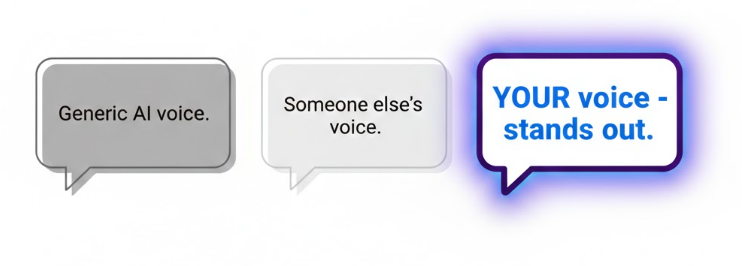
But does it sound like you?
Probably not.
It sounds like AI.
Generic. Safe. Forgettable.
Here’s the problem: most people think AI voice training is complicated.
It’s not. It’s just systematic.
Today, you’ll learn the exact process for teaching AI to write in your specific voice.
Not “conversational.” Not “professional.” YOUR voice.
The voice that makes people say “This sounds exactly like you.”
This is advanced territory. But the payoff is massive.
Let’s build your voice model.
You may also like:
- How to Write Product Reviews Using AI (Without Sounding Robotic)
- How to Refine AI Content
- AI Prompt Builder
Why Voice Matters More Than You Think
Your voice is your competitive advantage.
Everyone has access to the same AI tools.
Everyone can generate content.
But only you can sound like you.
Voice creates:
- Recognition: People know it’s your content before seeing your name
- Trust: Consistency builds credibility over time
- Connection: Authentic voice creates genuine relationships
- Differentiation: You stand out in a sea of generic content
Without a distinct voice, your content is replaceable.
With it, you’re irreplaceable.
That’s why voice training isn’t optional for serious affiliate marketers.
It’s essential.
The Three-Layer Voice Architecture
Your voice isn’t one thing.
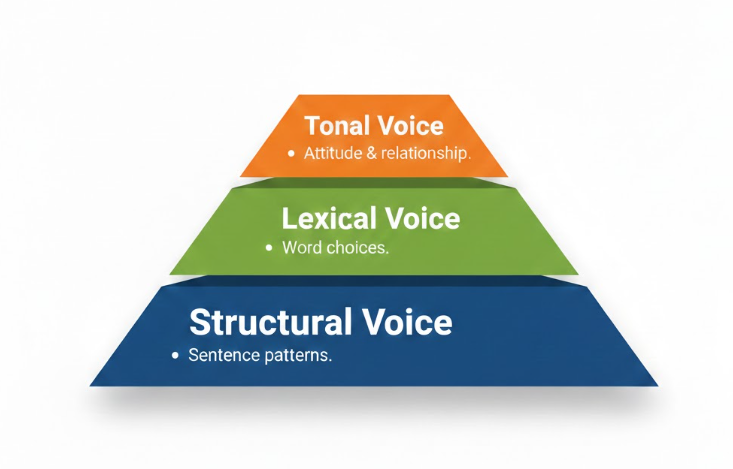
It’s three distinct layers that work together.
Understanding this changes everything.
Layer 1: Structural Voice (The Foundation)
How your sentences are built.
- Sentence length patterns: Short and punchy? Long and flowing? Mixed?
- Paragraph structure: Single-sentence paragraphs? Dense blocks? Varied?
- Rhythm and pacing: Fast and energetic? Slow and deliberate? Conversational cadence?
Example of structural voice:
Writer A: “AI content creation is challenging. Many struggle with it. They don’t know where to start.”
Writer B: “Here’s what nobody tells you about AI content creation—it’s not about the tools, it’s about knowing exactly what to ask for.”
Same information. Completely different structural voice.
Layer 2: Lexical Voice (Your Word Choices)
The specific vocabulary you use and avoid.
- Signature phrases: What expressions are uniquely yours?
- Word preferences: “Start” vs. “begin.” “Get” vs. “acquire.” “Thing” vs. “element.”
- Vocabulary level: Simple everyday words? Technical terminology? Academic language?
- Taboo words: What words do you never use?
Example of lexical voice:
Writer A: “Utilize this methodology to optimize your outcomes.”
Writer B: “Use this method to get better results.”
Same meaning. One sounds corporate. One sounds human.
Layer 3: Tonal Voice (Your Attitude)
How you relate to your reader.
- Authority level: Expert teacher? Peer sharing discoveries? Humble learner?
- Emotional range: Enthusiastic? Calm? Skeptical? Matter-of-fact?
- Reader relationship: Friend? Student? Colleague? Skeptic you’re convincing?
- Humor usage: Sarcastic? Self-deprecating? Playful? Serious?
Example of tonal voice:
Writer A: “Research indicates that most individuals fail to implement these strategies correctly.”
Writer B: “You’re probably doing this wrong. I did too. Here’s how to fix it.”
Same observation. One is distant. One is connected.
All three layers combine to create your unique voice.
Train AI on all three, and it starts sounding like you.
The Voice Analysis Process
Before you can train AI, you need to analyze your own voice.
Most people skip this step.
Big mistake.
You can’t teach what you haven’t defined.
Step 1: Collect Your Voice Samples
Gather 10-15 pieces of content you’ve personally written that feel “like you.”
What to include:
- Email responses you’re proud of
- Social media posts that got strong engagement
- Blog articles where you felt in flow
- Messages to friends about your business
- Any writing where you think “Yes, that’s my voice”
What NOT to include:
- Content you wrote trying to sound professional
- Anything written to please someone else
- Formal business documents
- Content you wrote that feels stiff or forced
You need authentic voice samples, not “business voice” samples.
Step 2: Run the Structural Analysis
Feed your samples to AI for pattern recognition.
The Structural Analysis Prompt:
I'm providing 5 writing samples that represent my authentic voice.

Analyze the STRUCTURAL patterns:

1. SENTENCE LENGTH: What's my typical range? Do I favor short punchy sentences? Long complex ones? A specific mix?

2. PARAGRAPH LENGTH: How do I typically break content into paragraphs? Single-sentence paragraphs? Dense blocks? What's the pattern?

3. OPENING PATTERNS: How do I tend to start paragraphs or sections? With questions? Bold statements? Transitions?

4. RHYTHM: Describe the pacing and flow. Fast and energetic? Measured and deliberate? Conversational with varied rhythm?

5. FORMATTING HABITS: Do I use lots of line breaks? Bold text? Bullets? How do I structure information visually?

Provide specific examples from my samples to support each observation.

Here are my samples:
[Paste 5 samples]
AI will map your structural patterns with examples.
This becomes your structural voice profile.
Step 3: Run the Lexical Analysis
Now analyze your word choice patterns.
The Lexical Analysis Prompt:
Using the same writing samples, analyze my LEXICAL patterns:

1. VOCABULARY LEVEL: Do I use simple everyday language? Technical terms? Academic vocabulary? Give me the approximate reading level.

2. SIGNATURE PHRASES: What expressions or phrases appear repeatedly across my samples? What seems to be "my language"?

3. WORD PREFERENCES: When I have choices (start/begin, get/obtain, thing/element), which do I consistently choose?

4. CONTRACTIONS: Do I use them freely? Sparingly? Never?

5. WORDS I AVOID: Based on these samples, what common words am I clearly NOT using? What vocabulary seems absent that others might use?

Provide specific examples and word counts where possible.

Samples:
[Paste same 5 samples]
This gives you your lexical voice profile.
Step 4: Run the Tonal Analysis
Finally, analyze how you relate to your reader.
The Tonal Analysis Prompt:
Using the same samples, analyze my TONAL patterns:

1. AUTHORITY STANCE: Do I position myself as an expert? A peer? A fellow learner? How do I establish credibility?

2. READER RELATIONSHIP: How do I address the reader? As a friend? Student? Skeptic? What's the implicit relationship?

3. EMOTIONAL QUALITY: What's the emotional tone? Enthusiastic? Measured? Skeptical? Matter-of-fact? Warm? Direct?

4. VULNERABILITY: Do I share mistakes and uncertainties? Stay confident throughout? Show self-doubt?

5. HUMOR AND PERSONALITY: How do I use humor? Self-deprecating? Sarcastic? Observational? Serious?

Describe the overall "personality" someone would perceive from reading these samples.

Samples:
[Paste same 5 samples]
This completes your tonal voice profile.
Now you have all three layers documented.
Building Your Voice Training Document
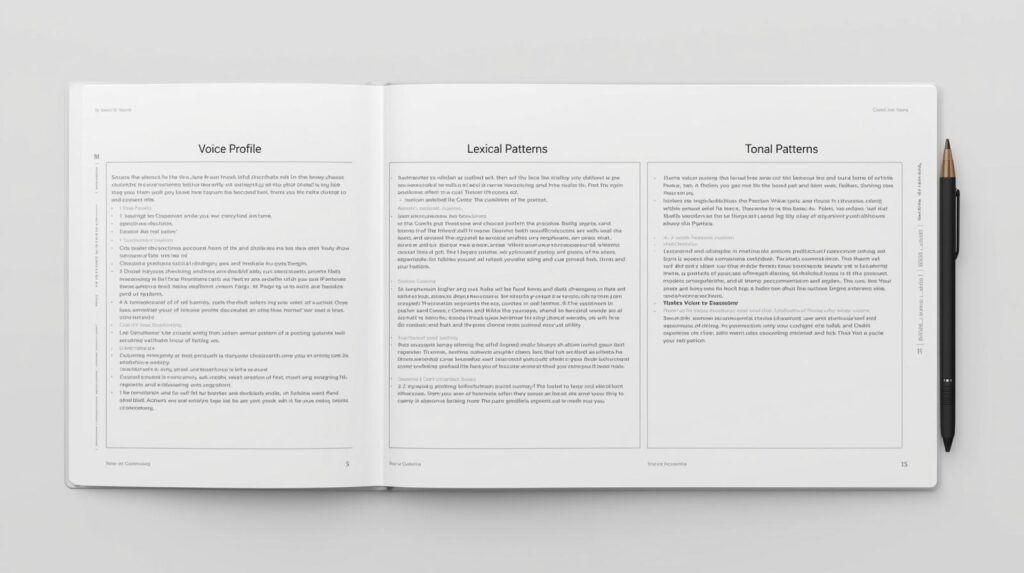
Take your three analysis outputs and create one master document.
This is your AI voice training document.
Structure it like this:
MY VOICE PROFILE - [Your Name]

=== STRUCTURAL VOICE ===

Sentence Length: [Pattern from analysis]
Example: [Specific example from your writing]

Paragraph Structure: [Pattern from analysis]
Example: [Specific example from your writing]

Opening Style: [Pattern from analysis]
Example: [Specific example from your writing]

Rhythm & Pacing: [Description from analysis]

Formatting Preferences: [Your patterns]

=== LEXICAL VOICE ===

Vocabulary Level: [Reading level and style]

Signature Phrases: [List 5-10 phrases you use repeatedly]
- "Here's the thing:"
- "Let me be clear:"
- [etc.]

Word Preferences:
- I use "get" not "obtain"
- I use "start" not "commence"
- [etc.]

Words I Avoid: [List words you never use]
- Never use: "leverage," "synergy," "utilize"
- [etc.]

Contractions: [Your usage pattern]

=== TONAL VOICE ===

Authority Stance: [Your approach]
Example: [Quote from your writing showing this]

Reader Relationship: [How you address readers]

Emotional Quality: [Your typical tone]

Vulnerability Level: [How open you are about mistakes]
Example: [Quote showing this]

Humor Style: [Your approach to humor]
Example: [Quote if applicable]

=== DO NOT WRITE LIKE THIS ===

[Include 2-3 examples of voices that are NOT yours]
- Not corporate: "We leverage our synergies to optimize outcomes"
- Not overly casual: "Hey guys what's up lol"
- Not academic: "Research suggests implementation methodologies vary"
Save this document.
You’ll use it in every content creation prompt going forward.
The Voice Injection Method
Now that you have your voice profile, here’s how to use it.
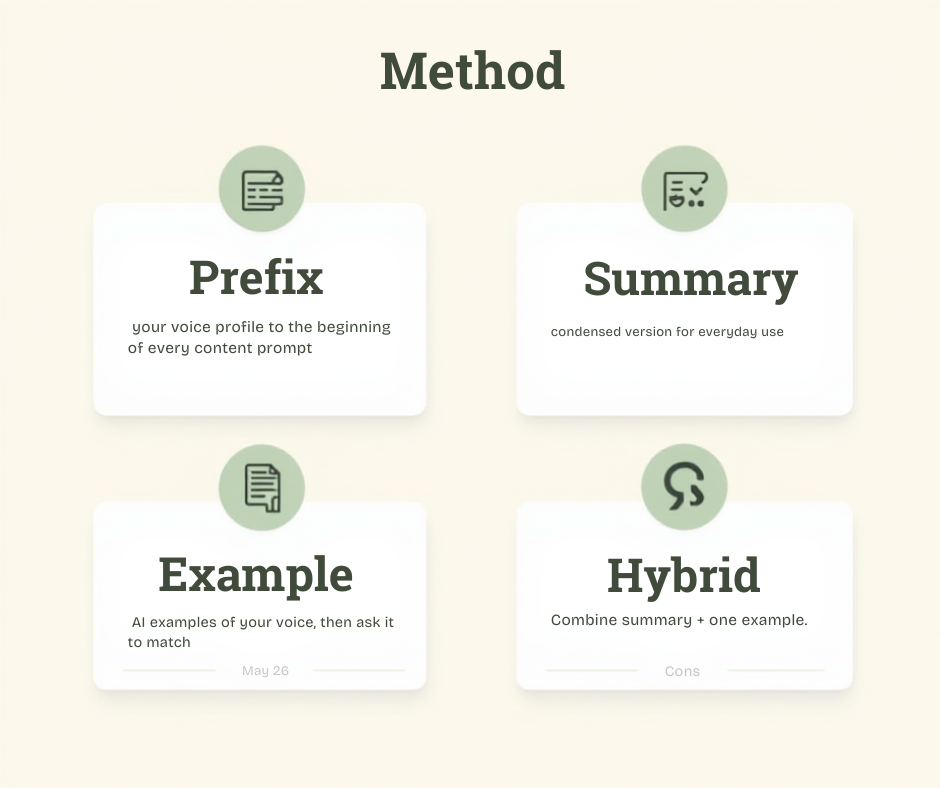
Method 1: The Prefix Injection (Simple)
Add your voice profile to the beginning of every content prompt.
Structure:
[PASTE YOUR VOICE PROFILE DOCUMENT]

Now, using the voice patterns described above, write:
[Your specific content request]
This tells AI exactly how to sound like you before it writes anything.
Pros: Simple, works immediately Cons: Uses a lot of tokens, long prompts
Method 2: The Summary Injection (Efficient)
Create a condensed version for everyday use.
Example condensed voice profile:
VOICE INSTRUCTIONS:
- Short punchy sentences (5-15 words average)
- Single-sentence paragraphs frequently
- Always start sections with questions or bold statements
- Use simple words: "get" not "obtain," "start" not "begin"
- Signature phrases: "Here's the thing," "Let me be clear"
- Never use: leverage, synergy, utilize, optimize
- Tone: Direct friend sharing what works, not expert lecturing
- Show mistakes honestly: "I screwed this up for months"
- No exclamation points, no excessive enthusiasm
This fits in any prompt without eating your token budget.
Pros: Efficient, reusable Cons: Less detailed than full profile
Method 3: The Example Injection (Most Powerful)
Show AI examples of your voice, then ask it to match.
Structure:
Here are 3 examples of my writing voice:

Example 1:
[Paste 100-150 words of your writing]

Example 2:
[Paste 100-150 words of your writing]

Example 3:
[Paste 100-150 words of your writing]

Write the following content matching this exact voice, style, and tone:
[Your content request]
This is the most effective method for voice matching.
Pros: AI learns by example, highest accuracy Cons: Requires more prompt space
Method 4: The Hybrid Approach (Best for Most Users)
Combine summary + one example.
VOICE GUIDE:
[Your condensed voice profile - 8-10 lines]

VOICE EXAMPLE:
[One 150-word sample of your writing]

Now write:
[Your content request]
This balances effectiveness with efficiency.
Advanced Voice Training Techniques
Once you’ve mastered the basics, these techniques refine further.
Technique 1: Negative Voice Examples
Show AI what you DON’T sound like.
MY VOICE:
[Your voice profile]

I DO NOT sound like this:
[Paste 100 words of a voice that's opposite to yours]

Specifically avoid:
- That formal, distant tone
- Those long complex sentences
- That corporate vocabulary
Negative examples create boundaries.
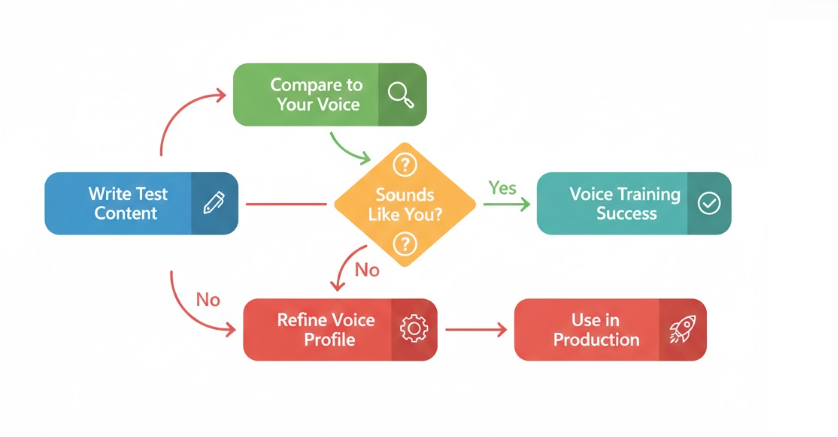
Technique 2: Voice Calibration Testing
Regularly test if AI is matching your voice.
The Voice Match Test:
Write two paragraphs about [topic]:
Paragraph 1: In my voice (use the profile)
Paragraph 2: In a generic AI voice

Label each clearly so I can compare.
Read both. If you can’t tell which is “your voice,” your profile needs work.
If Paragraph 1 sounds distinctly like you, your training is working.
Technique 3: Voice Evolution Tracking
Your voice changes over time.
Every 6 months, re-run the analysis process.
Update your profile with:
- New signature phrases you’ve adopted
- Structural patterns that have shifted
- Tonal changes as you’ve grown
Your voice training document should evolve with you.
Technique 4: Context-Specific Voice Variants
Your voice might shift slightly by platform or content type.
Create variants:
BASE VOICE: [Your core voice profile]

TWITTER VARIANT:
- Even shorter sentences (3-10 words)
- More direct, less warm
- No multi-sentence tweets

LONG-FORM VARIANT:
- Longer sentences allowed (up to 25 words)
- More narrative flow
- Deeper explanations
This maintains voice consistency while adapting to context.
Technique 5: Voice Collaboration Training
If you have a team, train AI on your brand voice, not just personal voice.
Team Voice Profile Structure:
TEAM VOICE BASELINE:
[Shared structural, lexical, and tonal patterns]

APPROVED BY: [Team member samples that exemplify it]

NOT OUR VOICE: [Examples of what to avoid]

CONTEXT RULES:
- Customer-facing: [Specific adjustments]
- Internal docs: [Specific adjustments]
- Marketing: [Specific adjustments]
This ensures brand consistency across multiple writers.
Common Voice Training Mistakes
Even with a good process, people make these errors.
Mistake 1: Analyzing Business Writing Instead of Authentic Writing
You analyze formal blog posts you wrote trying to “sound professional.”
Then you wonder why AI sounds stiff.
Fix: Only analyze writing that felt natural and authentic to you.
Mistake 2: Voice Profile Too Vague
“I’m conversational and helpful.”
Everyone thinks they’re conversational and helpful.
Fix: Be specific. “I use 2-3 word sentences frequently. I start 40% of paragraphs with questions. I never use exclamation points.”
Mistake 3: Not Including Examples
You describe your voice but never show it.
AI doesn’t have a reference point.
Fix: Always include at least one 150-word example of your actual writing.
Mistake 4: Expecting Perfection Immediately
AI won’t nail your voice on the first attempt.
It takes iteration and refinement.
Fix: Expect 70-80% voice match initially. Refine your profile based on what’s missing.
Mistake 5: Not Testing Across Content Types
You test your voice on social posts, then use it for long-form articles.
The voice doesn’t transfer well.
Fix: Test your voice profile on different content types. Adjust as needed.
The Voice Consistency System
Once your voice is trained, maintain consistency.
Daily Content Creation:
[Your condensed voice profile]

Today's content: [Specific request]
Monthly Voice Audit:
Generate 5 pieces of content with your voice profile.
Read them all.
Ask: “Does this sound like me consistently across all five?”
If not, identify where the voice breaks down and update your profile.
Quarterly Deep Analysis:
Re-run the three-layer analysis on recent content AI has created.
Compare to your voice profile.
Adjust the profile to match any natural evolution in your voice.
This system keeps AI aligned with your voice over time.
Measuring Voice Match Success
How do you know if it’s working?
The Recognition Test:
Show your AI-generated content to someone who knows your writing.
Don’t tell them it’s AI.
Ask: “Does this sound like me?”
If they say yes without hesitation, you’ve nailed it.
The Blind Test:
Create two pieces of content on the same topic:
- One written by you manually
- One generated by AI using your voice profile
Mix them up. Ask someone to identify which is which.
If they can’t tell, your voice training is working.
The Engagement Test:
Compare engagement rates:
- Content written in your voice (you manually)
- Content generated with voice training
- Generic AI content without voice training
If voice-trained AI content performs as well as your manual content, you’ve succeeded.
If it outperforms generic AI content but underperforms your manual content, keep refining.
The Business Case for Voice Training
Why invest this time and effort?
Time Savings:
Initial setup: 3-4 hours to build your voice profile.
Time saved per month: 10-15 hours of rewriting and editing AI content that doesn’t sound like you.
Quality Consistency:
Without voice training: 50% of AI content needs major rewrites.
With voice training: 20% needs minor tweaks.
Brand Strength:
Consistent voice across all content builds brand recognition 3-5x faster than inconsistent content.
Scaling Ability:
You can produce 10x more content while maintaining voice consistency.
Your output scales. Your voice doesn’t dilute.
The investment pays off within the first month.
Your Implementation Plan
Here’s how to build your voice training system this week.
Day 1: Collection (30 minutes) Gather 10-15 samples of your authentic writing.
Day 2: Analysis (90 minutes) Run all three voice analysis prompts.
Day 3: Documentation (60 minutes) Create your master voice training document.
Day 4: Testing (45 minutes) Generate 3 pieces of content using your voice profile. Read them. Note what works and what’s off.
Day 5: Refinement (30 minutes) Update your voice profile based on Day 4 testing.
Day 6: Implementation (15 minutes) Create your condensed voice profile for daily use.
Day 7: Validation (30 minutes) Run the recognition test with a friend or colleague.
Total time investment: ~5 hours.
Result: A voice training system you’ll use for years.
The Bottom Line
AI can write in any voice.
But it needs to be taught YOUR voice specifically.
Most people skip this step and wonder why their AI content feels generic.
You now have the complete system:
- Three-layer voice architecture (structural, lexical, tonal)
- Voice analysis process (collect, analyze, document)
- Four injection methods (prefix, summary, example, hybrid)
- Advanced techniques (negative examples, calibration, evolution)
- Consistency maintenance (audits, testing, refinement)
This isn’t easy.
But it’s the difference between AI content that’s replaceable and content that’s distinctly yours.
Spend the week building your voice profile.
The content you create afterward will sound like you wrote it personally.
Because AI finally knows what “you” sounds like.