Most content creators publish randomly.
A good idea appears.
They write it.
They publish it.
Then they wait for another idea.
No strategy.
No structure.
No connection between one piece and the next.
The result is a blog that looks busy but doesn’t build anything — no authority, no traffic momentum, no clear path to revenue.
A content calendar fixes this.
It connects each piece of content to a goal, a keyword, and an audience. It ensures you publish consistently without burning out on planning what comes next.
And with AI, you can build 90 days of it in 30 minutes.
You may also like:
- SEO Keyword Research Prompts (Finding Low-Competition Opportunities)
- Automation Prompts (Creating SOPs and Process Documentation)
- Temperature and Creativity: Understanding AI Parameters (Simple Explanation)
Why Random Publishing Fails

Publishing without a calendar creates three specific problems.
No momentum. Traffic from one article doesn’t feed the next. Internal links don’t exist. Topic authority never builds because you never go deep on anything.
Feast or famine output. You publish three articles when inspired, then nothing for two weeks. Search engines reward consistency. Random output gets random results.
Wrong content mix. Without planning, most creators default to whatever feels interesting. They end up with too much top-of-funnel awareness content and almost no content that converts — which is why traffic doesn’t turn into revenue.
A 90-day calendar solves all three. You plan the mix intentionally. You set a sustainable pace. Each article connects to the ones around it.
What a Good Content Calendar Includes
Before the prompts, know what you’re building toward.
A calendar that actually works has five elements:
Publish date — when it goes live. Consistency matters more than frequency.
Working title — specific enough to write from, not just a topic label.
Target keyword — the primary search term this article is built around.
Content type — awareness, authority, or conversion. The mix determines your results.
Connecting links — which existing or planned articles this piece links to and from.
The prompts below build all five elements for a full 90-day period.
The 5 Prompts
Prompt 1: The Content Mix Calculator
Before filling a calendar, decide what ratio of content types you need.
My content goals for the next 90 days are: [e.g. grow organic traffic,
increase affiliate revenue, build email list]

My current content situation:
- Number of published articles: [X]
- Current monthly traffic: [X visitors]
- Primary monetization: [affiliate marketing / products / ads]
- Publishing capacity: [X articles per month]

Recommend the right content mix for my goals using these three types:

AWARENESS CONTENT (top of funnel):
— Broad topics that attract new readers
— No direct monetization, builds traffic and authority

AUTHORITY CONTENT (middle of funnel):
— Deep guides and how-tos that establish expertise
— Indirect monetization through internal links

CONVERSION CONTENT (bottom of funnel):
— Reviews, comparisons, and best-of lists
— Direct affiliate monetization

Give me:
1. The recommended percentage split (e.g. 40% / 30% / 30%)
2. How many articles of each type per month at my publishing capacity
3. Why this mix fits my specific goals right now
This is the most important prompt in the framework. The wrong content mix is why most affiliate sites get traffic but not revenue — or revenue potential but no traffic to monetize.
Prompt 2: The 90-Day Topic Generator
Now fill the calendar with specific, connected topics.
My niche is: [your niche]
My target audience is: [describe them]
My content mix is: [paste Prompt 1 output]
My publishing schedule is: [X articles per week / month]

Generate 90 days of content topics organized by month.

For each article include:
- WORKING TITLE: specific and search-friendly
- CONTENT TYPE: awareness / authority / conversion
- TARGET KEYWORD: primary search term
- AUDIENCE: which segment of my audience this targets
- CONNECTION: which other articles in this plan it links to

Rules:
- Group related topics together — don't scatter them randomly
- Build at least 2-3 topic clusters where multiple articles
  support a central pillar piece
- Alternate content types — don't stack 5 conversion pieces in a row
- Include at least one seasonal or timely angle per month

Output as a month-by-month list, not a random dump.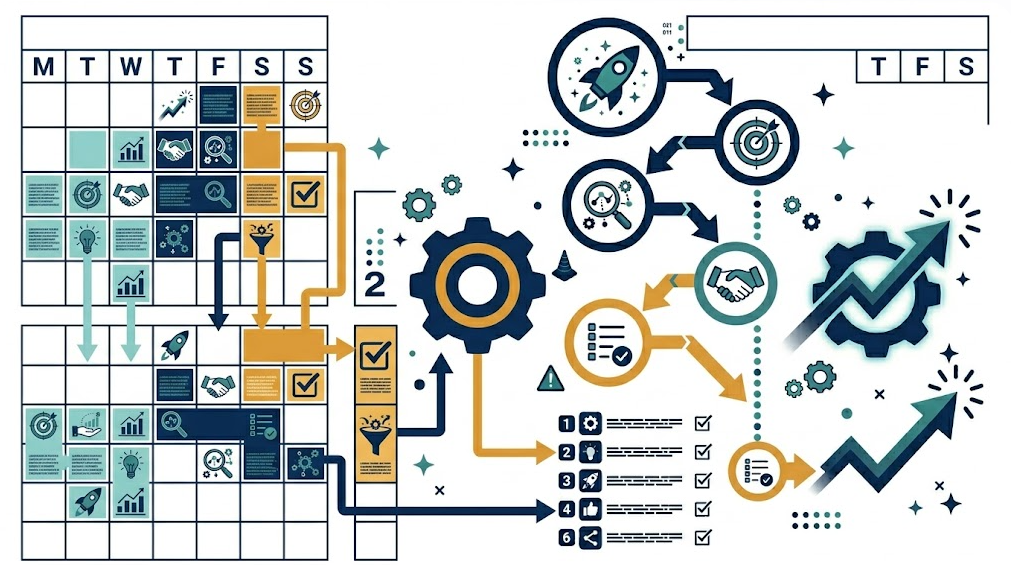
The topic cluster rule is critical.
Three articles on the same subtopic — one pillar, two supporting — build more authority than three articles on three different topics. AI will build these clusters naturally if you ask for them explicitly.
Prompt 3: The Pillar and Cluster Builder
Take your strongest topic area and build it into a proper cluster.
My strongest topic area is: [choose one from Prompt 2 output]
My target audience's main question about this topic is: [state it]

Build a content cluster around this topic:

PILLAR ARTICLE (2000+ words, targets a broad keyword):
- Working title
- Target keyword
- 6-8 subtopics this article covers at a high level

CLUSTER ARTICLES (800-1200 words each, target specific subtopics):
- Generate 4-6 supporting articles that go deep on each subtopic
- Each should target a long-tail variation of the pillar keyword
- Each should link back to the pillar and to at least one other cluster article

INTERNAL LINK MAP:
- Show how the pillar and cluster articles connect
- Which cluster articles link to each other (not just to the pillar)

This cluster becomes your strongest authority signal for [topic].
One well-built cluster does more for your SEO than 20 disconnected articles.
This is how sites with low domain authority rank against bigger competitors — by becoming the definitive resource on a specific subtopic.
Prompt 4: The Publishing Schedule Builder
Topics without dates are just a wishlist. This prompt turns your topic list into an actual schedule.
Here are my 90-day content topics: [paste Prompt 2 output]

My publishing constraints:
- Days I publish: [e.g. Monday and Thursday]
- Articles per week: [X]
- Launch date for this calendar: [date]
- Any blackout dates: [holidays, travel, launches]

Build a week-by-week publishing schedule that:
1. Assigns each article a specific publish date
2. Sequences the topic clusters so pillar articles publish
   before their supporting cluster articles
3. Spaces conversion content evenly — no more than 2 in a row
4. Builds toward any seasonal opportunities in the 90-day window
5. Flags any weeks where my capacity is at risk
   (e.g. too many complex articles scheduled close together)

Output as a weekly table:
Week | Publish Date | Title | Content Type | Target Keyword
Sequencing matters more than most people realize. A cluster article linking to its pillar piece only adds value once the pillar exists. Publishing them out of order wastes the internal link equity.
Prompt 5: The Calendar Audit and Gap Finder
Before you lock the calendar in, check it for strategic gaps.
Here is my complete 90-day content calendar: [paste full schedule]

My goals are: [repeat your goals from Prompt 1]
My monetization model is: [affiliate niche / products]

Audit this calendar for strategic gaps:

CONTENT MIX CHECK:
— Does the actual mix match my recommended ratio?
— Am I over-indexed on any one content type?

KEYWORD COVERAGE:
— Are there obvious keyword opportunities I'm missing?
— Am I targeting the same keyword multiple times?

AUDIENCE COVERAGE:
— Does every audience segment appear at least once per month?
— Are beginners, intermediate, and advanced readers all served?

MONETIZATION CHECK:
— Is there a clear path from each awareness article to a conversion article?
— Which conversion articles have no supporting awareness content feeding them?

QUICK WINS:
— Are there any low-competition, high-intent keywords I should
   add even if they weren't in my original plan?

Give me a list of specific changes to make the calendar stronger.
This audit catches the blind spots that always appear in first drafts. The monetization check is the most important one — a calendar full of awareness content that never connects to a revenue piece is a traffic machine with no engine.
Maintaining Your Calendar
Build the habit, not just the document.
Weekly: Check next week’s articles. Is the content drafted? Do you have everything you need to publish on schedule?
Monthly: Run a quick review. What published last month? What performed? Does the next month need any adjustments based on what you learned?
Quarterly: Run the full framework again. Use real performance data to inform the next 90-day mix. Double down on what worked. Cut what didn’t.
Your second 90-day calendar will be better than your first. Your fourth will be better than your second. The process compounds.
The Bottom Line
Random publishing produces random results.
A 90-day content calendar built on the right mix, the right clusters, and the right sequence produces compounding results — traffic that builds, authority that grows, and revenue that follows.
Five prompts. Thirty minutes. Ninety days of strategic, connected, purposeful content.
Stop reacting to inspiration. Start building a system.