Bitcoin often sparks debates about privacy and security.
One common misconception is that Bitcoin transactions are completely anonymous, like cash in a dark alley.
But the reality is more nuanced:
Bitcoin is pseudonymous, not anonymous.
This distinction is crucial for anyone exploring crypto, whether you’re a beginner investor or a seasoned enthusiast.
In this guide, we’ll break down what pseudonymity means, how blockchain transparency works, real-world examples, pros and cons, busted myths, and frequently asked questions.
So you’ll have a clearer picture of Bitcoin’s privacy features—and why they’re designed this way.
What Does “Pseudonymous” Mean in Bitcoin?
At its core, pseudonymity refers to using an alias or identifier that isn’t directly tied to your real-world identity.
Think of it like writing a book under a pen name: the content is public, but the author’s true name is hidden unless someone connects the dots.
In Bitcoin:
- Anonymity would mean no trace at all—no records, no links, completely invisible.
- Pseudonymity means transactions are recorded publicly, but they’re linked to a “wallet address” (a unique string of letters and numbers, like “1A1zP1eP5QGefi2DMPTfTL5SLmv7DivfNa”) instead of your name, email, or ID.
This setup comes from Bitcoin’s foundational design by Satoshi Nakamoto in 2008.
The goal?
Create a trustless system where users don’t need intermediaries like banks, but everything is verifiable to prevent fraud.

How Blockchain Transparency Plays a Role
Bitcoin runs on a blockchain—a decentralized, public ledger that’s like a giant, uneditable spreadsheet.
Every transaction ever made is stored here, visible to anyone with an internet connection.
- Transparency in Action:
When you send Bitcoin, the blockchain records the sender’s address, receiver’s address, amount, and timestamp.
Tools like blockchain explorers (e.g., Blockchain.com or Blockchair) let you search these details for free. - Why Public?
This openness ensures the network’s integrity. Miners (computers securing the blockchain) verify transactions against the public record to avoid double-spending or fake coins.
But here’s the key:
While the data is transparent, your personal info isn’t attached—unless you reveal it (e.g., by linking your address to an exchange account with KYC requirements).
Real-World Examples: Tracing Addresses Ethically
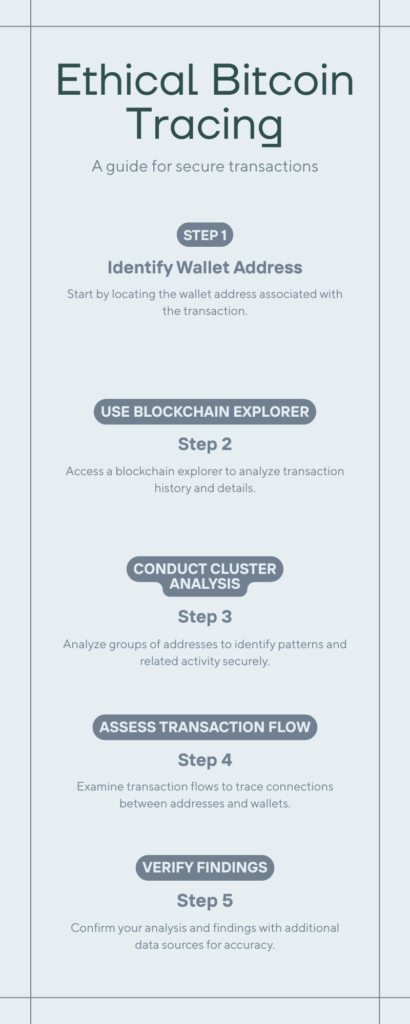
Tracing Bitcoin addresses isn’t about spying; it’s often used for legitimate purposes like compliance, research, or security.
Here’s how it works ethically:
Basic Tracing
Suppose you receive Bitcoin from the address “bc1qxy2kgdygjrsqtzq2n0yrf2493p83kkfjhx0wlh.”
Using a blockchain explorer, you can see its transaction history:
- past sends/receives,
- total balance, and
- connected addresses.
No names—just data.
Cluster Analysis (Ethical Use)
Tools like Chainalysis or Elliptic (used by law enforcement and researchers) group addresses by patterns.
For example, if multiple addresses send/receive from the same IP or exchange, they might belong to one entity.
Ethically, this helps track stolen funds (e.g., recovering from hacks like the 2022 Ronin Bridge exploit) without invading privacy.
Example Scenario
Imagine a charity accepts Bitcoin donations.
They publish their wallet address publicly.
Donors can verify on the blockchain that funds aren’t misused—transparency builds trust.
If traced ethically (with consent), it shows flow to legitimate causes.
Important:
Always respect privacy laws like GDPR.
Unethical tracing (e.g., doxxing) can lead to legal issues.
For personal use, stick to public explorers and avoid linking real identities without permission.
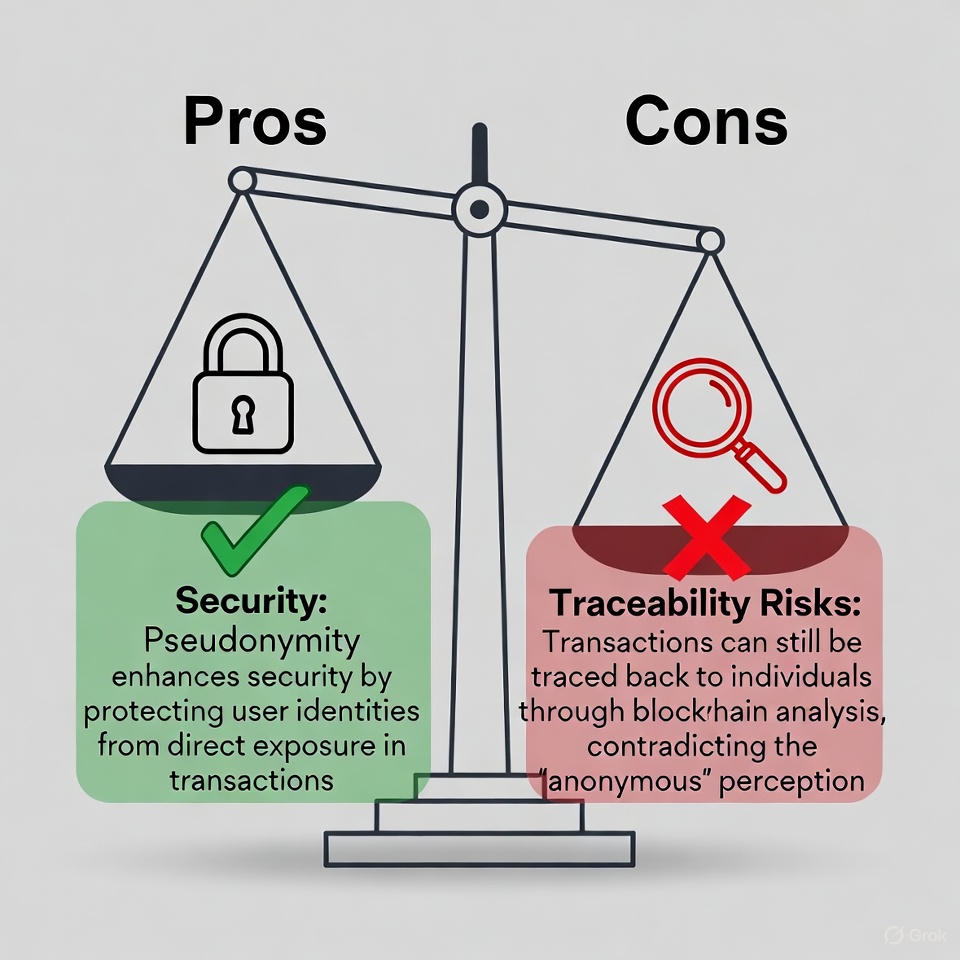
Pros and Cons of Bitcoin’s Pseudonymity
Like any system, Bitcoin’s approach has upsides and downsides.
Pros
- Enhanced Security: Public transparency makes fraud hard—everyone can audit the ledger.
- User Control: You can create new addresses for each transaction, adding privacy layers (like using different email aliases).
- Global Accessibility: No need for personal info to start, empowering users in restrictive regimes.
- Innovation Driver: Pseudonymity encourages adoption without full exposure, balancing privacy with accountability.
Cons
- Traceability Risks: Exchanges with KYC can link addresses to identities, making transactions traceable (e.g., for taxes or investigations).
- Limited True Privacy: Advanced analysis can de-anonymize users through patterns (e.g., timing, amounts).
- Misconceptions Lead to Mistakes: New users assuming full anonymity might overshare details, risking exposure.
- Regulatory Scrutiny: Governments push for more transparency, potentially eroding pseudonymity (e.g., EU’s MiCA regulations in 2025).
Busting Common Myths About Bitcoin Privacy
Myth 1: Bitcoin is Completely Anonymous.
Reality: As we’ve covered, it’s pseudonymous. True anonymity requires tools like mixers (e.g., CoinJoin) or privacy coins (e.g., Monero), but even those aren’t foolproof.
Myth 2: The Blockchain Hides Criminal Activity.
Reality: Transparency actually helps catch illicit use. In 2025, blockchain analytics have recovered billions in stolen crypto, proving the ledger’s double-edged sword.
Myth 3: You Can’t Be Traced at All.
Reality: If you link your address to real-world info (e.g., buying from a KYC exchange), traces are possible. Always use best practices like hardware wallets and VPNs.
Myth 4: Pseudonymity Means No Taxes.
Reality: Many countries (e.g., IRS in the US) require reporting crypto gains. Transparency aids enforcement.
Frequently Asked Questions (FAQs)
Q: How can I improve my Bitcoin privacy?
A: Use new addresses per transaction, avoid KYC exchanges for small amounts, and consider privacy-enhancing tools like Lightning Network for faster, off-chain transfers.
Q: Is Bitcoin safer than traditional banking for privacy?
A: It depends. Banks have full access to your data; Bitcoin gives you control but requires vigilance against tracing.
Q: Can governments ban pseudonymity?
A: They can regulate exchanges, but the blockchain’s decentralized nature makes full bans tough. In 2025, focus is on AML (anti-money laundering) compliance.
Q: What’s the difference between Bitcoin and privacy-focused coins?
A: Coins like Zcash use zero-knowledge proofs for true anonymity, while Bitcoin prioritizes transparency for security.
Q: How do I check a transaction without revealing myself?
A: Use public explorers anonymously via Tor or VPNs.
Conclusion: Embracing Bitcoin’s Balanced Privacy
Bitcoin’s pseudonymity strikes a smart balance: enough privacy to empower users, paired with transparency to build trust in a decentralized system.
It’s not perfect for absolute secrecy, but that’s by design—fostering accountability in a borderless economy.
As crypto evolves in 2025, understanding these nuances helps you navigate safely.
Whether you’re holding Bitcoin for investment or exploring affiliate opportunities in crypto (like on our site), knowledge is your best defense.
What are your thoughts on Bitcoin privacy?
Share in the comments below!
Disclaimer: This article is for educational purposes only and not financial advice. Crypto involves risks; always do your own research.