Most affiliate marketers never test anything.
Not because they don’t believe in testing. Because creating variations takes too long.
Writing three versions of a headline. Drafting two different calls to action. Rewriting an introduction four different ways.
Each one is its own creative task — and by the time you’ve done all that, you’ve spent more time on testing infrastructure than on the content itself.
AI removes that barrier completely.
Generating five headline variations now takes 30 seconds instead of 30 minutes.
Which means you can test more, learn faster, and make better decisions — without the time cost that used to make testing impractical.
This article gives you six prompts that generate ready-to-test variations for every element that affects your conversions.
You may also like:
- SEO Keyword Research Prompts (Finding Low-Competition Opportunities)
- Hook Writing Formulas (AI Prompts for Attention-Grabbing Openings)
- Negative Prompting: What NOT to Include (And Why It Matters)
What’s Actually Worth Testing
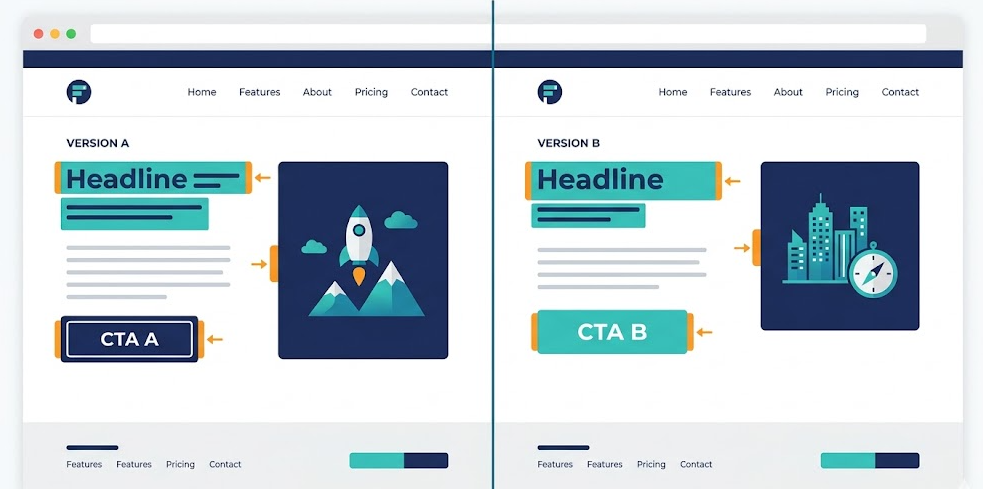
Not everything deserves a test. Testing low-impact elements wastes traffic and time.
High-impact elements worth testing:
Headlines and titles — the single biggest lever. A headline change can double or halve click-through rate. Test these first, always.
Opening hooks — the first 2-3 sentences determine whether readers stay. Different hooks attract different readers and create different moods for what follows.
Calls to action — the exact wording of your CTA changes conversion rate significantly. “Get the free guide” vs. “Download now” vs. “Show me how” — each creates a different psychological trigger.
Email subject lines — open rate is entirely dependent on the subject line. Everything else in the email is irrelevant if it never gets opened.
Meta descriptions — these directly affect click-through from search results. Different angles attract different searchers.
Lead magnets and offers — the framing of what you’re giving away changes sign-up rates dramatically even when the actual offer is identical.
Low-impact elements not worth testing early:
Button colors, font sizes, image placement — these are micro-optimizations. Don’t test them until the big elements are already optimized.
The V.A.R.Y. Framework

Four principles behind every effective variation prompt.
V — Volume: Generate more variations than you think you need. More options means a higher chance of finding a real winner.
A — Angle: Each variation should change the angle, not just rephrase the same idea. Different psychological triggers. Different reader emotions. Different implied promises.
R — Rationale: Know why each variation should work. Blind variation generation produces noise. Purposeful variation generation produces learning.
Y — Yield: Every test should produce a decision. Not just “B was slightly better” — but a clear principle you can apply to future content.
The 6 Prompts
Prompt 1: The Headline Variation Generator
Headlines first. Always.
Here is my current headline: [paste headline]
My article is about: [one sentence summary]
My target reader is: [describe them — their situation and goal]

Generate 10 headline variations using these distinct approaches:

1. CURIOSITY GAP — hints at a surprising answer without revealing it
2. SPECIFIC OUTCOME — leads with the exact result the reader gets
3. TIME-BOUND PROMISE — emphasizes speed or a specific timeframe
4. PROBLEM-FIRST — names the pain before the solution
5. CONTRARIAN — challenges a common belief in this space
6. SOCIAL PROOF ANGLE — implies others have succeeded with this
7. NUMBER-LED — leads with a specific number (if not already)
8. QUESTION FORMAT — turns the headline into a direct question
9. HOW-TO DIRECT — clear instructional promise
10. FEAR OF MISSING OUT — frames it around what they're losing by not knowing this

Label each variation with its approach.
Note which 3 you'd recommend testing first and why.
Ten variations in 30 seconds. Pick your top three. Run them as a test. The approach labels tell you what psychological lever each one pulls — which means when one wins, you know why.
Prompt 2: The CTA Variation Generator
The call to action is where intent becomes action. Small wording changes here have outsized effects.
My current call to action is: [paste your CTA]
The action I want the reader to take: [click, sign up, download, buy, etc.]
What they get by taking the action: [describe the value]
The reader's main hesitation before taking this action: [name it]

Generate 8 CTA variations using these psychological angles:

1. VALUE-FOCUSED — emphasizes what they get
2. ACTION-FOCUSED — emphasizes what they do (strong verb)
3. CURIOSITY-DRIVEN — makes them want to see what's on the other side
4. URGENCY — creates a sense of time pressure (without being fake)
5. EASE — emphasizes how simple or fast the action is
6. SOCIAL — implies others are doing this
7. PERSONALIZED — uses "my" instead of "your" (e.g. "Get my free guide")
8. OBJECTION-HANDLING — directly addresses the hesitation

Label each. Flag your top 3 picks with a one-line reason.
The “my” vs. “your” test (variation 7) consistently outperforms in many niches — but not all. This is exactly why you test instead of assume.
Prompt 3: The Email Subject Line Tester
Open rate lives and dies by the subject line. One test here affects every subscriber on your list.
My email is about: [describe the content and its main value]
My subscriber is: [describe your audience and their current situation]
The email's goal is: [drive traffic / promote offer / nurture / re-engage]

Generate 10 subject line variations across these styles:

1. DIRECT — states exactly what's inside
2. CURIOSITY — intrigues without revealing
3. PERSONAL — sounds like it came from a friend
4. NUMBER-LED — specific stat or list number
5. QUESTION — prompts them to think about their own situation
6. CONTRARIAN — challenges a common assumption
7. URGENCY — time-sensitive framing
8. BENEFIT-LED — leads with the outcome they'll get
9. STORY TEASE — hints at a narrative
10. RE-ENGAGEMENT — assumes they haven't been opening lately

Keep each under 50 characters where possible.
Mark which ones risk spam filters (all-caps, excessive punctuation, spam trigger words).
Recommend your top 3 for this specific audience and goal.
The spam filter note is practical. Subject lines that trigger filters never get tested — they just disappear. Always check before deploying.
Prompt 4: The Opening Hook Variation Generator
Different readers respond to different emotional entry points. Testing hooks tells you which emotion resonates most with your specific audience.
My article topic is: [topic]
My target reader's main frustration is: [describe it specifically]
My current opening is: [paste it — or write "none yet"]

Generate 5 opening hook variations using these emotional entry points:

1. FRUSTRATION — meets them in the pain of where they are right now
2. ASPIRATION — meets them in the excitement of where they want to be
3. CURIOSITY — opens with something surprising or counterintuitive
4. AUTHORITY — establishes credibility through a specific data point or insight
5. STORY — drops into a relatable moment without setup

Each hook: 2-3 sentences maximum.
No fluff. No "In this article..."
First word of each hook should be strong — not "The", "In", or "If".

Label each with its emotional approach.
Hook testing doesn’t just improve the article you’re testing. It reveals which emotional angle your audience responds to — and that insight shapes every piece of content you write afterward.
Prompt 5: The Meta Description Variation Generator
Meta descriptions don’t affect rankings. They directly affect whether searchers click.
My article title is: [title]
My target keyword is: [keyword]
My article's main promise to the reader: [what they'll learn or get]
My target reader's main hesitation before clicking: [what makes them scroll past]

Write 6 meta description variations under 155 characters each:

1. BENEFIT-FOCUSED — leads with the outcome they'll get
2. CURIOSITY GAP — hints at something surprising inside
3. PROBLEM-SOLUTION — names their problem, promises the fix
4. SPECIFIC AND NUMBERED — uses concrete details to signal depth
5. DIRECT CHALLENGE — calls out a behavior or assumption
6. SOCIAL PROOF — implies results others have gotten

Include the target keyword naturally in each version.
Mark the character count for each.
Flag any over 155 characters.
Character counts matter here — descriptions over 155 characters get truncated in search results, cutting off your message mid-sentence. Always check.
Prompt 6: The Variation Analysis Prompt
After running a test, extract the learning — not just the winner.
Here were my A/B test variations: [list them]
Here are the results: [winner, metrics — click rate, open rate, conversion rate]

Analyze what this test tells me:

1. WHY DID THE WINNER WIN?
   — What psychological principle does the winning variation use
     that the others don't?

2. WHAT DOES THIS TELL ME ABOUT MY AUDIENCE?
   — What does the winning angle reveal about what my readers
     respond to emotionally?

3. WHAT SHOULD I APPLY IMMEDIATELY?
   — Which other headlines, CTAs, or content should I update
     based on this result?

4. WHAT SHOULD I TEST NEXT?
   — Based on what we learned, what's the most valuable next test?

5. WHAT WOULD CHANGE THIS RESULT?
   — Is there a different audience segment or traffic source where
     the loser might actually win?
This is the prompt most people never run. They declare a winner and move on. But the real value of a test isn’t the winning variation — it’s the principle the winner reveals. This prompt extracts that principle and turns one test into a compounding asset.
Building a Testing Habit
Testing works as a system, not as a one-off.
One element at a time. Never test headlines and CTAs simultaneously. You won’t know which change drove the result.
Minimum viable sample. For most affiliate sites, wait for at least 200-300 clicks per variation before calling a winner. Small samples produce false positives.
Document everything. Keep a simple log: what you tested, what won, what it taught you. After ten tests, patterns emerge. Those patterns become your editorial instincts.
Prioritize high-traffic pages. Tests on pages with 50 visitors a month take forever to reach significance. Test your highest-traffic pages first — you’ll get results faster and the wins will compound more.
The Bottom Line
The marketers with the best conversion rates aren’t guessing better than you.
They’re testing more than you.
AI removes the last excuse for not testing — the time cost of creating variations. Six prompts. Dozens of variations. Generated in minutes, not hours.
Pick one element. Generate variations today. Run the test this week.
One winning headline on your top article is worth more than ten new articles on topics you haven’t validated.