You may also like:
- How to Write Product Reviews Using AI (Without Sounding Robotic)
- How to Prompt AI for 3000+ Word Articles
- Negative Prompting (What NOT to Include And Why It Matters)
You got someone to join your email list.
Great start.
Now what?
Most affiliate marketers send random emails whenever they feel like it.
Or they blast promotional content immediately and watch their unsubscribe rate spike.
There’s a better way.
A strategic 7-email sequence that builds trust, delivers value, and positions your offer naturally.
Today, you’ll get the exact prompts to generate each email in the sequence.
Not theory. Templates.
Let’s build your conversion sequence.
Why 7 Emails?
Why not 3? Why not 10?
Seven emails is the sweet spot for affiliate marketing sequences.
Too few (3-4 emails): Not enough time to build trust before asking for a sale.
Too many (10-15 emails): People lose interest. Your open rates drop off a cliff.
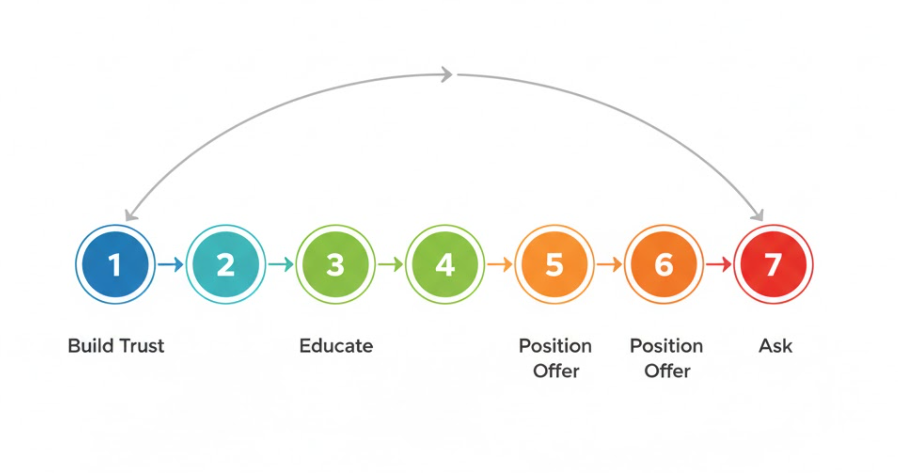
Seven emails hits the rhythm:
- Email 1-2: Build trust, establish value
- Email 3-4: Educate on the problem and solution
- Email 5-6: Position your offer as the best solution
- Email 7: Clear ask with urgency
The sequence creates a natural progression from “Who are you?” to “Take my money.”
That progression takes exactly seven strategic touchpoints.
The Strategic Framework
Before the prompts, understand the psychology.
Each email has a specific job in the sequence.
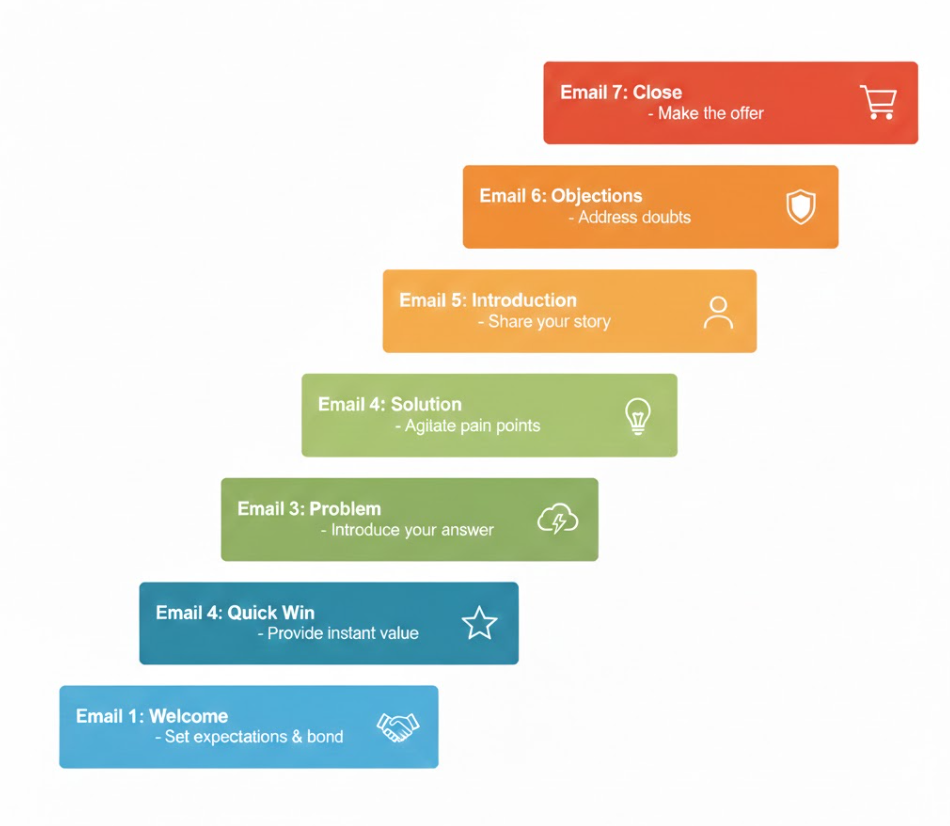
Email 1: The Welcome Job: Make them feel good about joining. Set expectations.
Email 2: The Quick Win Job: Deliver immediate value so they open Email 3.
Email 3: The Problem Awareness Job: Help them understand their problem more clearly.
Email 4: The Solution Framework Job: Show them what’s possible and how solutions work.
Email 5: The Soft Introduction Job: Introduce your affiliate offer naturally, as the best solution.
Email 6: The Objection Handler Job: Address the top 3 reasons people hesitate to buy.
Email 7: The Closing Ask Job: Create urgency and make the ask directly.
Each email builds on the previous one.
Skip one, and the sequence breaks.
Email 1: The Welcome
This email sets the tone for everything that follows.
Get it wrong, and people never open Email 2.
The Welcome Email Prompt
Write a welcome email for new subscribers who just downloaded [lead magnet name] about [topic].

TONE: Warm, personal, not salesy

STRUCTURE:
- Subject line: Welcome them personally
- Opening: Thank them for joining, acknowledge their download
- Middle: Tell them what to expect from these emails (frequency, value they'll get)
- Transition: Briefly introduce yourself (one personal detail that builds credibility)
- Close: Set expectation for next email (coming in [timeframe]) and what it will contain

LENGTH: 200-250 words

KEY RULES:
- No hard sell in this email
- Make them feel good about their decision to join
- Set clear expectations (when will they hear from you, what will you send)
- End with a question or reply prompt to encourage engagement
Example Output Structure
Subject: Welcome! Here’s your [lead magnet] + what happens next
Body: Hey [Name],
Thanks for grabbing the [lead magnet name]. It should be in your inbox now (check spam if you don’t see it).
Over the next 7 days, I’m sending you an email sequence that goes deeper into [topic]. No fluff. No constant selling. Just practical [specific value they’ll get].
Quick intro: I’m [your name]. I’ve been [brief credibility statement — one sentence max]. I know exactly what it’s like to [relate to their problem].
Tomorrow, I’m sending you [specific next email preview]. It’s the first thing I wish someone had told me when I started.
Talk soon, [Your name]
P.S. These emails are short. I respect your inbox.
Email 2: The Quick Win
People need a win fast.
Give them something they can use immediately.
This builds trust and ensures they open Email 3.
The Quick Win Email Prompt
Write the second email in my welcome sequence. The first email welcomed them.
This email delivers immediate, actionable value.

LEAD MAGNET THEY DOWNLOADED: [describe it]
AUDIENCE: [who they are, their main problem]

GOAL: Give them one quick, practical tip they can implement today

STRUCTURE:
- Subject line: Promise a specific quick win
- Opening: Reference the welcome email briefly ("Yesterday I welcomed you...")
- Main content: One clear, actionable tip with specific steps (3-5 steps maximum)
- Why this matters: Brief explanation of the benefit
- Close: Tease tomorrow's email (which goes deeper)

LENGTH: 250-300 words

KEY RULES:
- Focus on ONE thing they can do today
- Make it achievable in under 30 minutes
- No product mentions yet
- Build momentum with a small win
Example Output Structure
Subject: The 15-minute [specific outcome] trick
Body: Yesterday I welcomed you to the list.
Today, I’m giving you something you can use right now.
If you do nothing else this week, do this:
[ONE SPECIFIC ACTIONABLE TIP — 3-5 clear steps]
Why this works: [brief explanation of the mechanism/benefit]
I learned this the hard way after [brief personal anecdote showing you’ve done this].
Tomorrow, I’m sending you the framework that takes this quick win and turns it into a complete system.
[Your name]
Email 3: The Problem Awareness
Now you’ve built some trust.
Time to help them understand their problem more deeply.
This creates the “aha moment” that makes your solution obvious.
The Problem Awareness Email Prompt
Write the third email in my sequence. So far, I've welcomed them and given them a quick win.

This email helps them see their problem more clearly.

AUDIENCE PROBLEM: [their main pain point]
WHAT THEY USUALLY MISS: [the hidden aspect of the problem they don't see]

GOAL: Help them realize why their current approach isn't working

STRUCTURE:
- Subject line: Curious question or surprising statement about the problem
- Opening: "You tried [common approach], right?"
- Problem deepening: Explain why the obvious solution doesn't work (be specific about what fails)
- The real issue: Reveal the hidden cause they haven't considered
- Hope: Hint that there's a better way (which you'll share tomorrow)
- Close: Ask if this resonates with their experience

LENGTH: 300-350 words

KEY RULES:
- Don't be negative, be enlightening
- Show you understand their frustration
- The "hidden cause" should be a genuine insight, not manufactured
- Still no product pitch
Example Output Structure
Subject: Why [common approach] keeps failing you
Body: You’ve tried [common approach], right?
Everyone does. It’s the obvious answer to [problem].
But here’s what happens: [describe the typical failure pattern]
I did the same thing. For [timeframe], I kept [specific behavior] thinking it would eventually work.
It didn’t.
Here’s why: [reveal the hidden cause — the real reason the obvious approach fails]
Most people don’t realize [specific insight]. They keep doing [ineffective behavior] because they think the problem is [wrong assumption].
The actual problem is [real cause].
Once I understood this, everything changed.
Tomorrow, I’m breaking down the framework that actually works when you account for [that real cause].
Does this pattern sound familiar to you? Hit reply and let me know.
[Your name]
Email 4: The Solution Framework
They understand the problem.
Now show them what the solution looks like.
Still not selling. Just educating on what actually works.
The Solution Framework Email Prompt
Write the fourth email. They now understand the problem deeply.
This email introduces the solution framework without selling anything yet.

THE PROBLEM THEY NOW UNDERSTAND: [recap]
THE SOLUTION APPROACH: [your framework/method]

GOAL: Show them what works and why it works

STRUCTURE:
- Subject line: "Here's what actually works for [outcome]"
- Opening: Reference their problem from Email 3
- The framework: Present 3-4 key principles of what works (not specific tools yet)
- Why this works: Explain the logic behind the framework
- Proof: Brief example or result (yours or someone else's)
- Tomorrow preview: You'll show them the best tool/resource for implementing this

LENGTH: 350-400 words

KEY RULES:
- Focus on the approach, not specific products
- Make the framework feel achievable, not overwhelming
- Create desire for implementation without naming your affiliate product yet
- Build curiosity about "how" to do this
Example Output Structure
Subject: The [Framework Name] that changed everything
Body: Yesterday I explained why [common approach] fails.
Today: what actually works.
I call it [Framework Name]. It has [number] key principles:
Why does this work when [common approach] doesn’t?
[Explanation of the mechanism — why this addresses the real problem you identified in Email 3]
When I started using this framework, [specific result in specific timeframe].
[Optional: Brief testimonial or case study from someone else]
The challenge most people face: knowing this framework is one thing, implementing it is another.
Tomorrow, I’m showing you the exact tool I use to implement this framework. It’s the difference between understanding this intellectually and actually doing it.
[Your name]
Email 5: The Soft Introduction
This is where you introduce your affiliate product.
But softly. As a helpful recommendation, not a sales pitch.
The Soft Introduction Email Prompt
Write the fifth email. They understand the problem and the solution framework.
Now introduce the affiliate product as the best way to implement that framework.

THE FRAMEWORK FROM EMAIL 4: [describe it]
AFFILIATE PRODUCT: [product name and what it does]
WHY IT'S THE BEST FIT: [specific reasons this product implements the framework]

GOAL: Introduce the product naturally as your implementation tool of choice

STRUCTURE:
- Subject line: "The tool I use for [outcome]"
- Opening: Recap the framework, transition to implementation
- The recommendation: Introduce the product by name, explain what it does
- Why this one: 2-3 specific reasons this product fits the framework perfectly
- Personal experience: How long you've used it, what results you've seen
- Not a hard sell: Make it a recommendation, not a pitch
- Link: Include affiliate link naturally ("If you want to check it out, here's where I got it")
- Tomorrow preview: You'll address common questions and concerns

LENGTH: 350-400 words

KEY RULES:
- Position yourself as a user sharing what works, not a salesperson
- Be specific about why this product (not just "it's good")
- Include the affiliate link but don't push hard
- Make it clear this is a recommendation, they can implement the framework other ways too
Example Output Structure
Subject: This is the tool I use (and why)
Body: So you know the [Framework Name] from yesterday.
Now: how do I actually implement it?
I use [Product Name].
Here’s what it does: [2-3 sentence clear explanation]
Why this one specifically?
- [Specific reason tied to framework principle]
- [Specific reason tied to framework principle]
- [Specific feature that solves a common implementation problem]
I’ve been using it for [timeframe]. [Specific result you’ve achieved].
It’s not the only way to implement [framework], but it’s the most [specific advantage — straightforward, comprehensive, beginner-friendly, etc.].
If you want to check it out, here’s where I got it: [affiliate link]
Tomorrow, I’m answering the three most common questions people have before they commit to [product category]. If you’re on the fence, that email will help.
[Your name]
Email 6: The Objection Handler
People are interested but hesitant.
Address their objections directly.
This email moves fence-sitters toward a decision.
The Objection Handler Email Prompt
Write the sixth email. They've seen the product recommendation but haven't bought yet.
This email addresses the top objections preventing purchase.

PRODUCT: [name]
TARGET AUDIENCE: [who they are]

COMMON OBJECTIONS FOR THIS AUDIENCE:
1. [Objection 1 — e.g., "It's too expensive"]
2. [Objection 2 — e.g., "I don't have time to learn a new tool"]
3. [Objection 3 — e.g., "What if it doesn't work for me?"]

GOAL: Address each objection honestly and directly

STRUCTURE:
- Subject line: "3 questions before you try [product name]"
- Opening: "A few people asked me about [product]. Here are the honest answers."
- Objection 1: State it, address it with specific information
- Objection 2: State it, address it with specific information
- Objection 3: State it, address it with specific information
- Closing: Remind them of the link, mention tomorrow is last email
- No pressure: Make it clear they should only get it if it fits their situation

LENGTH: 400-450 words

KEY RULES:
- Don't dismiss objections, address them respectfully
- Use specific information (exact costs, time investments, refund policies)
- Be honest about who this IS and ISN'T right for
- Include affiliate link again but keep it low-pressure
Example Output Structure
Subject: 3 questions before you try [product name]
Body: A few people replied to yesterday’s email with questions about [product name].
Here are the honest answers.
“Isn’t it expensive?”
[Current price]. Compared to [alternative approach], it’s [comparison]. The way I think about it: [cost-benefit framing specific to your audience].
“Do I have time to learn another tool?”
Setup takes [specific time]. Getting comfortable with the core features takes [specific time]. You don’t need to master everything immediately—just [specific starting point] gets you [specific results].
“What if it doesn’t work for me?”
They have a [number]-day refund policy. [Specific conditions if any]. I’d suggest [specific trial/test approach].
Look, this isn’t right for everyone. If [specific situation], you probably don’t need it yet. But if [specific situation], this is the fastest path to [specific outcome].
Here’s the link again if you want to check it out: [affiliate link]
Tomorrow is my last email in this sequence. I’m talking about what happens after you implement [the framework]—the next-level challenge nobody warns you about.
[Your name]
Email 7: The Closing Ask
Final email in the sequence.
Create urgency and make a direct ask.
The Closing Ask Email Prompt
Write the seventh and final email in the sequence.
Time to close with urgency and a clear call to action.

THE JOURNEY SO FAR: They've learned the problem, the framework, seen the tool, had objections addressed
THE OFFER: [product name]
URGENCY ELEMENT: [time-limited bonus, price increase, limited spots, or deadline]

GOAL: Create urgency and get a decision

STRUCTURE:
- Subject line: Creates urgency without being clickbait
- Opening: "This is my last email in the sequence. Here's what happens next."
- Recap the value: Briefly summarize the framework and opportunity
- The urgency: Explain the time-sensitive element (be honest)
- The ask: Direct call to action — clear what they should do
- What's next: Explain what happens if they join vs. if they don't
- Final note: You'll still email them (but less frequently) even if they don't buy

LENGTH: 300-350 words

KEY RULES:
- Create real urgency, don't manufacture fake scarcity
- Be direct about what you're asking them to do
- Make it clear what happens next either way
- End on a high note regardless of their decision
Example Output Structure
Subject: Last call: [specific outcome] by [timeframe]
Body: This is my last email in the sequence.
Over the past week, I’ve shown you:
- Why [common approach] fails
- The [Framework Name] that works
- How [product name] implements it perfectly
Here’s the thing: [Specific urgency element — e.g., “The current pricing goes up on Friday,” “The bonus I negotiated expires tonight,” “They’re closing enrollment in 48 hours”]
If you’ve been on the fence, now’s the time to decide.
Here’s what happens if you join: [Specific outcome/benefit in specific timeframe]
Here’s what happens if you don’t: [Realistic consequence — not fear-mongering, just honest about the status quo]
The link: [affiliate link]
What happens next:
I’ll keep sending you emails, but less frequently. Probably once a week with [type of content you’ll send]. No hard feelings if [product] isn’t right for you right now.
But if you’re ready to [specific outcome], this is how you do it.
[Your name]
P.S. [Specific reminder or final benefit statement]
Timing and Delivery Schedule
When should each email send?
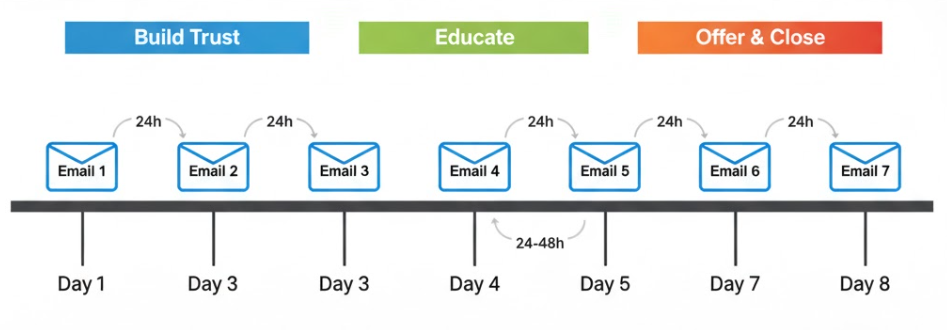
Recommended Schedule:
- Email 1: Immediately upon signup (welcome)
- Email 2: 24 hours after Email 1
- Email 3: 24 hours after Email 2
- Email 4: 24 hours after Email 3
- Email 5: 24-48 hours after Email 4 (give them time to think)
- Email 6: 24 hours after Email 5
- Email 7: 24 hours after Email 6
Total sequence: 7-8 days from signup to close.
Why this timing?
Daily emails build momentum. They stay engaged.
The 24-48 hour gap before Email 5 (the product introduction) lets them digest the framework before seeing the recommendation.
After the sequence ends, drop to once-per-week emails with valuable content and occasional promotional emails.
Customizing the Prompts for Your Niche
These prompts are templates.
Customize them for your specific situation.
Replace these placeholders every time:
- [lead magnet name] → Your actual freebie
- [topic] → Your specific niche
- [audience] → Who exactly you serve
- [problem] → Their specific pain point
- [framework] → Your approach/method
- [product name] → Your affiliate offer
- [timeframe] → Actual time periods
- [specific outcome] → Concrete result they want
The more specific your replacements, the better the output.
Example:
Generic: “Write for someone interested in making money online”
Specific: “Write for a 28-year-old corporate employee who wants to build a side income through affiliate marketing but only has 5-7 hours per week and feels overwhelmed by all the conflicting advice”
Specific wins every time.
Testing and Improving Your Sequence
Your first sequence won’t be perfect.
Track these metrics:
Email Performance:
- Open rates (which subject lines work)
- Click rates (which CTAs work)
- Unsubscribe rates (where people drop off)
Sequence Performance:
- Percentage who reach Email 7
- Conversion rate (signups to sales)
- Revenue per subscriber
After 100 subscribers through the sequence:
Identify your weakest email (lowest open rate or highest drop-off).
Rewrite just that one email.
Test the new version for the next 100 subscribers.
Improve one email at a time.
Over months, you’ll have a sequence that converts significantly better than your first version.
The Bottom Line
Most affiliate marketers wing their email sequences.
You now have the exact prompts to build a strategic 7-email sequence that:
- Builds trust before asking for anything
- Educates on the problem and solution
- Introduces your offer naturally
- Handles objections directly
- Closes with urgency
Use these prompts. Customize them for your niche.
Test and refine over time.
Your email list becomes your most valuable asset.
But only if you actually nurture it strategically.
That’s what this sequence does.