You may also like:
- Negative Prompting: What NOT to Include (And Why It Matters)
- Context Windows Explained (How Much Information Can AI Actually Remember)
- Advanced Prompt Techniques: Constraints, Personas, and Output Control
What if you didn’t have to write prompts at all?
What if AI wrote them for you?
That’s meta-prompting.
And it’s one of the most powerful — and least talked about — techniques in prompt engineering right now.
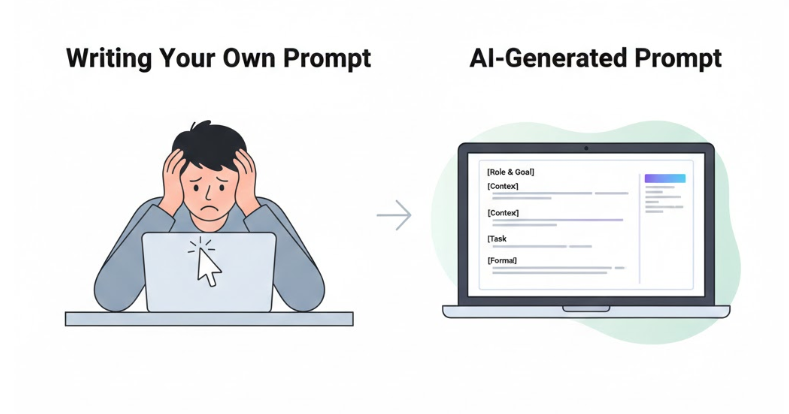
Most people spend hours crafting the perfect prompt.
Testing it. Tweaking it. Wondering why the output still isn’t quite right.
Meta-prompting flips the entire process.
Instead of writing prompts yourself, you teach AI to generate, evaluate, and improve prompts on your behalf.
You become the director. AI becomes both the writer and the critic.
The result? Better prompts than you’d ever write manually. Faster. Consistently.
This is cutting-edge territory. Not many affiliate marketers are using this yet.
That means opportunity.
Let’s go deep.
What Is Meta-Prompting?
The word “meta” means “about itself.”
Meta-prompting is prompting about prompting.
You use AI to generate, analyze, refine, and optimize the very prompts you’ll later use to create content.
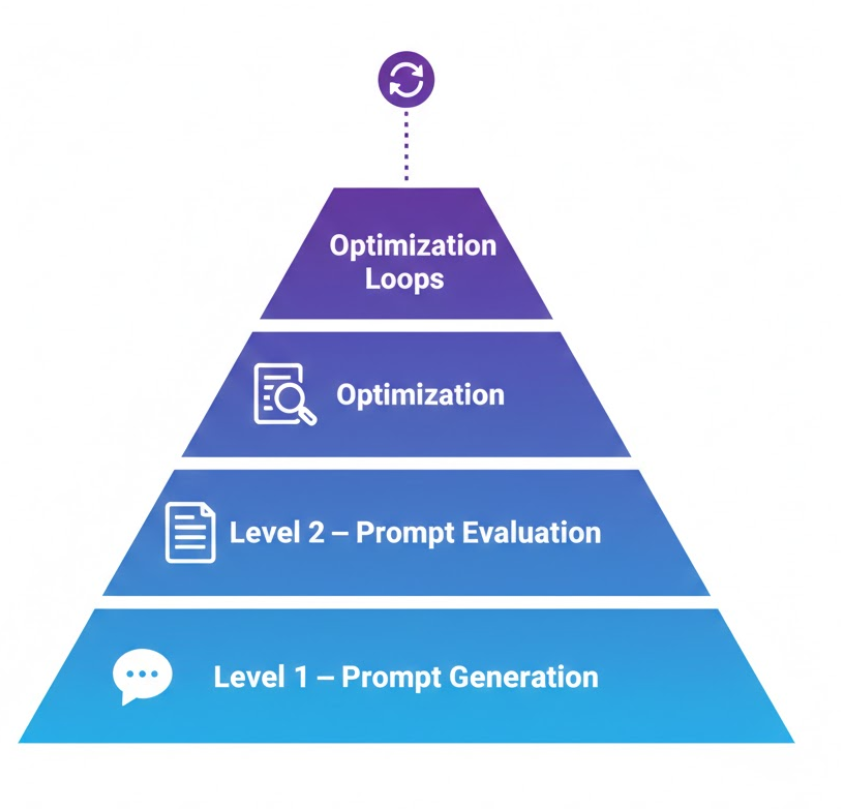
There are three core ways this works.
Level 1: Prompt Generation You describe what you want to achieve. AI writes the prompt to achieve it.
Level 2: Prompt Evaluation You give AI an existing prompt. AI analyzes its weaknesses and suggests improvements.
Level 3: Prompt Optimization Loops AI generates a prompt, tests it, evaluates the output, refines the prompt, tests again. Automatically. Repeatedly.
Most people only know Level 1 exists.
By the end of this article, you’ll be using all three.
Why This Matters More Than You Think
Here’s an uncomfortable truth.
Most affiliate marketers are terrible at writing prompts.
Not because they’re not smart.
Because writing good prompts requires a deep understanding of how AI processes language, what it needs to produce quality output, and where most requests break down.
That’s a specialist skill set.
Meta-prompting lets you access that expertise without having it yourself.
Think of it this way.
You wouldn’t design your own logo just because you have access to Photoshop.
You’d hire a designer who understands visual communication principles.
Meta-prompting is hiring AI as your prompt designer.
It already understands exactly what it needs to produce great output.
So why not ask it to write its own instructions?
The answer, almost always, is better than what you’d write yourself.
Level 1: Getting AI to Write Your Prompts
This is the entry point.
Simple. Immediate. Valuable.
The Basic Meta-Prompt Formula:
I need to create [specific content type] for [specific purpose].
My audience is [audience description].
The output should [key requirements].

Write me an optimized prompt I can use to generate this content.
Include all necessary context, constraints, tone instructions,
and output format specifications.
Let’s see this in action.
Your Meta-Prompt:
I need to create product review articles for affiliate marketing.
My audience is beginners exploring home office equipment — they
don't understand tech specs but care deeply about comfort,
productivity, and value for money.

The output should be conversational, honest, around 700 words,
and include a clear recommendation at the end.

Write me an optimized prompt I can use to generate this content
for any home office product I paste in.
What AI Produces: A complete, detailed prompt with persona definitions, content constraints, structural requirements, tone guidelines, and output formatting — everything you’d spend 30 minutes figuring out on your own.
And here’s the key insight.
AI writes this prompt knowing exactly what information it needs to produce quality output.
You’re asking the chef to write the recipe. Not the customer.
Taking It Further: Specialty Prompt Generation
Don’t just ask for generic prompts.
Ask for prompts tailored to specific tactical situations.
For comparison articles:
Generate an optimized prompt for creating a comparison article
between two competing products. The comparison needs to feel
balanced and trustworthy, not like a sales pitch. It should
help undecided readers make a confident decision.
For email sequences:
Generate a prompt for writing a 5-email welcome sequence for
new subscribers who just downloaded a free lead magnet about
[topic]. They know nothing about our products yet. Build trust
before selling anything.
For SEO content:
Generate a prompt for writing a blog post that naturally
incorporates a target keyword without keyword stuffing. The
post should read like a helpful article, not an SEO piece.
Target keyword: [your keyword]. Audience: [your audience].
Each of these produces a ready-to-use, professionally structured prompt.
Not a rough starting point. A finished tool.
Level 2: Getting AI to Evaluate and Improve Your Prompts
You have an existing prompt.
It works okay. But results aren’t consistent.
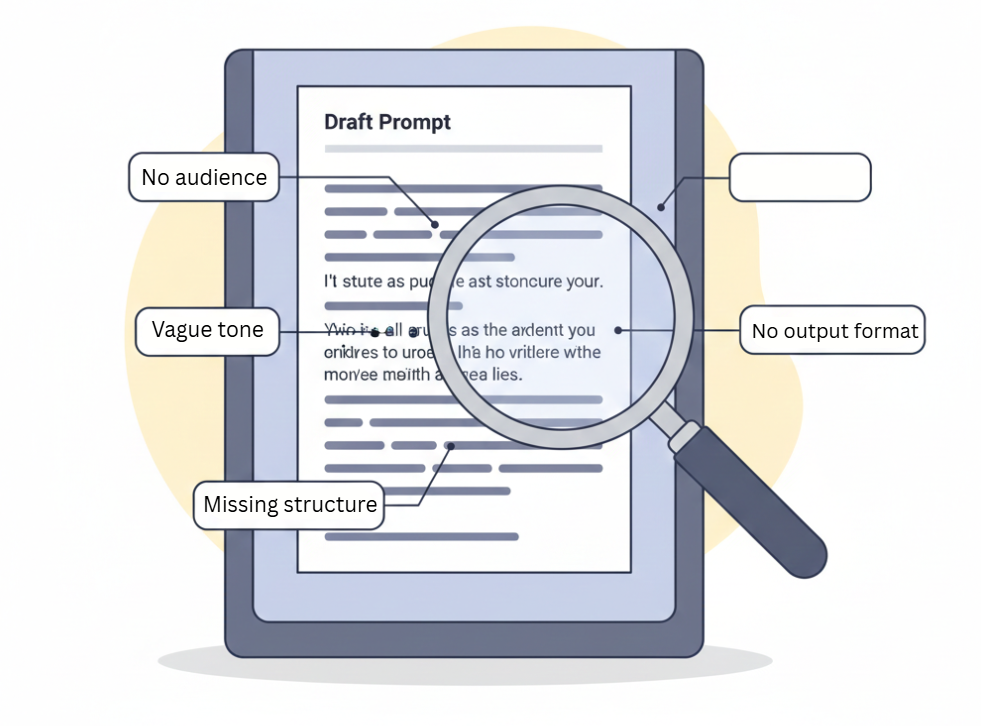
Level 2 meta-prompting uses AI to diagnose exactly what’s wrong and how to fix it.
The Prompt Evaluation Formula:
Here is a prompt I've been using:

[PASTE YOUR PROMPT]

Please analyze this prompt for weaknesses.
Specifically evaluate:
1. Clarity — Is the instruction unambiguous?
2. Context — Is enough background provided?
3. Constraints — Are requirements specific enough?
4. Output format — Is the desired structure clear?
5. Potential failure points — Where might AI misinterpret this?

Then rewrite an improved version addressing all weaknesses you found.
This is like hiring a prompt engineer to audit your work.
Except it’s free and takes 30 seconds.
Real Evaluation Example
Your current prompt (weak version): “Write a product review for [product name] that’s honest and helpful for buyers.”
After evaluation, AI might identify:
- No audience definition (honest and helpful for who?)
- No length or structure requirement
- No guidance on what “honest” means (mention flaws? How many? How directly?)
- No CTA or recommendation format
- Tone undefined — “helpful” means different things in different contexts
- No instruction on whether to compare to alternatives
AI’s improved version:
You are an experienced affiliate marketer writing for first-time
buyers of [product category] who are cautious about spending
money online. They've been burned before by overhyped reviews.

Review [product name] with these specifications:

LENGTH: 650-750 words
STRUCTURE:
- Opening (75 words): Hook with the main problem this product solves
- What You Get (150 words): Core features explained in plain English,
  no spec sheets
- Real-World Performance (200 words): How it performs in actual daily
  use — include one specific limitation honestly
- Who It's For / Who It's Not For (100 words): Clear segmentation
- Verdict (100 words): Direct recommendation with confidence level

TONE: Trustworthy friend, not salesperson. Never use words like
"amazing," "game-changer," or "must-have." If there's a drawback,
state it plainly.

OUTPUT: Provide article only, no meta-commentary.
Same intent. Completely different quality ceiling.
That’s what evaluation delivers.
The Comparative Evaluation Method
Take this one level further.
Run two different prompts and ask AI to compare their effectiveness before you use either.
Here are two prompts for the same task. Which will produce
better output and why? Identify the specific strengths and
weaknesses of each. Then create a version that combines the
best elements of both.

Prompt A: [paste prompt A]
Prompt B: [paste prompt B]
This is especially useful when you’ve been iterating and aren’t sure which version is actually stronger.
Level 3: Prompt Optimization Loops
This is where meta-prompting becomes genuinely advanced.
You’re not just generating or evaluating prompts.
You’re creating a self-improving system.
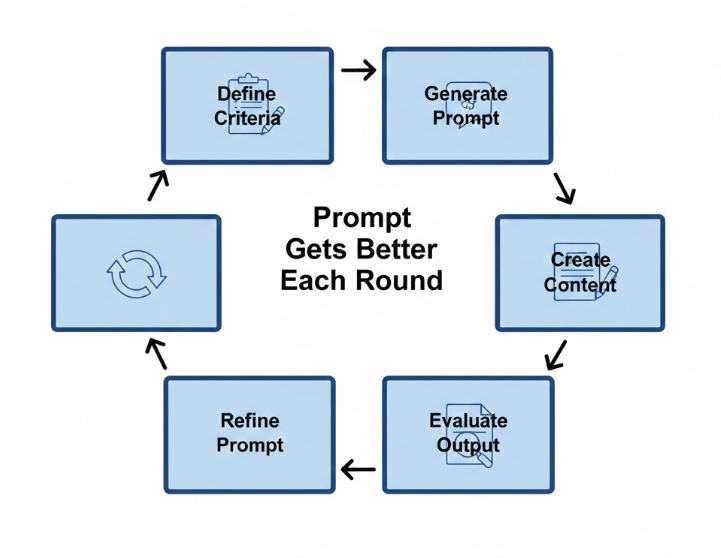
The concept: AI generates a prompt, uses it to create content, evaluates that content against your criteria, identifies where the prompt caused the failure, refines the prompt, and repeats.
It’s a feedback loop where the prompt itself is the thing being optimized.
Here’s how to run one manually.
The Optimization Loop Protocol
Step 1: Define your success criteria clearly
Before anything else, write down what “perfect output” looks like.
Success criteria for this product review:
- Reads like it was written by a real user, not a marketer
- Mentions exactly one genuine limitation of the product
- Ends with a clear, specific recommendation (not "it depends")
- Contains zero marketing clichés
- Under 700 words
- Someone reading it could make a confident purchase decision
This is your benchmark. Every loop measures against it.
Step 2: Generate an initial prompt
Based on these success criteria: [paste criteria]
Generate an optimized prompt for writing product reviews.
Step 3: Use the prompt to generate content
Run the generated prompt on a real product.
Step 4: Evaluate the output against criteria
Here is a product review generated using this prompt: [paste prompt]

Review generated: [paste output]

Success criteria: [paste criteria]

Evaluate the review against each criterion. Score each 1-10.
Identify specifically which elements of the prompt caused
any criteria to score below 8. Be precise — point to the
exact prompt language that led to the failure.
Step 5: Refine the prompt
Based on your evaluation, rewrite the prompt to address the
specific failures identified. Explain what you changed and why.
Step 6: Repeat
Run the new prompt. Evaluate again. Refine again.
Three to four loops typically produces a prompt that consistently hits all criteria.
That prompt becomes a permanent asset in your library.
Why Optimization Loops Are Worth the Effort
One hour building an optimized prompt through loops.
Saves ten minutes of editing on every single piece of content you create with it.
If you publish 200 reviews per year, that’s over 33 hours saved.
From one optimization session.
The math on meta-prompting is extraordinary.
Advanced Meta-Prompting Techniques
Once you’re comfortable with the three levels, these techniques extend your capability significantly.
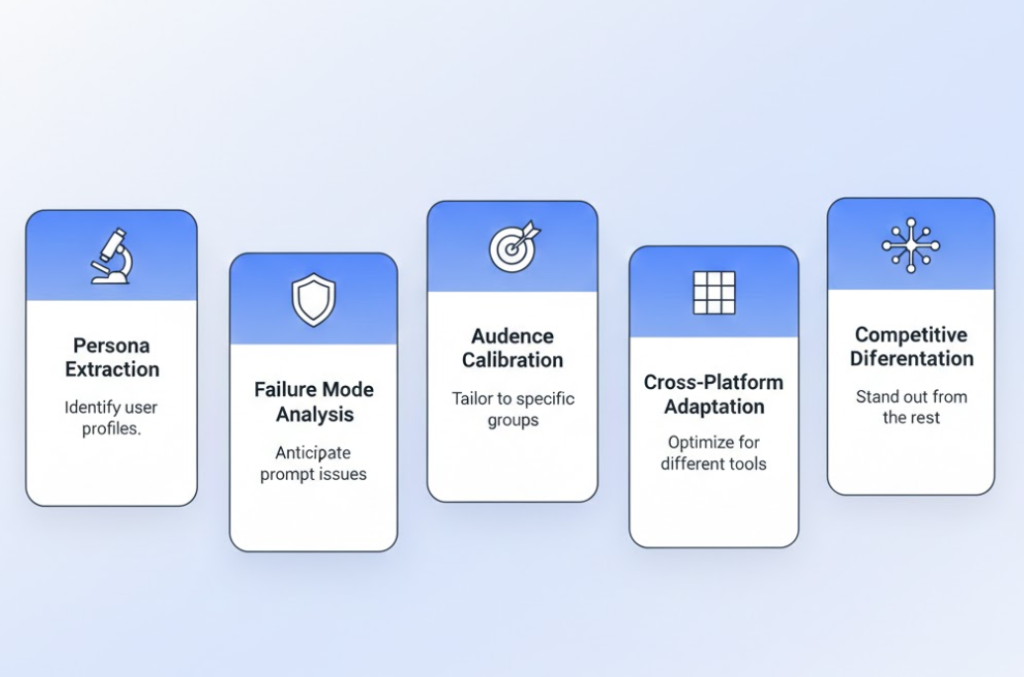
Technique 1: The Persona Extraction Method
Don’t just ask AI to write a prompt.
Ask it to extract the ideal prompt from high-quality examples.
Here are three product reviews I consider excellent:

Review 1: [paste]
Review 2: [paste]
Review 3: [paste]

Analyze what makes these reviews effective. Identify the
structural patterns, tonal qualities, content elements,
and writing techniques they share.

Then write a prompt that would reliably produce content
at this quality level — capturing everything you observed.
AI reverse-engineers quality.
You give it the destination. It figures out the directions.
Technique 2: The Failure Mode Analysis
Most prompts fail in predictable ways.
Use AI to anticipate failures before they happen.
Here is a prompt I plan to use: [paste prompt]

Before I use it, predict the 5 most likely failure modes.
For each failure mode:
1. Describe exactly what the bad output would look like
2. Explain which part of the prompt causes this failure
3. Suggest a specific fix

Then provide a revised prompt incorporating all fixes.
This turns reactive editing into proactive prompt design.
You fix problems that haven’t happened yet.
Technique 3: The Audience Calibration Test
Your prompt might be technically good but wrong for your audience.
I've written this prompt for my target audience: [paste prompt]

My audience is: [detailed description]

Evaluate whether this prompt will produce content that
genuinely resonates with this specific audience. Identify:
- Any assumptions the prompt makes that don't fit this audience
- Missing context this audience specifically needs
- Tonal elements that will feel wrong to this reader
- What this audience needs to hear that the prompt doesn't include

Rewrite the prompt calibrated precisely for this audience.
Technique 4: The Cross-Platform Adaptation
You have one great prompt. You need it to work across multiple formats.
Here is an optimized product review prompt that works well
for long-form blog articles: [paste prompt]

Adapt this prompt for each of the following formats while
preserving everything that makes it effective:

1. Email newsletter version (300 words, personal tone)
2. Social media carousel (7 slides, punchy headlines)
3. YouTube script intro (90 seconds spoken word)
4. Comparison table entry (50 words per product)

For each adaptation, explain what you changed and why.
One prompt becomes four.
Your content system scales without starting from scratch.
Technique 5: The Competitive Differentiation Prompt
Use meta-prompting to stand out in saturated niches.
Search your training data for common patterns in affiliate
product reviews in the [niche] space.

What are the most overused:
- Opening hooks
- Section structures
- Phrases and expressions
- Recommendation approaches
- Calls to action

Now write me a prompt that deliberately avoids all of these
patterns and produces a review that reads completely differently
from the typical content in this niche.
This produces content that stands out on its own because the prompt itself was designed to differentiate.
Building Your Meta-Prompt Library
Meta-prompting produces two kinds of assets.
Prompts: The outputs you use to create content.
Meta-Prompts: The prompts you use to generate and improve prompts.
Both deserve to be saved.
Your Meta-Prompt Toolkit (Save These)
The Generator:
I need to create [content type] for [purpose and audience].
Key requirements: [list 3-5 requirements].
Write an optimized prompt for this task including all necessary
context, constraints, tone, structure, and output specifications.
The Evaluator:
Analyze this prompt for weaknesses: [paste prompt].
Evaluate clarity, context, constraints, format, and failure points.
Rewrite an improved version.
The Loop Runner:
Success criteria: [paste criteria].
Prompt used: [paste prompt].
Output generated: [paste output].
Score each criterion 1-10. Identify which prompt elements
caused low scores. Rewrite the prompt to address failures.
The Extractor:
Analyze these high-quality examples: [paste examples].
Identify what makes them effective.
Write a prompt that reliably replicates this quality.
The Failure Forecaster:
Predict the 5 most likely failure modes for this prompt: [paste].
For each: describe the bad output, identify the cause,
suggest the fix. Provide a revised prompt with all fixes applied.
Save these five. They cover 90% of your meta-prompting needs.
Organizing Your Prompt Library
Structure your saved prompts in two tiers.
Tier 1: Meta-Prompts (your generators) These create and improve other prompts. Store by task category: Reviews, Emails, Comparisons, Landing Pages, Social.
Tier 2: Optimized Prompts (your production tools) These create your actual content. Store by content type and record which optimization loop version they are.
Label every saved prompt with:
- Version number (v1, v2, v3)
- Date last optimized
- Success rate / notes from testing
- Which meta-prompt generated it
Treat your prompt library like a product.
It has versions. It improves over time. It’s a business asset.

Common Mistakes in Meta-Prompting
Mistake 1: Accepting the First Generated Prompt
AI’s first attempt at prompt generation is a starting point, not a finished product.
Run it through the evaluator. Improve it.
Don’t trust Version 1.
Mistake 2: Vague Success Criteria
“Good content” is not a success criterion.
“Reads like a real user review, mentions one limitation, ends with a specific recommendation, under 700 words, zero marketing clichés” — that’s a success criterion.
The quality of your loop outputs depends entirely on the specificity of your criteria.
Mistake 3: Skipping the Failure Mode Analysis
Most people generate a prompt and immediately use it.
Running a 2-minute failure mode analysis before deployment prevents hours of bad outputs.
Make it a habit.
Mistake 4: Not Versioning Your Prompts
You improve a prompt. It’s better now.
But you didn’t save the old version.
Later you realize the new version breaks something the old one did well.
Always version. Always date. Never delete old versions.
Mistake 5: Using Meta-Prompts for Simple Tasks
Meta-prompting overhead is worth it for complex, frequently-used content types.
Product reviews you write weekly. Email sequences. Landing pages.
It’s overkill for a one-off social media post.
Match the technique to the task complexity.
The Business Case for Meta-Prompting
Let’s put numbers on this.
You run a niche affiliate site.
You publish 4 product reviews per week.
Each review currently takes 45 minutes with AI — including prompt writing, multiple iterations, and editing.
You invest 3 hours building an optimized review prompt through meta-prompting loops.
After optimization, each review takes 20 minutes — the prompt is so dialed-in that output needs minimal editing.
That’s 25 minutes saved per review.
4 reviews per week × 25 minutes = 100 minutes saved weekly.
Over a year: 87 hours saved.
From one afternoon of meta-prompting.
That’s not a productivity improvement. That’s a business transformation.
And the prompt keeps getting better each time you run it through another evaluation loop.
Your Action Plan
Day 1: Test Level 1 Pick your most common content type. Use the Generator meta-prompt to build a new prompt for it. Compare output quality to your current prompt.
Day 2-3: Run Level 2 Take your existing best prompt. Run it through the Evaluator. Apply the improvements. Test the new version.
Day 4-5: Your First Loop Choose your highest-frequency content type. Write clear success criteria. Run 3 optimization loop iterations. Save the final prompt as your production standard.
Week 2: Build the Toolkit Save all five meta-prompts. Organize into a two-tier library. Run Failure Mode Analysis on all active prompts.
Month 1: Full System Every content type you regularly produce has an optimized prompt. Every prompt has a version history. Meta-prompting is part of your standard workflow.
The Bottom Line
Meta-prompting is the difference between using AI and mastering it.
Everyone else is spending time writing prompts.
You’ll be spending time letting AI perfect them.
Everyone else gets first-draft quality.
You get optimized, tested, refined output from minute one.
The technique is advanced. The learning curve is real.
But the gap it creates between you and other affiliate marketers is significant.
And it widens every time you run another optimization loop.
Start with Level 1 today.
Run your first evaluation tomorrow.
Build your first loop this week.
By the end of the month, you’ll have a prompt library that’s a genuine competitive advantage.
That’s what cutting-edge looks like in practice.