You may also like:
- How to Write Product Reviews Using AI (Without Sounding Robotic)
- AI Prompt Builder
- Prompt Anatomy 101 (The 7 Essential Components Every Prompt Needs)
AI can write a blog post in minutes.
Google can ignore it in seconds.
Most affiliate marketers learn this the hard way.
They pump out AI content, publish it, wait for traffic… and get nothing.
The problem isn’t AI. The problem is treating AI like a magic content machine.
Google doesn’t rank content just because it exists.
It ranks content that serves searchers better than alternatives.
Today, you’ll learn the exact 5-part formula for creating AI blog posts that actually rank.
Not just get published. Rank.
Let’s build a system.
Why Most AI Blog Posts Don’t Rank
Before the formula, understand what’s going wrong.
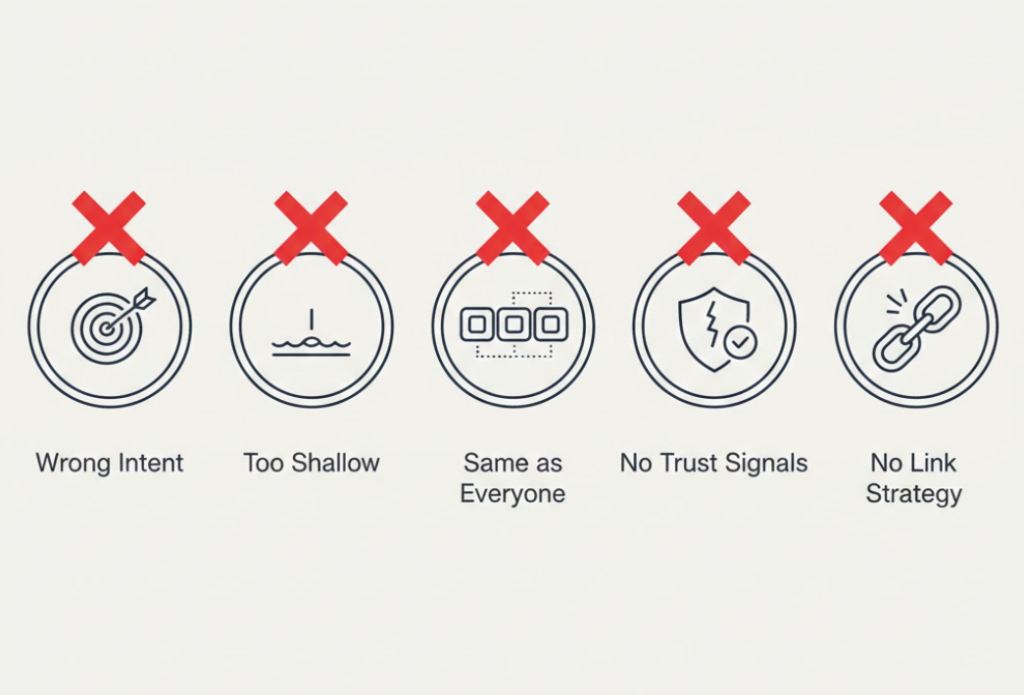
Problem 1: No Search Intent Match
AI writes what sounds good.
Google ranks what matches what people actually want when they search.
If your content answers a different question than the searcher asked, it doesn’t rank. Period.
Problem 2: Generic Depth
AI gives you surface-level information on everything.
Google ranks content that goes deep on something specific.
Shallow coverage of 10 topics loses to deep coverage of 1 topic.
Problem 3: No Competitive Differentiation
Everyone’s using the same AI tools.
Everyone’s getting similar outputs.
Google doesn’t need five identical articles. It picks one and ignores the rest.
Problem 4: Missing Trust Signals
AI content often lacks the specific details, examples, and insights that signal expertise.
Google’s algorithm specifically looks for expertise, experience, authority, and trustworthiness (E-E-A-T).
Generic content doesn’t demonstrate any of these.
Problem 5: No Strategic Internal Linking
AI doesn’t know your site structure.
It can’t strategically link to your other content, your product pages, or your conversion paths.
Google uses internal links to understand site hierarchy and topic relationships.
The 5-part formula fixes all five problems.
The 5-Part Formula Overview
Here’s the framework.
Part 1: Search Intent Deep-Dive Understand exactly what the searcher wants before writing anything.
Part 2: Competitive Gap Analysis Identify what’s missing from top-ranking content.
Part 3: Depth-First Content Architecture Structure content to go deep, not wide.
Part 4: Trust-Signal Injection Add expertise indicators AI can’t generate on its own.
Part 5: Strategic Link Integration Build internal linking that serves both users and SEO.
Each part has specific prompts and processes.
Master these five parts, and your AI content starts ranking.
Let’s break down each one.
Part 1: Search Intent Deep-Dive
Most people skip this entirely.
They take a keyword and ask AI to write about it.
That’s backwards.
Start by understanding exactly what people want when they search that keyword.
The Intent Analysis Prompt
I'm targeting the keyword: [your keyword]

Analyze this keyword and tell me:
1. What is the primary search intent? (informational, commercial, transactional, navigational)
2. What specific question or problem is the searcher trying to solve?
3. What format would best serve this intent? (tutorial, comparison, list, guide, review)
4. What related questions does someone searching this likely also have?
5. What would make someone satisfied they found the right answer?

Based on this analysis, what should the content structure focus on?
AI gives you a strategic foundation.
Example:
Keyword: “best standing desk for home office”
AI might identify:
- Primary intent: Commercial investigation (comparing before buying)
- Specific problem: Need to decide between multiple options
- Best format: Comparison guide with decision framework
- Related questions: “Are standing desks worth it?” “How tall should mine be?” “What about standing desk converters?”
- Satisfaction criteria: Clear recommendation based on specific needs, not generic “all are good”
Now you know what to write. Before writing a single word.
The Top-10 Content Analysis
Take this deeper.
Here are the current top 10 ranking URLs for [keyword]:
[paste URLs or titles]

What patterns do you see across these results?
- What subtopics do most of them cover?
- What format do most use?
- What's the typical depth level?
- What are they optimizing for?

Based on this, what's the implicit promise Google is currently ranking for this keyword?
This tells you what Google currently thinks satisfies the search intent.
Your content needs to match or exceed that expectation.
[Image suggestion: Funnel diagram showing keyword at top, flowing through “Intent Analysis” layer (question marks, magnifying glass icon), then “Top 10 Review” layer (trophy icons), narrowing to “Strategic Foundation” at bottom (blueprint icon). Clean process flow visualization]
Part 2: Competitive Gap Analysis
You know what Google ranks.
Now find what’s missing.
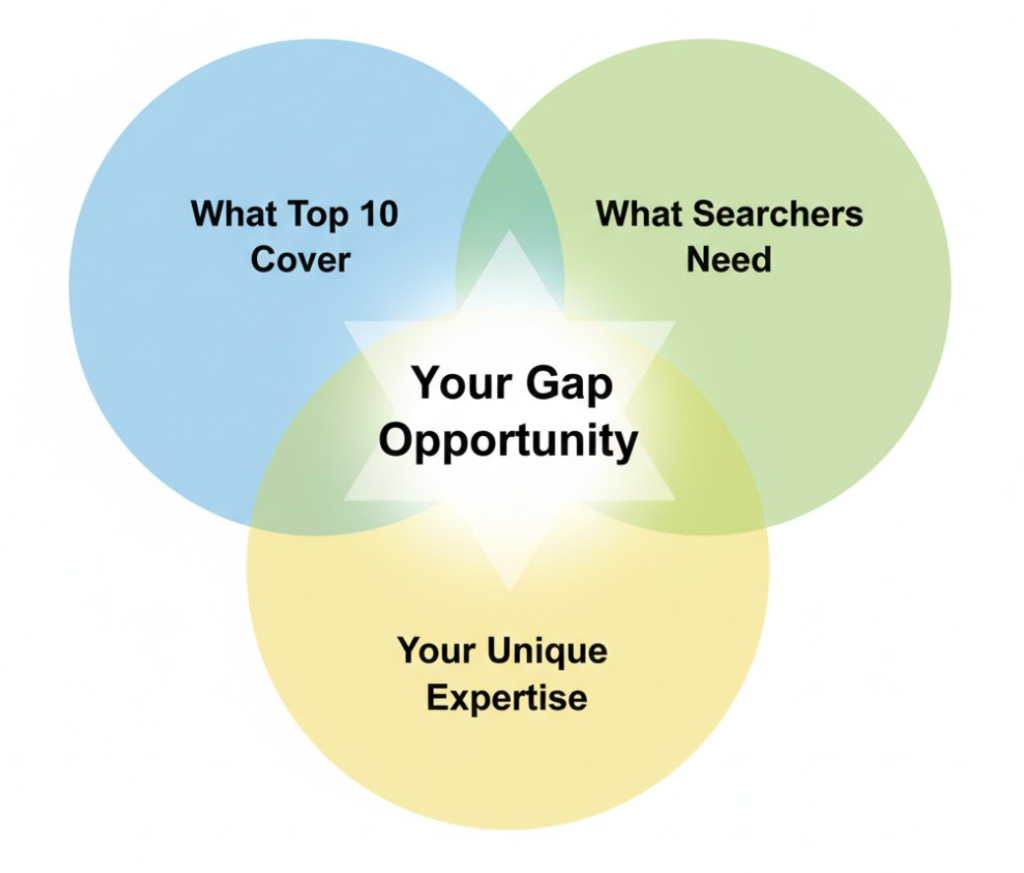
Every top-10 list has gaps. Questions left unanswered. Angles not covered. Specifics glossed over.
Those gaps are your opportunity.
The Gap Identification Prompt
I've reviewed the top 10 ranking articles for [keyword].

Here's what they all cover: [list common elements]

Analyze these articles for gaps:
1. What questions do they NOT answer that a searcher might have?
2. What level of detail is missing? (Too surface-level on what?)
3. What perspectives are absent? (Beginner, advanced, budget-conscious, etc.)
4. What practical examples or case studies are they lacking?
5. What objections or concerns are they not addressing?

Create a list of 5 gap opportunities I can fill that would make my content more valuable than what currently ranks.
This gives you a differentiation strategy.
Real Example:
For “how to start affiliate marketing,” top articles might cover:
- Choosing a niche
- Finding affiliate programs
- Creating content
But they might miss:
- Actual time investment week-by-week for the first month
- Real cost breakdown (not just “low cost to start”)
- Common failure points in weeks 2-4 specifically
- What “finding your first sale” actually looks like step-by-step
- Tax implications people don’t think about until it’s too late
Those five gaps become your competitive advantage.
The Unique Angle Selection
Once you have gaps, pick your angle.
Based on these gaps: [list gaps]

And my unique perspective: [your experience/audience/approach]

What's the single most valuable angle I can take on [keyword] that:
1. Fills a significant gap
2. Aligns with my expertise
3. Hasn't been done extensively yet
4. Would serve the target audience better

Recommend one primary angle and explain why it's the strongest choice.
This focuses your entire article around one differentiated approach.
Not trying to cover everything. Covering one thing uniquely well.
Part 3: Depth-First Content Architecture
Now you know what to write and what angle to take.
Time to structure it properly.
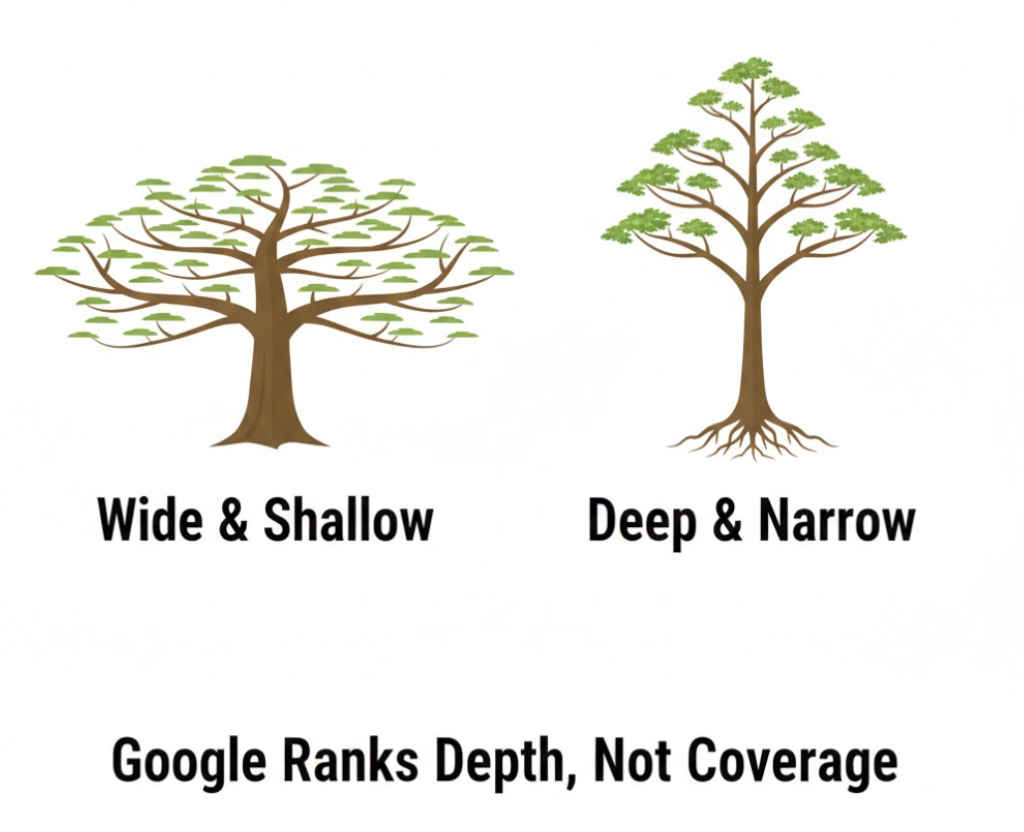
Most AI articles go wide and shallow. They touch on 10 things briefly.
Ranking articles go narrow and deep. They explore 3-4 things thoroughly.
The Depth-First Outline Prompt
Create an outline for an article on [keyword] that:

PRIMARY FOCUS: [your chosen angle from Part 2]

STRUCTURE REQUIREMENTS:
- Maximum 4 main sections (go deep, not wide)
- Each section should have 3-4 substantial subsections
- Each subsection should support one specific point with depth
- Include a spot for at least 2 real examples or case studies
- Build in logical flow: context → framework → application → verification

DEPTH INDICATORS:
- Each main section should be 400-500 words minimum
- Include specific how-to steps, not just concepts
- Anticipate and answer follow-up questions within each section
- Provide decision frameworks, not just information

Create the outline with this depth-first approach.
This produces structure that supports ranking.
Example Outline (Depth-First):
Topic: “How to Start Affiliate Marketing” Angle: First 30 days week-by-week breakdown with real cost and time investment
I. Week 1: Foundation & Cost Reality (450 words)
   A. Actual startup costs broken down by tool
   B. Time investment: 10-12 hours this week doing what specifically
   C. First decision: niche selection framework (not just "pick a niche")
   D. Common mistake: why starting with products instead of audience fails

II. Week 2-3: Content System Setup (500 words)
   A. Creating your first 3 pieces of content (step-by-step process)
   B. Time investment: 15-20 hours week 2, 12-15 hours week 3
   C. Affiliate program applications (which to apply to and why)
   D. The "ugly middle" problem and how to push through

III. Week 4: First Promotion & Expectations (450 words)
   A. When and how to add your first affiliate links
   B. Realistic traffic expectations (actual numbers to expect)
   C. The emotional challenge: no sales yet is normal
   D. What success looks like at day 30 (not sales, but...)

IV. Beyond Month 1: Sustainable System (400 words)
   A. Content calendar that works long-term
   B. When to expect your first sale (real timeline)
   C. Tax preparation you should do now
   D. Decision point: double down or pivot?
Four sections. Each goes deep. Specific steps. Real numbers. Frameworks.
That’s depth-first architecture.
The Depth-Enhancement Prompt
Before writing, enhance your outline one more time.
Take this outline: [paste outline]

For each section, identify:
1. Where can I add a specific example or case study?
2. What question might readers still have after reading this section?
3. What would make this section uniquely valuable vs. other content?
4. What common mistake or misconception should I address?

Suggest additions to the outline that increase depth without adding new sections.
This layers in the specific details that signal expertise.
Part 4: Trust-Signal Injection
AI can generate content.
AI can’t generate trust signals.
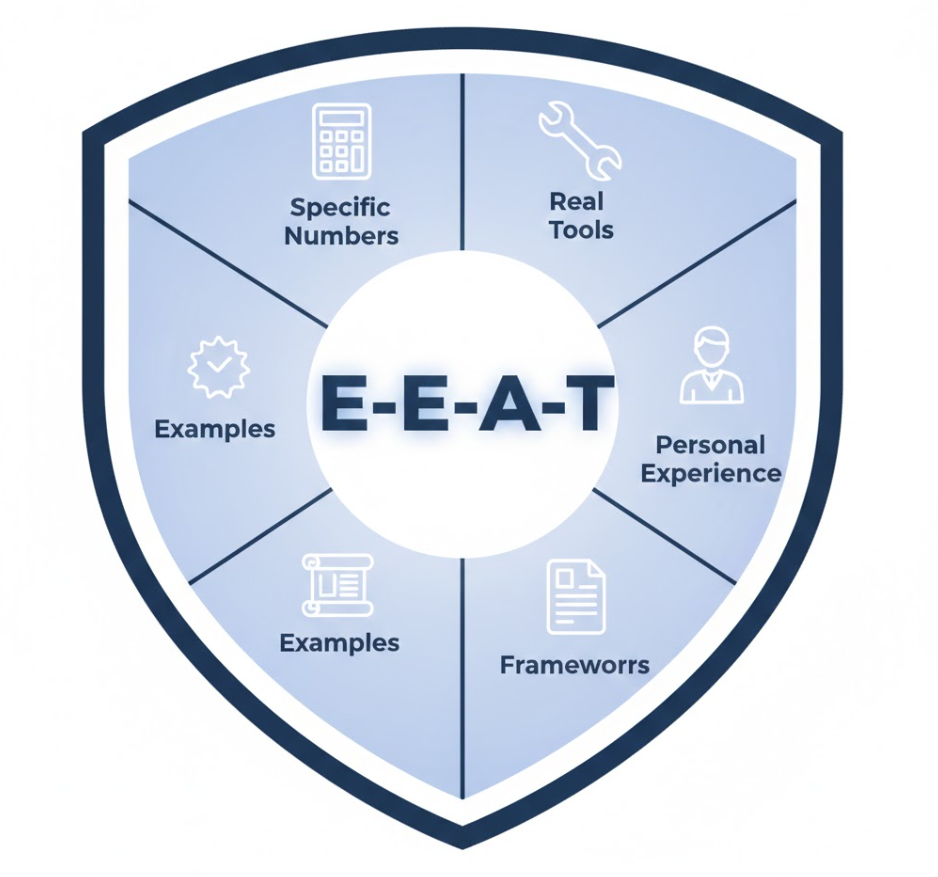
Trust signals are the specific details that show you actually know what you’re talking about.
These must be injected manually or through very specific prompting.
What Trust Signals Look Like
Specific numbers and timeframes: “It took me 47 days to see my first sale” beats “It takes time to see sales”
Real tool names and costs: “I use ConvertKit ($29/month) for email” beats “You’ll need an email tool”
Actual experiences: “When I first promoted Amazon Associates, my application got rejected because…” beats “Some people get rejected”
Specific mistakes: “I wasted $300 on a premium WordPress theme I didn’t need” beats “Don’t overspend on tools”
Frameworks you’ve developed: “I use a 3-question framework to evaluate affiliate programs” beats “Evaluate programs carefully”
The Trust-Injection Prompt
After AI generates the initial content:
Review this article: [paste content]

Identify 5 places where I should add specific trust signals:
1. Where should I add real numbers or timeframes from experience?
2. Where should I name specific tools or resources I actually use?
3. Where should I share a personal mistake or learning moment?
4. Where should I provide a specific framework or checklist I've developed?
5. Where would a real example make the advice more credible?

Mark these locations and explain what kind of detail would strengthen each.
Then add those details yourself.
AI can find the spots. You provide the authentic content.
The E-E-A-T Enhancement Checklist
Before publishing, verify:
- At least 3 specific tool names with actual costs mentioned
- At least 2 real timeframes from personal experience
- At least 1 honest mistake or challenge shared
- At least 1 framework or process you actually use
- At least 2 specific examples with real details
- Author bio that establishes relevant expertise
- Factual claims backed by data sources when possible
Each checkmark adds trust.
Trust signals are what separate content that ranks from content that doesn’t.
Part 5: Strategic Link Integration
Last part. Often overlooked. Always important.
Internal links do three things:
- Help users find related content
- Tell Google how your content connects
- Guide users toward conversion paths
AI doesn’t know your site structure. You need to prompt it strategically.
The Link Mapping Prompt
Before writing content:
I'm writing an article about [topic] on my affiliate site.

Here are my existing relevant articles:
- [Article 1 title and URL]
- [Article 2 title and URL]
- [Article 3 title and URL]

Here are my key conversion pages:
- [Product review/comparison page]
- [Resource page]
- [Email signup page]

Create a strategic internal linking plan:
1. Which existing articles should I link to and why?
2. What anchor text should I use for each link?
3. Where in the content flow does each link make most sense?
4. How can I naturally guide readers toward conversion pages?
5. What related content should I create next to strengthen this topic cluster?

Provide a linking strategy that serves both SEO and user experience.
This creates an intentional link structure instead of random mentions.
The Contextual Link Prompt
When AI is writing the content:
As you write this content, naturally incorporate these internal links:

Link 1: [anchor text] → [URL] → [why this is relevant here]
Link 2: [anchor text] → [URL] → [why this is relevant here]
Link 3: [anchor text] → [URL] → [why this is relevant here]

RULES:
- Never link just for SEO — only where it genuinely helps the reader
- Use descriptive anchor text (not "click here")
- Space links at least 200 words apart
- Each link should feel like a natural extension of the current point
This ensures AI integrates links properly, not awkwardly.
The Conversion Path Design
Every blog post should have a conversion path.
Not aggressive selling. Strategic guiding.
For this article on [topic], design a conversion path:

1. What's the natural next step for a reader who found this helpful?
2. Where in the article would it make sense to mention my [product/tool]?
3. How can I frame that mention as genuinely helpful, not salesy?
4. What content upgrade could I offer that extends this article's value?
5. What's a compelling but non-pushy CTA for the end?

Create language for 2-3 conversion touchpoints that feel natural, not forced.
Your blog post becomes part of a funnel, not an isolated piece.

Putting the Formula Together: The Complete Workflow
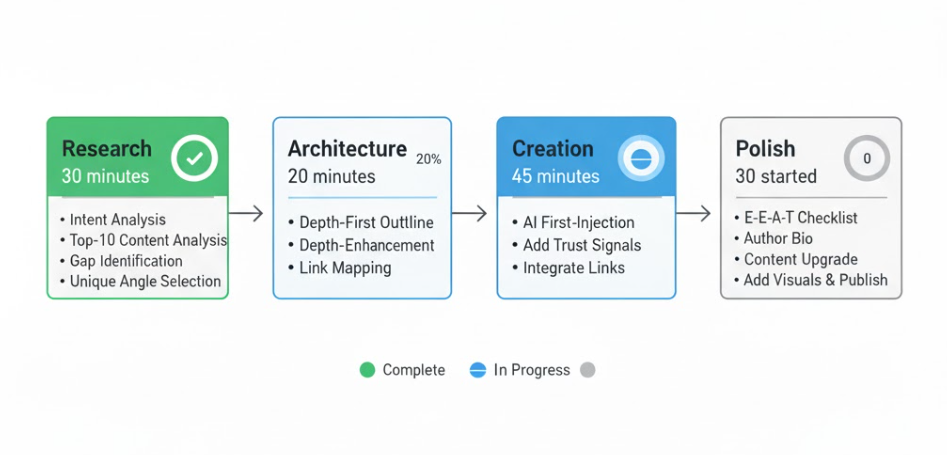
Here’s how you use all five parts in sequence.
Session 1: Research & Strategy (30 minutes)
- Run Intent Analysis Prompt → understand what to write
- Run Top-10 Content Analysis → understand current ranking bar
- Run Gap Identification Prompt → find your differentiation angle
- Run Unique Angle Selection → commit to your approach
Session 2: Architecture (20 minutes)
- Run Depth-First Outline Prompt → create structure
- Run Depth-Enhancement Prompt → layer in specifics
- Run Link Mapping Prompt → plan your linking strategy
Session 3: Content Creation (45 minutes)
- Use AI to write the first draft following your enhanced outline
- Run Trust-Injection Prompt → identify where to add authenticity
- Manually add trust signals (your specific numbers, tools, experiences)
- Manually integrate strategic links using your linking plan
Session 4: Polish & Publish (30 minutes)
- Run E-E-A-T Enhancement Checklist → verify trust signals present
- Add author bio establishing your expertise
- Insert content upgrade offer if applicable
- Add images/screenshots where they add value
- Final readability check → publish
Total time: ~2 hours for a 1,800-2,000 word ranking-focused article.
Most people spend 20 minutes asking AI to write a generic article.
You spend 2 hours creating something strategically positioned to rank.
Which one actually drives traffic?
Common Mistakes That Kill Rankings
Even with the formula, these mistakes can sabotage your rankings.
Mistake 1: Skipping the Intent Analysis
“I know what people want.”
Maybe. But verify anyway.
Intent mismatches are the #1 reason AI content doesn’t rank.
Spend the 10 minutes. Run the prompt. Confirm your assumptions.
Mistake 2: Trying to Compete on Coverage
“I’ll cover MORE subtopics than the top 10.”
No. Go deeper on fewer topics.
Coverage wars favor the biggest brands. Depth wars favor focused expertise.
Mistake 3: Not Adding Personal Trust Signals
“I’ll let AI write everything.”
AI content is training data for AI.
Google doesn’t need more AI regurgitating training data.
It needs your specific experiences, your frameworks, your real examples.
Add them manually. This is non-negotiable.
Mistake 4: Publishing Immediately
“AI wrote it, I’m publishing it.”
Bad plan.
The 2-hour workflow exists for a reason.
Research and architecture are PART of creating ranking content, not optional extras.
Mistake 5: Ignoring the Linking Strategy
“I’ll add links later.”
Later never comes.
Plan your links during architecture. Integrate during creation.
Internal linking structure directly impacts rankings.
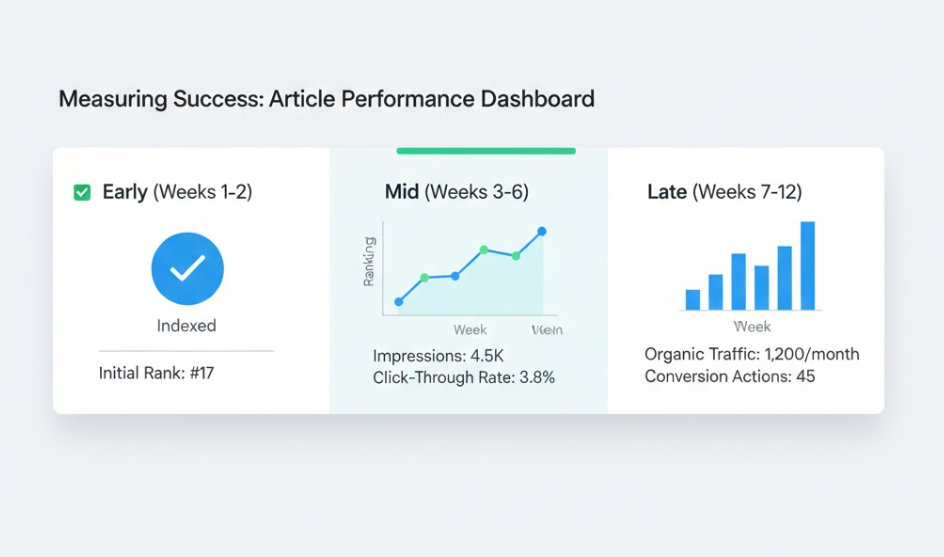
Measuring Success: What to Track
You can’t improve what you don’t measure.
Track these metrics for each article:
Week 1-2:
- Indexing (is Google seeing it?)
- Initial ranking position for target keyword
Week 3-6:
- Ranking movement (climbing or stuck?)
- Impressions in Google Search Console
- Click-through rate from search
Week 7-12:
- Settled ranking position
- Organic traffic volume
- Engagement metrics (time on page, scroll depth)
- Conversion actions (email signups, affiliate clicks)
If an article isn’t ranking by week 6, diagnose:
- Does it match search intent? (Check your Intent Analysis)
- Is it deep enough? (Compare depth to top 3 results)
- Are trust signals present? (Run E-E-A-T checklist again)
- Is linking strategy working? (Check internal link flow)
Then improve. Google rewards improvements to published content.
The Bottom Line
AI doesn’t write content that ranks.
AI writes content that CAN rank when you guide it strategically.
The 5-part formula is that guidance system:
- Understand search intent deeply before writing
- Identify competitive gaps to differentiate
- Structure for depth, not coverage
- Inject trust signals AI can’t generate
- Integrate strategic internal linking
This isn’t faster than generic AI content creation.
It’s better.
Fast content that doesn’t rank is worthless.
Strategic content that ranks drives traffic for years.
Choose strategic.
The formula works. But only if you actually implement all five parts.
Not three. Not four. All five.
That’s the difference between publishing and ranking.