You may also like:
- The 7 Essential Components Every Prompt Needs
- Repurposing obsahu pomocí AI: jeden článek, 20 různých formátů
- Advanced Prompt Techniques (Constraints, Personas, and Output Control)
AI writes 500-word articles easily.
But 3,000+ words? That’s where most people fail.
They ask AI for a long article. AI produces something long but shallow.
Lots of words. Zero depth. Repetitive sections. No real value.
Here’s the truth: long-form content isn’t just “more words.”
It’s deep research, strategic structure, and layered information that serves reader intent completely.
AI can write long-form content at that level.
But you need a completely different prompting strategy.
Today, you’ll learn the advanced techniques for prompting AI to create genuinely valuable 3,000+ word articles that actually rank and convert.
This isn’t beginner territory.
Let’s go deep.
Why Long-Form Content Requires Different Prompting
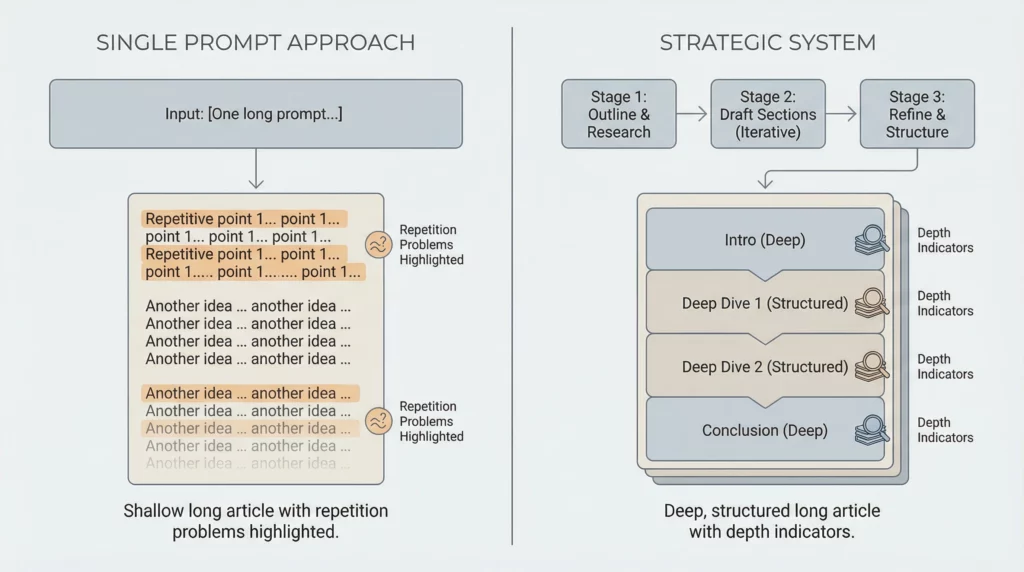
Most people prompt AI like this:
“Write a 3,000-word article about [topic].”
AI produces 3,000 words of fluff.
Why this fails:
AI’s default mode is breadth, not depth.
Ask for 3,000 words without structure, and you get:
- The same point restated 10 different ways
- Surface-level coverage of many topics
- Filler phrases stretching thin ideas
- No logical progression or depth
Long-form content that actually works requires:
- Deep research phase before writing
- Strategic information architecture
- Multiple knowledge layers
- Intentional depth allocation
- Coherent narrative flow across thousands of words
You can’t get this with a single prompt.
You need a system.
The 5-Phase Long-Form Framework
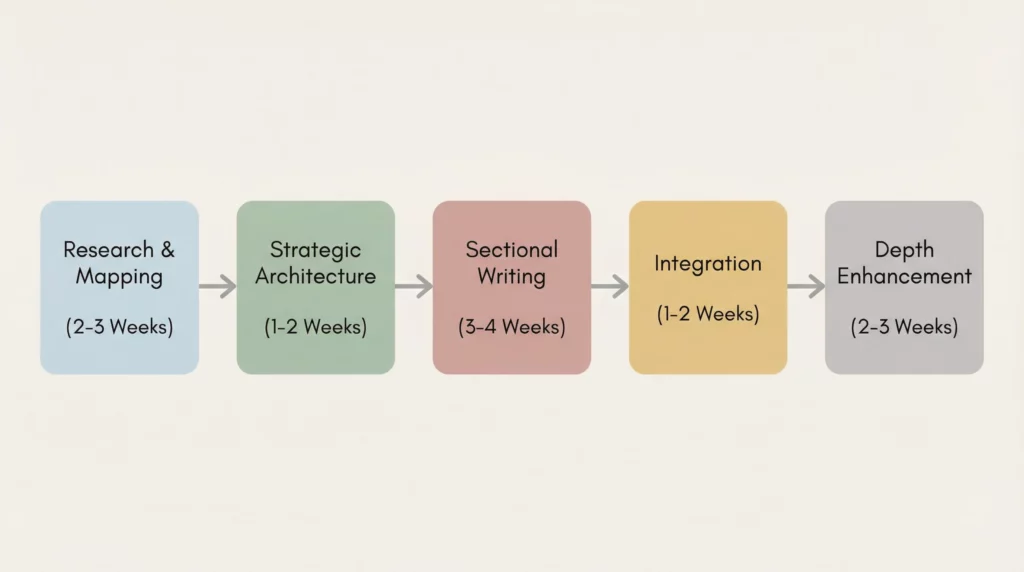
Here’s the system that produces genuinely valuable long-form content.
Phase 1: Deep Research & Mapping (30 minutes) Understand the topic completely before writing anything.
Phase 2: Strategic Architecture (20 minutes) Design the structure that supports depth.
Phase 3: Sectional Deep-Dive Writing (90 minutes) Write each major section as its own deep piece.
Phase 4: Integration & Flow (30 minutes) Stitch sections into coherent narrative.
Phase 5: Depth Enhancement (30 minutes) Add layers that transform good into exceptional.
Total time: ~3 hours for a truly valuable 3,000-word article.
Compare that to the single-prompt approach: 5 minutes to generate, 3 hours to fix.
Let’s break down each phase.
Phase 1: Deep Research & Mapping
Before you write a single word, map the knowledge territory.
The Research Mapping Prompt
I want to write a comprehensive 3,000+ word article about [TOPIC].

Before writing anything, help me map the knowledge landscape.

RESEARCH OBJECTIVES:
1. What are the 5-7 major subtopics that must be covered for completeness?
2. What depth level does each subtopic deserve? (surface, medium, deep)
3. What are the key questions readers have at each knowledge level?
   - Beginner questions
   - Intermediate questions
   - Advanced questions
4. What common misconceptions exist about this topic?
5. What's missing from existing content on this topic?
6. What's the logical order to present these subtopics?

COMPETITIVE ANALYSIS:
Review what's currently ranking for this topic. Identify:
- What depth are competitors achieving?
- What angles are they missing?
- What could be explained better?

Provide a research map, not an outline. This is about understanding the topic completely before structuring anything.
This prompt produces strategic intelligence.
You’ll see gaps competitors miss. Questions they don’t answer. Depth they skip.
That’s your differentiation opportunity.
The Search Intent Analysis Prompt
For the topic [TOPIC], analyze search intent across different query types:

QUERY ANALYSIS:
1. What do people searching "[topic]" actually want to accomplish?
2. What's the difference between someone searching:
   - "[topic]" (general)
   - "how to [topic]" (instructional)
   - "best [topic]" (comparison)
   - "[topic] guide" (comprehensive)

3. What secondary questions arise after the primary question is answered?

4. What does "comprehensive coverage" mean for this specific topic?
   - What must be included?
   - What can be excluded?
   - What depth is expected?

5. Where do most articles on this topic fail to satisfy search intent?

This analysis will determine our strategic approach and depth allocation.
You now know what readers actually need, not what you assume they need.
The Expert Knowledge Extraction Prompt
Act as an expert with 10+ years of experience in [TOPIC/FIELD].

What knowledge do beginners typically lack when learning about [TOPIC]?

Specifically:
1. What foundational concepts do they need first?
2. What do they consistently misunderstand?
3. What "obvious to experts" information is never explained?
4. What practical details make the difference between theory and application?
5. What would you explain differently than typical content does?

Provide the expert insight layer that most content misses.
This surfaces the depth that separates good content from exceptional content.
You now have three research documents:
- Knowledge map (what to cover)
- Intent analysis (what readers need)
- Expert insights (what adds unique value)
Don’t skip this phase. This IS the article quality differentiator.
Phase 2: Strategic Architecture
Now design the structure that supports depth.
The Depth-First Architecture Prompt
Using this research: [paste your research findings]

Design a comprehensive article structure for 3,000+ words.

ARCHITECTURE REQUIREMENTS:

1. Main sections: 4-6 major sections (not 10+ shallow ones)
2. Depth allocation: Assign word counts by value, not equality
   - Critical sections: 600-800 words each
   - Important sections: 400-500 words
   - Supporting sections: 200-300 words

3. Information layers within each section:
   - Conceptual layer (what it is)
   - Practical layer (how to apply it)
   - Nuance layer (edge cases, exceptions, when rules break)

4. Knowledge progression:
   - Order sections by logical learning sequence
   - Each section builds on previous sections
   - No jumps that leave readers confused

5. Strategic waypoints:
   - Where should examples appear?
   - Where do readers need comparison frameworks?
   - Where will tactical steps help?
   - Where does data/proof matter most?

Provide the architecture with:
- Section titles
- Target word count per section
- Key points to cover in each
- Depth indicators (surface/medium/deep)
- Transition logic between sections

This is the blueprint. We'll build from this.
This produces a strategic content architecture, not a generic outline.
You’ll see sections weighted by importance, not artificially balanced.
The Anti-Fluff Structure Check
Review this article structure: [paste architecture]

Identify potential fluff zones:
1. Where might AI repeat the same idea in different words?
2. Which sections risk being generic filler?
3. Where is depth most critical?
4. What could be cut entirely without losing value?

For each potential fluff zone, suggest:
- Specific information to include instead
- Questions to answer
- Examples to provide
- Frameworks to explain

Make the structure fluff-proof before writing begins.
This prevents the most common long-form failure: inflated word count without substance.
You now have a fluff-proof architecture that allocates depth strategically.
Phase 3: Sectional Deep-Dive Writing
Don’t write the entire article at once.
Write each major section as its own deep piece.
The Section Writing Prompt Template
Write Section [NUMBER]: [SECTION TITLE]

CONTEXT FROM PREVIOUS SECTIONS:
[Briefly summarize what's been covered so far]

THIS SECTION'S OBJECTIVES:
Target length: [600-800 words or whatever your architecture specifies]
Depth level: [Deep/Medium/Surface]
Key points to cover: [from your architecture]

WRITING REQUIREMENTS:

1. DEPTH MARKERS - Include all of these:
   - Specific examples (at least 2)
   - One framework or mental model if applicable
   - Edge cases or exceptions
   - Common mistakes related to this point
   - Practical application steps

2. STRUCTURE:
   - Opening (establish why this section matters)
   - Main body (cover key points with depth)
   - Transition (bridge to next section naturally)

3. AVOID:
   - Generic statements that could apply to any topic
   - Repeating points from previous sections
   - Filler phrases or unnecessary elaboration
   - Explaining things that were already explained

4. VOICE: [Insert your voice profile if you have one]

Write this section as if it were a standalone piece that must be thoroughly valuable on its own.
The sectional approach prevents:
- AI forgetting what it wrote 1,000 words ago
- Degrading quality as the article progresses
- Running out of new things to say
- Repetition across sections
The Example Integration Prompt
For this section: [paste section text]

The section feels theoretical. Add practical depth with examples.

EXAMPLE REQUIREMENTS:
- Include 2-3 specific, concrete examples
- Each example should illustrate a different aspect
- Make examples realistic and relatable to [target audience]
- Show the "before and after" or "right way vs wrong way"
- Keep examples brief but detailed enough to be useful

Examples should enhance understanding, not pad word count.
Examples are where depth lives.
AI can write concepts. Examples prove you understand application.
The Nuance Layer Prompt
Review this section: [paste section text]

Add the nuance layer - the expert insights that beginners miss.

NUANCE TO ADD:
1. When does the advice in this section NOT apply?
2. What's the subtle difference between related concepts?
3. What mistake do people make when implementing this?
4. What works in theory but fails in practice?
5. What's the counterintuitive truth about this topic?

Add 100-150 words of nuanced insight that elevates this from "correct" to "expert-level understanding."
Nuance is what separates 3,000 words of value from 3,000 words of filler.
Repeat this sectional process for all major sections.
You now have deeply-written sections, not shallow coverage stretched thin.
Phase 4: Integration & Flow
You have 5-6 deeply-written sections.
Now stitch them into one coherent piece.
The Integration Prompt
I have written these sections for a comprehensive article:

[PASTE ALL SECTIONS]

INTEGRATION TASKS:

1. TRANSITIONS:
   - Review the end of each section and beginning of the next
   - Rewrite transitions to create natural flow
   - Each transition should bridge ideas, not just say "next we'll discuss..."

2. CONTINUITY:
   - Identify any concepts that need to be explained earlier
   - Flag any repetition across sections
   - Note any gaps in logical progression

3. VOICE CONSISTENCY:
   - Check that tone stays consistent throughout
   - Flag any sections that feel stylistically different
   - Ensure technical level is consistent (not jumping from beginner to advanced language)

4. REFERENCE FLOW:
   - Where should sections reference earlier sections?
   - Where can internal callbacks strengthen points?
   - Are there concepts that need cross-section integration?

Provide:
- Rewritten transitions for each section break
- List of continuity issues to fix
- Suggestions for strengthening flow
This transforms sections into an article.
The Narrative Arc Check
Review this complete article: [paste integrated article]

Long-form content needs narrative momentum. Evaluate:

1. OPENING: Does the introduction make the reader want to keep reading?
   - Is the hook strong?
   - Does it establish why 3,000 words are necessary?
   - Does it promise a clear payoff?

2. MIDDLE: Do sections build on each other compellingly?
   - Is there a sense of progression?
   - Does each section add value beyond the previous?
   - Are there strategic "aha moments" throughout?

3. CLOSING: Does the conclusion earn the reader's time investment?
   - Does it synthesize key insights?
   - Does it provide clear next steps?
   - Does it feel like a satisfying ending?

Flag any sections where momentum lags. Suggest fixes.
Long-form content loses readers if it drags.
Momentum matters as much as depth.
Phase 5: Depth Enhancement
Your article is good.
Now make it exceptional with strategic depth layers.
The Data & Research Layer
Review this article: [paste article]

Identify 5-7 places where adding data, research, or specific numbers would strengthen credibility.

For each location:
1. What type of data would be most compelling?
2. What claim needs backing?
3. What statistic would surprise readers?
4. What research would prove the point?

Suggest where to place: "According to [source], [stat]" or "Research shows [finding]."

Note: I will add real sources. Just identify where data strengthens the piece.
Data transforms opinion into authority.
The Comparison Framework Layer
Identify 3-5 places in this article where a comparison framework would add clarity:

[Paste article]

FRAMEWORK TYPES:
- Comparison tables (this vs that)
- Decision matrices (when to use X vs Y)
- Spectrum charts (beginner to advanced)
- Process comparisons (method A vs method B)

For each identified location:
- What's being compared?
- What dimensions matter for the comparison?
- What format makes the comparison clearest?

Provide the content for each framework. I'll format it visually.
Frameworks organize complexity.
They’re depth multipliers.
The Tactical Depth Layer
Review this article: [paste article]

The article explains concepts well but could be more actionable.

Identify 3-5 places to add tactical depth:
1. Step-by-step processes
2. Checklists
3. Decision frameworks
4. Templates or formulas
5. Specific tools or resources mentioned by name

For each:
- Where does it fit?
- What specifically should be included?
- How does it enhance the section?

Make the article not just informative but immediately useful.
Tactical elements prove you’ve actually done this.
The FAQ/Objection Layer
Based on this article: [paste article]

Generate 5-7 questions readers will still have after reading it.

These are:
- Edge case questions
- "But what about..." objections
- Clarifications on nuanced points
- Application-specific scenarios

For each question:
- Write the question
- Provide a 50-75 word answer
- Identify where in the article it should be addressed (add a callout box or expand an existing section)

This layer handles the "yeah, but..." reader skepticism.
FAQ sections are easy depth wins in long-form content.
You’ve now added four enhancement layers:
- Data/research
- Comparison frameworks
- Tactical depth
- FAQ/objections
These layers transform good into exceptional.
Advanced Techniques for Long-Form Excellence
Technique 1: The Depth Gradient
Not every section needs equal depth.
Use the 40/30/20/10 allocation:
- 40% of words: 2-3 critical sections (deep, comprehensive)
- 30% of words: 2-3 important sections (medium depth)
- 20% of words: Supporting sections (necessary but brief)
- 10% of words: Introduction and conclusion
This creates natural depth variation.
Technique 2: The Perspective Shift
In long-form content, shift perspectives strategically:
- Sections 1-2: Conceptual (what and why)
- Sections 3-4: Practical (how to apply)
- Sections 5-6: Strategic (when and why not)
This keeps readers engaged through thousands of words.
Technique 3: The Expert Interview Simulation
Simulate an interview with an expert on [TOPIC].

Generate 10 questions an interviewer would ask.
Then answer each as the expert would - with:
- Specific insights
- Real examples
- Nuanced perspectives
- Practical wisdom

Extract the 5 best insights and integrate them as "expert perspective" callouts throughout the article.
Simulated expert insights add authority.
Technique 4: The Controversy/Debate Integration
What are the controversial or debated aspects of [TOPIC]?

Identify:
1. Where do experts disagree?
2. What common advice is actually wrong?
3. What "best practice" has exceptions?
4. What's the contrarian take?

For each controversy:
- Present both sides fairly
- Explain when each perspective applies
- Take a clear stance with reasoning

Controversy adds depth and shows you understand nuance.
Addressing debates proves expertise.
Technique 5: The Progression Markers
In long articles, readers lose their place.
Add progression markers every 600-800 words:
- “So far we’ve covered…”
- “Now that you understand X, let’s explore Y…”
- “The next critical piece is…”
- “Building on that foundation…”
These keep readers oriented.
Quality Control Checklist for 3,000+ Word Articles
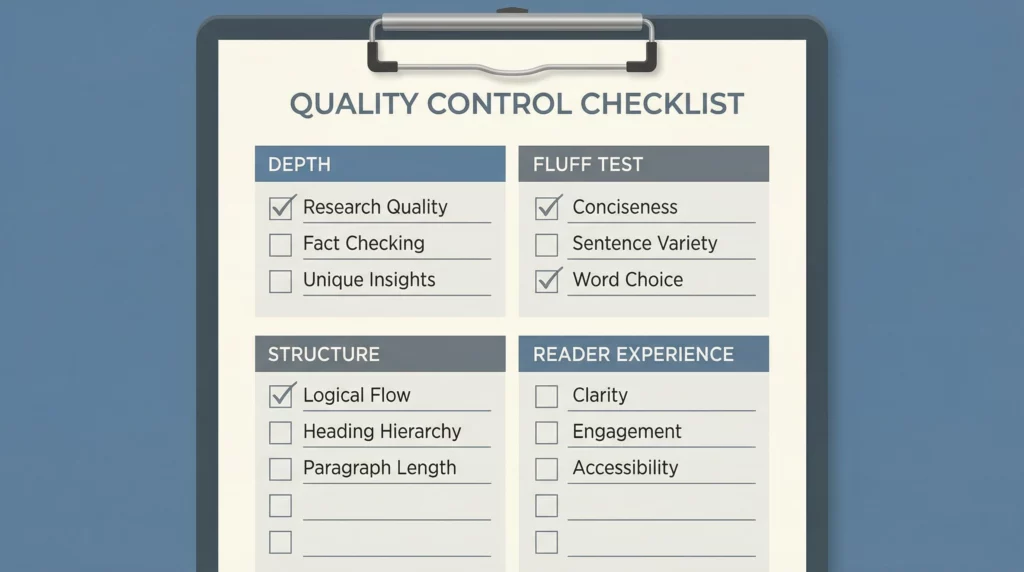
Before publishing, verify:
Depth Indicators
- [ ] At least 10 specific examples throughout
- [ ] At least 3 frameworks or mental models
- [ ] At least 5 “how to” tactical elements
- [ ] At least 3 data points or research citations
- [ ] At least 2 comparison frameworks
Structure Quality
- [ ] No section exceeds 800 words without a subheading
- [ ] Every section has a clear purpose
- [ ] Transitions feel natural, not forced
- [ ] No obvious repetition across sections
- [ ] Introduction promises match what article delivers
Depth vs. Fluff Test
- [ ] Could you cut 500 words without losing value? (If yes, it’s fluffy)
- [ ] Does every paragraph serve a purpose?
- [ ] Are examples specific or generic?
- [ ] Could a competitor write this without doing the work? (If yes, add depth)
Reader Experience
- [ ] Can you skim and still get value? (subheadings, bolding, formatting)
- [ ] Are there strategic stopping points? (good places to pause and resume)
- [ ] Does momentum build throughout?
- [ ] Does the conclusion satisfy?
If you check all these boxes, you have genuinely valuable long-form content.
Common Long-Form Failures (And How to Avoid Them)
Failure 1: The 300-Word Article Stretched to 3,000
Symptoms: Every point restated multiple ways. Obvious filler. Repetitive examples.
Fix: Use the research phase. If you don’t have 3,000 words of value, write 1,500 words instead.
Failure 2: The Outline Expansion
Symptoms: Each section is shallow. Covers many topics at surface level. Feels like a long list.
Fix: Use depth-first architecture. Fewer sections, deeper coverage.
Failure 3: The Context-Free Depth
Symptoms: Very detailed but readers don’t know why it matters. Technical without accessibility.
Fix: Every deep section needs context-setting. “Why this matters” before “how it works.”
Failure 4: The Momentum Killer
Symptoms: Article starts strong, middle sections drag, readers abandon before the end.
Fix: Use progression markers. Vary section depth. Add strategic “payoff” sections.
Failure 5: The Disjointed Collection
Symptoms: Sections feel like separate articles. No narrative flow. Repetitive introductions.
Fix: Use integration phase properly. Rewrite transitions. Add cross-references.
Time Investment Reality Check
Creating genuinely valuable 3,000+ word articles takes time:
Single-prompt approach:
- Prompt creation: 5 minutes
- AI generation: 2 minutes
- Fixing shallow/repetitive content: 3-4 hours
- Total: 3-4+ hours of frustration
5-Phase system:
- Phase 1 (Research): 30 minutes
- Phase 2 (Architecture): 20 minutes
- Phase 3 (Writing): 90 minutes
- Phase 4 (Integration): 30 minutes
- Phase 5 (Enhancement): 30 minutes
- Total: 3 hours of strategic work
Same time investment.
But the 5-phase system produces publishable quality from the start.
The single-prompt approach produces work you’ll rewrite entirely.
The Bottom Line
Long-form AI content fails when you treat it like short content that’s just… longer.
It requires:
- Deep research before writing
- Strategic architecture that supports depth
- Sectional writing that maintains quality
- Integration that creates flow
- Enhancement layers that add exceptional value
Use the 5-phase framework:
- Research & map the knowledge territory
- Design depth-first architecture
- Write sections as standalone deep pieces
- Integrate for coherent narrative flow
- Enhance with data, frameworks, and tactical depth
This produces 3,000+ word articles that actually serve readers completely.
Not 3,000 words of fluff.
3,000 words of value.
That’s the difference that ranks and converts.