Everyone is chasing the same keywords.
“Best affiliate marketing tools.” “How to make money online.” “Top credit cards 2024.”
Thousands of sites. Massive domain authority. Years of backlinks. You’re not ranking for those — not without a serious fight.
The opportunity isn’t there. It’s in the gaps.
Low-competition keywords are real search queries with real intent — that nobody has bothered to answer well yet. They exist in every niche.
Most people never find them because they’re looking in the wrong places with the wrong tools.
AI finds them faster than any keyword tool alone — because it thinks about language, intent, and audience the way humans do.
This article gives you six prompts that uncover keyword opportunities your competitors have missed.
You may also like:
- Email Management (Prompts for Drafting, Responding, and Organizing)
- Automation Prompts (Creating SOPs and Process Documentation)
- Hook Writing Formulas (AI Prompts for Attention-Grabbing Openings)
Why Most Keyword Research Misses the Best Opportunities

Standard keyword research follows a predictable pattern.
You open a tool. You type in your main topic. You sort by search volume. You pick the keywords with the highest numbers that don’t look impossible to rank for.
The problem with this approach:
Everyone else is doing it too. The same tools surface the same keywords to every marketer in your niche. High-volume keywords attract the most competition — which is exactly why they’re so hard to rank for.
Meanwhile, the low-competition opportunities hide in plain sight:
Long-tail variations nobody thought to check. Three, four, five-word phrases with specific intent and almost no competition.
Question-based queries that forums and Reddit are answering badly. Real people asking real questions that deserve a proper article.
Adjacent topic keywords just outside your niche that your audience is also searching for — but your competitors haven’t connected yet.
Comparison and alternative queries from buyers who are close to a decision and need one more piece of information.
AI finds all four categories — systematically — without you needing to guess.
The F.I.N.D. Framework
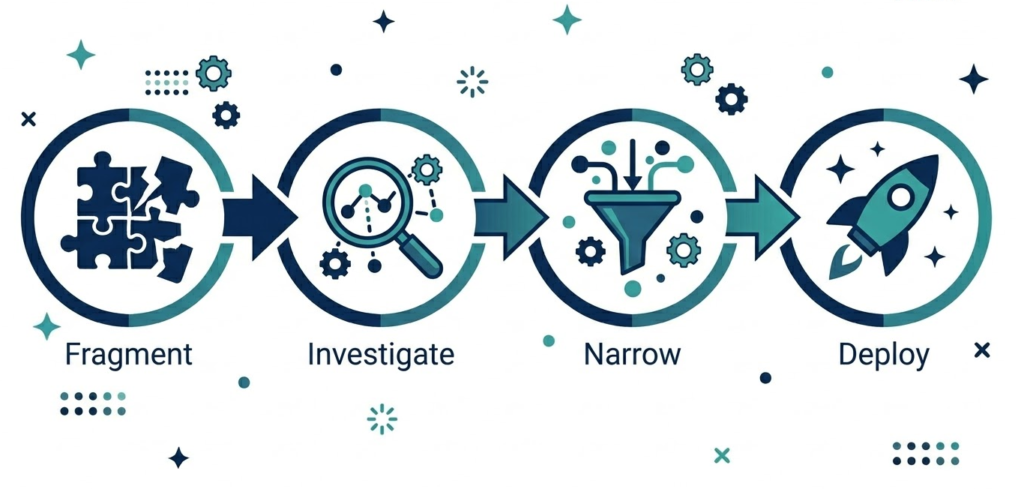
Four stages. Each one digs deeper into low-competition territory.
F — Fragment: Break your niche into specific subtopics and audience segments.
I — Investigate: Explore intent, questions, and language your audience actually uses.
N — Narrow: Filter for low-competition signals and buyer intent.
D — Deploy: Match keywords to content types and build your attack plan.
F — Fragment: Break Your Niche Into Specific Pieces
Broad topics breed broad competition. Specific topics breed opportunity.
The first step is breaking your niche into its smallest meaningful components — then finding the keywords that live inside each one.
Prompt 1: The Niche Fragmenter
My niche is: [describe your niche and target audience]
My main topic area is: [e.g. affiliate marketing, personal finance, home fitness]

Fragment this niche into specific subtopics by identifying:

1. AUDIENCE SEGMENTS — different types of people within my audience
   (e.g. beginners vs. experienced, different goals, different situations)

2. PROBLEM CATEGORIES — the distinct problems my audience faces
   (break each main problem into 3-5 specific sub-problems)

3. STAGE OF AWARENESS — keywords for each stage:
   - Problem-aware (they know they have a problem, don't know solutions)
   - Solution-aware (they know solutions exist, comparing options)
   - Product-aware (they know specific products, ready to decide)

4. CONTENT FORMATS — keywords that suggest a specific content format:
   (how-to, comparison, review, checklist, template, calculator)

For each fragment, generate 5 seed keyword ideas.
Do not worry about search volume yet — focus on specificity and relevance.
This prompt generates your keyword universe. You’re not optimizing yet — you’re expanding your thinking beyond the obvious before narrowing down.
I — Investigate: Find What People Actually Ask
Search tools show you what people type. They don’t show you what people mean.
AI bridges that gap by thinking about language, context, and intent — the way a real searcher does.
Prompt 2: The Question Miner
My target audience is: [describe them]
My niche topic is: [your topic]

Generate 30 specific questions my audience is asking about this topic.

Cover all four question types:

BEGINNER QUESTIONS (they're just starting out):
— What they search when they first discover this topic
— Basic "what is" and "how does" questions

FRUSTRATION QUESTIONS (they've tried and hit a wall):
— What they search when something isn't working
— "Why is my X not working" and "how to fix" queries

COMPARISON QUESTIONS (they're evaluating options):
— "X vs Y" and "best X for [specific situation]"
— "Is X worth it" and "X alternatives"

BEFORE-BUYING QUESTIONS (they're close to a decision):
— Specific product or solution questions
— "Does X work for [specific situation]"
— "[Product] review" with specific angles

Format as actual search queries — the way someone would type them
into Google, not formal questions.
The frustration and before-buying questions are your highest-value targets. They represent people who are actively engaged with the problem — and often close to taking action on a solution.
Prompt 3: The Language Pattern Extractor
Here is how my target audience describes their problem: [paste examples
from forums, reviews, Reddit threads, or comments you've observed]

If you don't have examples yet, describe: [audience, problem, niche]
and AI will generate realistic language patterns.

Analyze the language patterns to identify:

1. EXACT PHRASES they repeat — the specific words they use
   (not how a marketer would describe it — how they would)

2. EMOTIONAL LANGUAGE — words that show frustration, confusion,
   hope, or urgency

3. JARGON AND SHORTHAND — terms specific to this audience and niche

4. SEARCH-FRIENDLY VARIATIONS — how these phrases translate to
   actual Google search queries

5. LONG-TAIL OPPORTUNITIES — 4-6 word phrases that are highly
   specific and show clear intent

Output as a keyword swipe file organized by intent type.
The best SEO copy sounds like it was written by someone who has lived the problem. This prompt gives you the raw language — which feeds both your keyword targeting and your content tone.
N — Narrow: Filter for Low-Competition Signals
Now filter your keyword list for the ones worth targeting.
You don’t need a keyword tool to identify low-competition signals. AI can spot them from intent and specificity patterns alone.
Prompt 4: The Low-Competition Signal Spotter
Here is my list of potential keywords: [paste keywords from Prompts 1-3]

Evaluate each keyword for low-competition signals:

HIGH COMPETITION SIGNALS (likely to be hard to rank for):
- Single or two-word head terms
- Keywords dominated by major brands or publishers
- Generic informational queries with no specific angle
- Keywords where paid ads dominate results

LOW COMPETITION SIGNALS (likely easier to rank for):
- 4+ word long-tail phrases
- Question-based queries with specific context
- Comparison queries for niche-specific products
- Keywords combining a topic with a specific audience segment
- Recent or emerging topics without established content

Sort my keyword list into three groups:
- STRONG OPPORTUNITY (target now)
- MODERATE OPPORTUNITY (target when site grows)
- SKIP (too competitive for current stage)

For the "strong opportunity" keywords, explain in one sentence
why each represents a realistic ranking chance.
This sorting step is where most keyword research breaks down. People target keywords they want to rank for instead of keywords they can rank for. The gap between those two lists is where time gets wasted.
Prompt 5: The Buyer Intent Ranker
Traffic that doesn’t convert is vanity. This prompt prioritizes keywords by their likelihood of generating affiliate revenue — not just clicks.
Here are my strong-opportunity keywords: [paste filtered list]

My monetization model is: [describe your affiliate offers or products]

Rank these keywords by buyer intent using three tiers:

TIER 1 — HIGH BUYER INTENT:
Keywords where the searcher is close to a buying decision.
Signs: comparison queries, "best X for Y", "X review", "X vs Y",
"X alternative", "does X work", "X worth it"

TIER 2 — MEDIUM BUYER INTENT:
Keywords where the searcher is researching solutions.
Signs: "how to X", problem-solving queries, "X tips", "X strategy"

TIER 3 — LOW BUYER INTENT:
Keywords where the searcher is in early awareness.
Signs: "what is X", basic definitions, broad informational queries

For each Tier 1 keyword, suggest:
- The affiliate offer it connects to most naturally
- The content angle most likely to convert
- A working title for the article
Tier 1 keywords are your revenue content.
Tier 2 builds authority.
Tier 3 builds top-of-funnel traffic.
You need all three — but you build them in that order.
D — Deploy: Build Your Keyword Attack Plan
Keywords without a publishing plan are just a list. This final prompt connects your research to an actionable content strategy.
Prompt 6: The Content Attack Planner
Here are my prioritized keywords organized by intent tier: [paste Prompt 5 output]

My current situation:
- Site age / authority level: [new / 6 months / 1+ year]
- Publishing capacity: [X articles per month]
- Primary goal right now: [traffic / revenue / list growth]

Build a 90-day keyword attack plan:

MONTH 1 — Foundation:
- Which Tier 1 keywords should I target first and why?
- What supporting Tier 2 content should accompany each?
- What internal linking structure connects them?

MONTH 2 — Expansion:
- Which Tier 2 keywords build authority for the Month 1 content?
- What topic clusters should I develop?

MONTH 3 — Authority Building:
- Which Tier 3 content creates top-of-funnel traffic?
- How does it feed back into the revenue content from Month 1?

For each article in the plan:
- Working title
- Target keyword
- Intent tier
- Word count target
- Affiliate offer to include
- Internal links to and from existing content
A keyword attack plan turns individual research into a compounding content strategy. Each article supports the others. Traffic from Tier 3 flows toward Tier 1. Tier 2 builds the authority that makes Tier 1 rankings possible.
Combining AI with Keyword Tools
AI keyword research works best alongside — not instead of — traditional keyword tools.
Use AI to:
- Generate keyword ideas from intent and language patterns
- Identify low-competition signals from query structure
- Prioritize by buyer intent and monetization fit
- Build content strategy around keyword clusters
Use keyword tools (Ahrefs, SEMrush, Ubersuggest) to:
- Verify actual search volume
- Check keyword difficulty scores
- Confirm competitor rankings
- Find related keyword variations
The workflow: use AI to find the opportunities, use tools to validate them. AI thinks like your audience. Tools show you the numbers.
The Bottom Line
The best keywords aren’t hidden behind expensive tools or secret techniques.
They’re hiding in the specific questions your audience asks, the language they use when they’re frustrated, and the comparison queries they run before they buy.
AI surfaces all of it — systematically, quickly, and in the language of your actual reader.
Six prompts. One framework. A keyword list built on intent and opportunity instead of volume and wishful thinking.
Stop chasing the keywords everyone else wants. Find the ones nobody has claimed yet.