Your headline is doing three jobs simultaneously.
It has to earn the click from search results. It has to match what the reader expected when they searched. And it has to make them want to keep reading once they land.
Most people write one headline. Maybe two. Pick the one that feels better and publish.
That’s not testing. That’s guessing with extra steps.
Real headline testing means generating enough variations to find genuine differences in approach — not just slightly different phrasings of the same idea. And then having a system to choose the best one instead of the most comfortable one.
AI makes generating 50 headlines take five minutes. This article gives you the prompts to generate them and the system to choose the winner.
You may also like:
- Hook Writing Formulas (AI Prompts for Attention-Grabbing Openings)
- Campaign Strategy Development (From Audience to Conversion Path)
- SEO Keyword Research Prompts (Finding Low-Competition Opportunities)
Why More Variations Produce Better Headlines
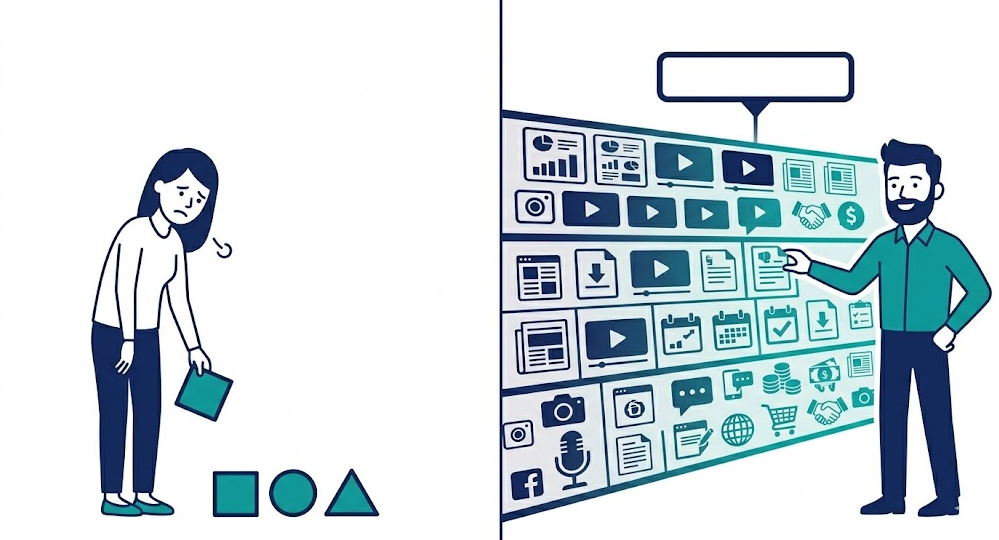
The first five headlines you write are the obvious ones.
They’re the angles everyone else is already using. The formulas that feel safe. The titles that sound like everything else in your niche.
Headlines 6 through 20 start to get interesting. You run out of obvious angles and start reaching for something different.
Headlines 20 through 50 are where the real opportunities appear. You’ve exhausted the predictable territory. What’s left is unexpected — and unexpected headlines are the ones that get clicked.
Quantity forces quality. Not because every variation is good — most won’t be. But because the winner is almost never in the first five.
The 4 Headline Dimensions
Before generating variations, understand what actually changes between headlines.
Every headline operates across four dimensions. Variations that only change words within the same dimension aren’t real variations — they’re rephrasing.
Dimension 1 — Format: How to / List / Question / Statement / Story
Dimension 2 — Angle: Benefit / Problem / Curiosity / Contrarian / Urgency / Social proof
Dimension 3 — Specificity: Vague vs. concrete numbers, timeframes, and outcomes
Dimension 4 — Audience signal: Who it’s explicitly for vs. implied for everyone
A real test changes dimensions, not just words. “7 Ways to Grow Your Traffic” and “7 Traffic Growth Tactics” are the same headline wearing different clothes. “The Traffic Strategy That Works After 3 Failed Attempts” is a different dimension entirely.
The 3 Prompts
Prompt 1: The 50-Headline Generator
I'm writing an article about: [topic]
The main thing the reader gets from this article: [specific outcome or insight]
My target reader is: [describe them — situation, experience level, goal]
My target keyword is: [primary keyword]

Generate 50 headline variations organized into 5 groups of 10.

GROUP 1 — FORMAT VARIATIONS:
2 How-to headlines, 2 list headlines, 2 question headlines,
2 statement headlines, 2 story-based headlines

GROUP 2 — ANGLE VARIATIONS:
Benefit-focused, problem-focused, curiosity-driven, contrarian,
urgency-based, social proof, fear of missing out, aspirational,
skeptic-facing, and insider-knowledge angles

GROUP 3 — SPECIFICITY VARIATIONS:
Vague to ultra-specific spectrum — from broad promise to
exact number / exact timeframe / exact situation

GROUP 4 — AUDIENCE SIGNAL VARIATIONS:
Headlines that signal different reader types — beginner,
experienced, frustrated with past failures, skeptic,
ready to act, researcher

GROUP 5 — HYBRID VARIATIONS:
Combine the strongest elements from Groups 1-4 into
10 headlines that blend format + angle + specificity

Rules:
- No two headlines should use the same combination of format and angle
- Include the target keyword naturally in at least 15 headlines
- Vary length — some under 8 words, some over 12
- Label each headline with its format and angle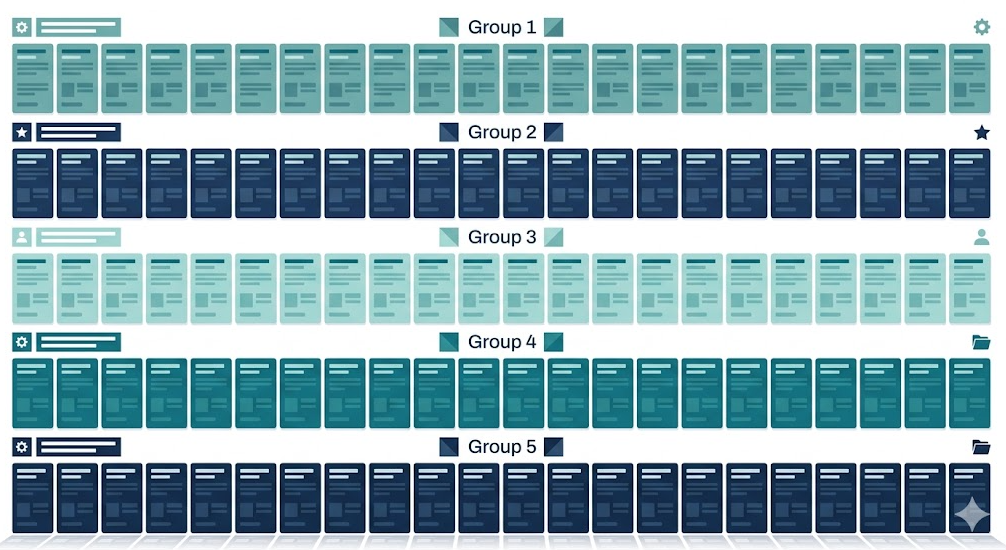
Run this once. You now have 50 options across genuinely different dimensions. Next step: cut to the best 5.
Prompt 2: The Headline Scorer
Don’t pick the headline that feels best. Score it.
Feelings favor familiarity. Scoring favors performance.
Here are my 50 headline variations: [paste Prompt 1 output]

Score each headline on these 5 criteria. Rate each 1-3.

CLARITY (1-3):
Does the reader instantly know what the article is about?
1 = confusing or vague
2 = understandable with effort
3 = immediately clear

CURIOSITY (1-3):
Does it create a desire to know more?
1 = nothing surprising or intriguing
2 = mildly interesting
3 = strong pull to find out what's inside

SPECIFICITY (1-3):
Does it use concrete details — numbers, timeframes, situations?
1 = completely generic
2 = some specificity
3 = highly specific and believable

KEYWORD FIT (1-3):
Does it include or closely relate to the target keyword naturally?
1 = keyword absent or forced
2 = keyword present but awkward
3 = keyword fits naturally

DIFFERENTIATION (1-3):
Does it stand out from typical headlines in this niche?
1 = sounds like every other article on this topic
2 = slightly different angle
3 = genuinely distinctive

Calculate a total score out of 15 for each headline.
List the top 10 by score.
Flag any headline that scores 3 on Curiosity AND 3 on Differentiation —
those are your priority tests regardless of total score.
The curiosity + differentiation flag is the override rule. A headline that’s both surprising and distinctive will outperform a technically “correct” headline in almost every niche — because it gets clicked out of pattern interruption.
Prompt 3: The Final 3 Selector
You have your top 10 scored headlines. Now cut to the final 3 you’ll actually test or choose between.
Here are my top 10 scored headlines: [paste top 10 from Prompt 2]
My primary goal for this article is: [SEO ranking / social sharing / email click / direct conversion]
My audience's awareness level is: [cold — don't know the topic / warm — know the problem / hot — ready to act]

Select the best 3 headlines for my specific goal and audience by evaluating:

SEARCH INTENT MATCH:
Which headline most accurately sets the expectation for what's in the article?
(Misleading headlines increase bounce rate and hurt rankings)

CLICK-THROUGH POTENTIAL:
Which headline would you click if you saw it in search results —
surrounded by five similar-looking results?

SOCIAL SHARE ANGLE:
Which headline would prompt someone to share it with a specific person?
("You need to read this" requires a clear reason)

CONVERSION ALIGNMENT:
Which headline attracts the reader most likely to take action
on the offer in the article?

For each of the final 3:
- State why it made the cut
- Name the one scenario where it would outperform the other two
- Suggest one small tweak that could strengthen it further

Then give me your single top recommendation with a clear reason.
The “one scenario where it would outperform” framing is the key. Different headlines win in different contexts. Understanding when each one performs best tells you which to use now — and which to keep for a different campaign or traffic source.
How to Actually Choose
After running all three prompts, you’ll have a scored top 10 and a final 3 with analysis.
Here’s the decision logic:
For SEO-primary content: Prioritize clarity and keyword fit. A confused reader who bounces immediately hurts your rankings more than a slightly boring headline hurts your click rate.
For social-primary content: Prioritize curiosity and differentiation. Nobody shares content that looks like everything else. Pattern interruption drives shares.
For email content: Prioritize specificity and audience signal. The reader already trusts you — they need a specific reason to open this email over the twenty others in their inbox.
For conversion content: Prioritize the audience signal dimension. A headline that repels the wrong reader and attracts the right one outperforms a headline that gets more clicks from people who’ll never buy.
When in doubt, pick the headline that scores highest on specificity. Specific headlines consistently outperform generic ones across all contexts because specificity signals credibility — it suggests you actually know what you’re talking about.
The One Test Worth Running
If you have enough traffic to test, run a simple title tag test.
Publish with Headline A. After 30 days, check click-through rate in Google Search Console. Change to Headline B. Compare after another 30 days.
That’s it. No tools required. No split testing software.
One data point per month from real searchers is more valuable than 50 opinions from people who haven’t seen the search results page.
The Bottom Line
Writing one headline and hoping it works is a coin flip.
Writing 50 headlines and scoring them is a system.
The winner is almost never in your first five attempts. It’s hiding in variation 23 or variation 41 — the angle you wouldn’t have reached without exhausting the obvious ones first.
Three prompts. Five minutes. Fifty options.
Pick the system over the guess every time.