Most people use AI wrong when building a business plan.
They ask it to write one.
AI produces a polished, professional-looking document full of generic sections, vague goals, and zero strategic insight.
It looks like a business plan. It reads like a business plan. It’s completely useless as a business plan.
Here’s the truth: AI shouldn’t write your business plan. It should think through it with you.
There’s a massive difference.
When AI writes it, you get a template with your name on it. When AI thinks with you, you get pressure-tested assumptions, spotted blind spots, challenged logic, and a strategy that’s actually yours.
That’s what this article teaches.
Seven prompts. One strategic framework. A business plan that holds up under scrutiny.
You may also like:
- AI-Powered Brainstorming (50 Ideas in 10 Minutes)
- Video Script Writing with AI
- Advanced Prompt Techniques (Constraints, Personas, and Output Control)
What AI Actually Does Well in Business Planning

Before the prompts, understand where AI adds real value — and where it doesn’t.
AI is excellent at:
- Asking questions you haven’t thought of
- Stress-testing assumptions and logic
- Generating multiple strategic options quickly
- Identifying gaps in your thinking
- Analyzing competitive positioning
- Translating vague goals into specific ones
AI is poor at:
- Knowing your specific market better than you do
- Predicting whether your idea will actually work
- Replacing real customer research
- Making the final call on strategy
The best use of AI in business planning is as a thinking partner — one that pushes back, asks hard questions, and forces clarity. Not one that fills blank spaces with convincing-sounding words.
Keep that distinction in mind throughout every prompt.
The S.T.R.I.D.E. Framework
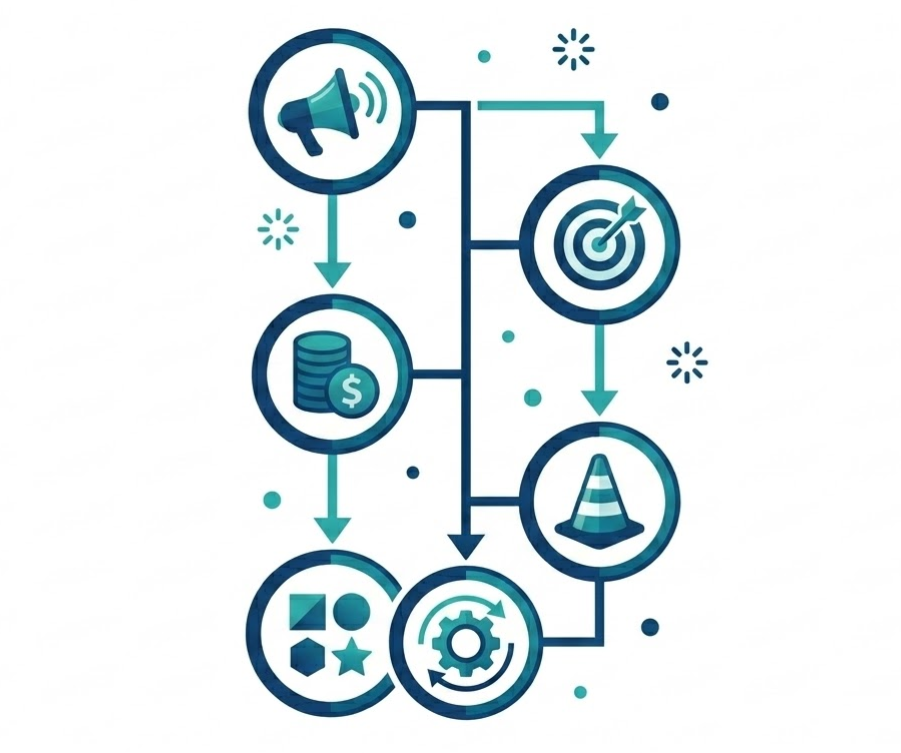
Six stages. Each one builds on the last.
S — Situation: Where you are right now. What you have, what you don’t, what the market looks like.
T — Target: Where you’re going. Specific goals with real numbers and timeframes.
R — Revenue: How money flows. What you’ll sell, to whom, at what price, and how often.
I — Issues: What could go wrong. Assumptions that could break. Problems you haven’t solved yet.
D — Differentiation: Why you specifically. What makes your approach distinct from everyone else.
E — Execution: What happens first. The 90-day plan that turns strategy into action.
Let’s build each stage.
S — Situation: Map Where You Are
Most business plans jump straight to goals. That’s backwards.
You can’t plot a route without knowing your starting point.
Prompt 1: The Situation Audit
I'm building a business plan for [describe your business idea or current business].

Before we get to goals or strategy, help me map my current situation honestly.

Ask me 10 probing questions that force me to clearly define:
1. What I currently have (skills, resources, audience, assets)
2. What the market actually looks like right now
3. Who's already doing this and how well
4. What I'm assuming that I haven't actually verified
5. What constraints I'm working within (time, money, experience)

After I answer, summarize the situation back to me — including any gaps or contradictions you notice in my answers.
Let AI interview you first. Answer every question honestly. The summary it produces back to you will reveal assumptions you didn’t know you were making.
T — Target: Define Where You’re Going
Vague goals produce vague plans.
“I want to make good money” is not a target. “I want to generate $5,000/month in affiliate commissions within 12 months by building a content site in the personal finance niche” is a target.
Prompt 2: The Goal Sharpener
Here are my business goals: [paste your goals]

Challenge these goals by:
1. Identifying any that are too vague to measure
2. Flagging any that lack a realistic timeframe
3. Pointing out where the numbers don't add up
4. Highlighting goals that conflict with each other
5. Asking what I haven't included that I probably should

Then rewrite each goal in this format:
"By [specific date], I will achieve [specific measurable outcome] by doing [specific actions], which I'll know is working when [leading indicator]."

If any goal can't be rewritten in this format, explain why — it probably isn't a goal yet.
This prompt is uncomfortable. Good. Vague goals feel safe because they can’t fail. Specific goals feel risky because they can. That’s exactly why you need them.
R — Revenue: Map How Money Flows
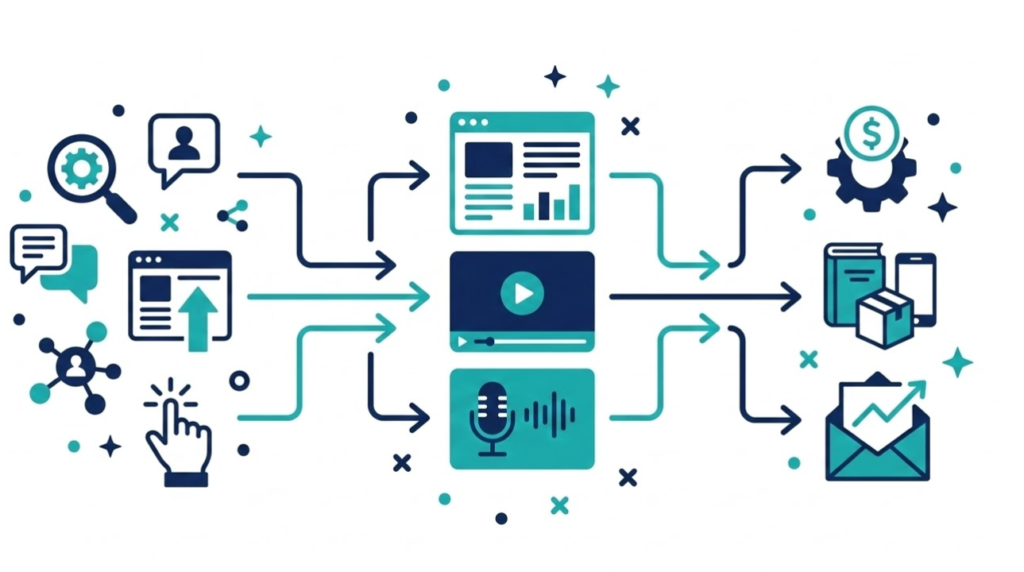
This is where most affiliate marketing business plans fall apart.
“I’ll make money from affiliate commissions” isn’t a revenue model. It’s a category.
You need to know the full chain: who you’ll reach, how you’ll reach them, what you’ll offer, what converts, and what the numbers look like at scale.
Prompt 3: The Revenue Model Builder
My business model is: [describe it briefly]
My target audience is: [describe them]
My primary traffic source will be: [SEO / social / email / paid]

Help me build a complete revenue model by working through:

1. TRAFFIC MATH
   - How many visitors/followers do I need monthly to hit my income goal?
   - What's a realistic conversion rate at each stage?
   - How long will it take to reach that traffic level?

2. OFFER STACK
   - What affiliate offers fit this audience?
   - Should I have multiple income streams? Which ones make sense together?
   - What's the logical sequence a reader goes through before buying?

3. UNIT ECONOMICS
   - What does one visitor need to be worth on average?
   - What commission rates make this model viable?
   - At what traffic level does this become a real business?

Show me the numbers. Point out where my assumptions are optimistic.
Run this back and forth. Push back on the numbers AI gives you. Ask “what if my conversion rate is half that?” Make the model survive pessimistic assumptions, not just optimistic ones.
Prompt 4: The Revenue Stress Test
Here is my revenue model: [paste Prompt 3 output]

Stress test it by:
1. Cutting my projected traffic by 50% — do the numbers still work?
2. Cutting my conversion rate by 50% — what happens?
3. Assuming my top affiliate program cuts commissions by 30% — how does that change things?
4. Adding 6 months to my timeline — can I sustain that financially?

For each scenario, tell me:
- Whether the model survives
- What would need to change
- What this reveals about my biggest vulnerability

Don't soften this. I need to know where the model breaks.
If your model breaks under mild stress, it’ll break in real life. Better to know now.
I — Issues: Find What Could Go Wrong
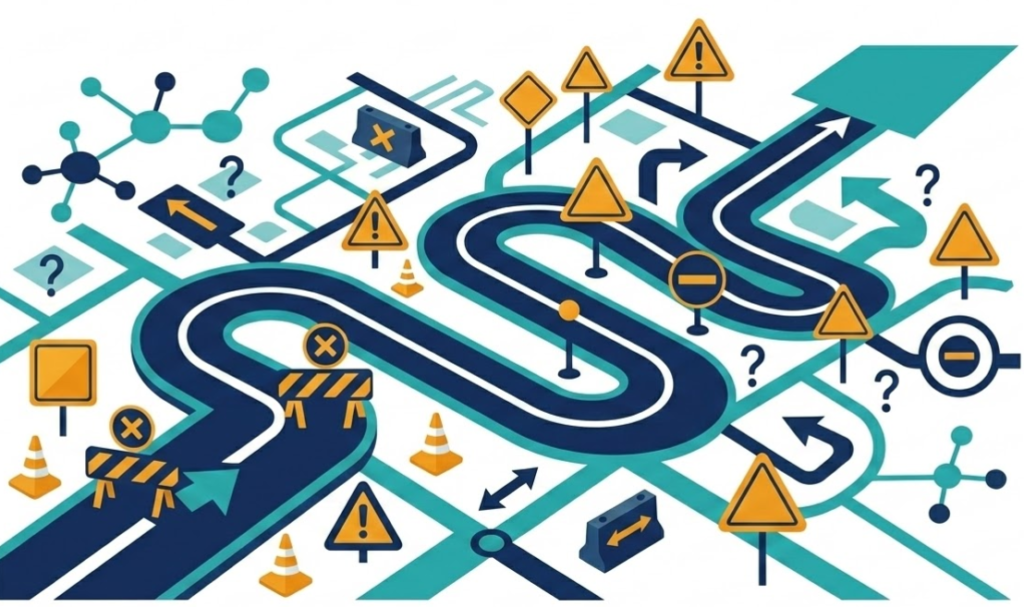
Every business plan has assumptions baked into it.
Most people ignore them. Smart planners surface them and deal with them upfront.
Prompt 5: The Assumption Excavator
Based on everything we've built so far: [paste your situation, goals, and revenue model]

Identify every assumption my plan depends on.

For each assumption:
1. State the assumption explicitly
2. Rate how confident I should be in it (high/medium/low)
3. Explain what happens to the plan if the assumption is wrong
4. Suggest how I could test or validate it before fully committing

Organize by priority — biggest risk assumptions first.

Then identify the single assumption that, if wrong, would completely break this business plan.
That last question is the most important one in the entire framework.
If you know the one thing that could kill your plan, you can either validate it first — or build a contingency around it. Most business failures trace back to one unvalidated assumption that everyone just decided to believe.
D — Differentiation: Define Why You
This is where most business plans are the weakest.
“I’ll create high-quality content” is not differentiation. Every competitor says the same thing.
Differentiation means something specific that you offer, do, or say that others genuinely don’t — and that your audience actually cares about.
Prompt 6: The Differentiation Pressure Test
Here is my business concept and target audience: [paste]

Here are my main competitors: [list 3-5]

Challenge my differentiation by:
1. Identifying what my competitors would say if asked the same "why us" question
2. Finding where my claimed differentiation is actually just table stakes
3. Asking what I have that competitors genuinely can't easily copy
4. Identifying underserved angles or audiences none of us are currently owning
5. Writing 3 positioning statements — from weak to strong — showing the difference between generic and genuinely differentiated

Then tell me honestly: do I currently have real differentiation, or do I need to find it?
Expect this to sting a little. If AI tells you your differentiation is weak, believe it — and fix it before you build a whole business on a shaky foundation.
E — Execution: Build the 90-Day Plan
Strategy without execution is just thinking.
This final prompt converts everything you’ve built into the first 90 days of actual work.
Prompt 7: The 90-Day Execution Plan
Based on this complete business plan: [paste everything]

Build me a 90-day execution plan.

Structure it as three 30-day sprints:

SPRINT 1 (Days 1-30): Foundation
- What must be built or decided before anything else can work?
- What are the 3 most important tasks?
- What does "done" look like at day 30?

SPRINT 2 (Days 31-60): Traction
- What signals will tell me the foundation is working?
- Where should I focus to get first real results?
- What should I stop doing if it isn't working by day 45?

SPRINT 3 (Days 61-90): Optimization
- What do I double down on based on what's working?
- What metrics should I be hitting by day 90?
- What does the plan look like for months 4-6 if Sprint 3 goes well?

For each sprint: list the top 3 tasks, the key metric, and the decision point — the moment where I evaluate and adjust.
A 90-day plan is short enough to commit to fully and long enough to see real results. It also forces prioritization — you can’t do everything, so you have to decide what matters most right now.
Using AI as an Ongoing Thinking Partner
The framework doesn’t end at day 90.
Use AI throughout execution:
Weekly: “Here’s what happened this week: [results]. What does this tell me? What should I adjust?”
Monthly: “Here are my metrics vs. projections: [data]. Where am I ahead? Where am I behind? What’s the most likely explanation?”
Quarterly: “It’s been 90 days. Here’s what worked and what didn’t: [summary]. Help me build the next 90-day plan based on what I’ve learned.”
The difference between AI as a one-time tool and AI as a thinking partner is consistency. The more context you give it, the better it thinks with you.
Common Business Planning Mistakes
Mistake 1: Planning in a vacuum
Symptoms: Beautiful document. Zero market validation. Real customers behave nothing like the plan assumed.
Fix: Use Prompt 5 (Assumption Excavator) to identify what needs to be tested before you build.
Mistake 2: Confusing activity with strategy
Symptoms: 90-day plan full of tasks, no clear logic connecting them to outcomes.
Fix: Every task in your execution plan should trace back to a specific goal from Prompt 2.
Mistake 3: Never updating the plan
Symptoms: Plan written in January, ignored by March. Reality diverged and nobody adjusted.
Fix: Treat your business plan as a living document. Re-run relevant prompts monthly with real data.
Mistake 4: Optimism without stress testing
Symptoms: Revenue projections assume everything goes right. First setback breaks the whole model.
Fix: Run Prompt 4 (Revenue Stress Test) until the model survives pessimistic scenarios.
The Bottom Line
AI won’t build your business for you.
But it will do something more valuable — it will think harder about your business than you’re willing to think alone.
It will ask the uncomfortable questions. Spot the weak logic. Surface the assumptions you’ve been quietly ignoring.
The S.T.R.I.D.E. framework gives you the structure. The seven prompts give you the conversation. What you do with the output is still entirely up to you.
That’s how it should be.