A pros and cons list feels like a decision-making tool.
It isn’t.
It’s a way of organizing your existing opinions into two columns.
Whatever you already believe ends up with more points in its favor.
The list confirms your bias and calls it analysis.
Real decision-making means pressure-testing your assumptions, identifying what you don’t know, separating emotion from logic, and thinking through second-order consequences.
AI can do all of that — if you go beyond the list.
This article gives you a six-prompt framework that turns any hard decision into a clear, defensible call.
You may also like:
- Project Planning with AI (From Concept to Timeline in One Conversation)
- The Role-Task-Context Framework (With 15 Examples)
- Advanced Prompt Techniques (Constraints, Personas, and Output Control)
Why Most Decisions Feel Hard
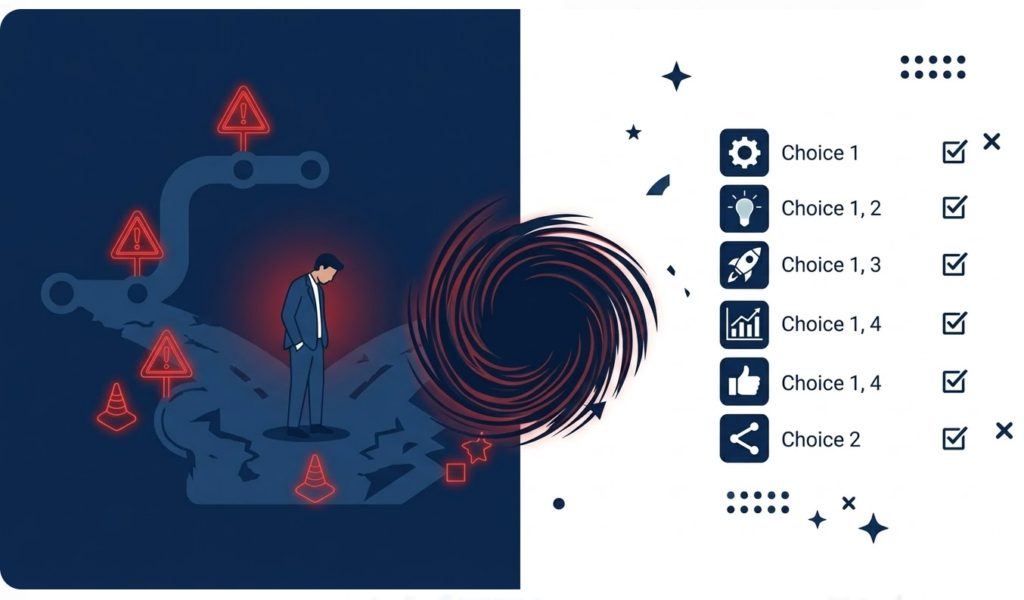
Hard decisions feel hard for specific reasons. Know which one you’re dealing with.
Too much information. You’ve researched so much that every option looks both good and bad. Analysis paralysis.
Too little information. You don’t know enough to be confident. But waiting for more information has a cost too.
Conflicting values. Both options are good — they just optimize for different things you care about. Speed vs. quality. Short-term vs. long-term. Security vs. growth.
Fear of being wrong. The decision itself is clear. What’s hard is accepting responsibility for the outcome.
AI helps with the first three directly. The fourth one is yours to work through — but having a clearer picture of the first three makes it easier.
The D.E.C.I.D.E. Framework
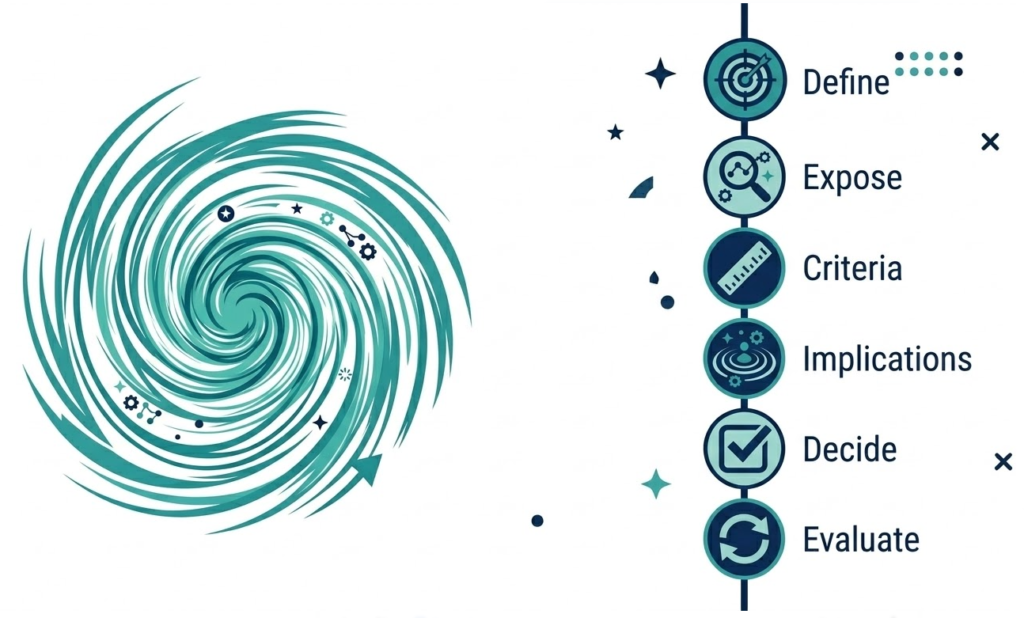
Six steps. Each one removes a layer of noise until the right call becomes visible.
D — Define: Clarify what decision you’re actually making.
E — Expose: Surface the hidden assumptions and unknowns.
C — Criteria: Establish what matters most before evaluating options.
I — Implications: Think through second and third-order consequences.
D — Decide: Make the call with full information.
E — Evaluate: Build in a review point so the decision stays alive.
D — Define: Get Clear on the Real Decision
Most people jump to evaluating options before they’ve defined the actual decision correctly.
Wrong question = wrong answer. Every time.
Prompt 1: The Decision Definer
I need to make a decision. But before evaluating options,
help me make sure I'm asking the right question.

THE SITUATION: [describe what's happening and why a decision is needed]
THE OPTIONS I SEE: [list what you're choosing between]
THE DEADLINE: [when does this need to be decided?]

Challenge my framing by asking:
1. Am I solving the real problem or a symptom of it?
2. Are there options I haven't considered?
3. Is this actually one decision or several smaller ones bundled together?
4. What happens if I decide nothing — is that also an option?
5. Who else is affected by this decision and should be part of making it?

Then restate the decision I should actually be making in one clear sentence.
Often the hardest part of a decision is realizing you’ve been deciding the wrong thing. This prompt catches that early.
E — Expose: Surface What You Don’t Know
Every decision rests on assumptions. Most of them go unexamined.
Prompt 2: The Assumption and Unknown Excavator
Here is the decision I'm facing: [paste Prompt 1 output]
Here are the options I'm considering: [list them]

For each option, identify:

ASSUMPTIONS I'M MAKING:
— What am I taking for granted that might not be true?
— What would need to be true for this option to work out well?

KEY UNKNOWNS:
— What information would change my thinking if I had it?
— What can I find out before deciding, and what can I not?

HIDDEN COSTS:
— What costs or downsides am I underweighting or ignoring?
— What does choosing this option make harder or impossible later?

Rate each unknown: can I resolve it before deciding (yes/no)?
Flag the ones I can't resolve — those are the risks I'm accepting.
The unknowns you can’t resolve are what you’re really deciding about. This prompt makes that explicit instead of letting those unknowns hide inside vague feelings of uncertainty.
C — Criteria: Decide What Matters Before You Evaluate
This is the step most people skip — and it’s the one that makes everything else objective.
If you evaluate options before setting criteria, your criteria will unconsciously shift to favor whichever option you already prefer. Set the criteria first. Lock them in. Then evaluate.
Prompt 3: The Criteria Builder
I'm deciding between these options: [list options]

Before evaluating any of them, help me establish my decision criteria.

Ask me:
1. What does a good outcome look like 12 months from now?
2. What would make me feel this was the wrong call?
3. What are my non-negotiables — things any option must have?
4. What am I willing to trade off and what am I not?
5. Whose interests matter most in this decision — and in what order?

Based on my answers, create a weighted criteria list:
- List 4-6 criteria that matter most
- Assign a weight to each (must add to 100%)
- Write a one-sentence definition of what "high performance"
  looks like for each criterion

I will use this criteria list to evaluate every option equally before choosing.
The weighting is the key.
“Good ROI” and “low risk” both matter — but which matters more? Until you decide that, every option looks equally valid.
I — Implications: Think Three Moves Ahead
Good decisions don’t just ask “what happens if I choose this?”
They ask “and then what? And then what after that?”
Prompt 4: The Second-Order Thinking Prompt
I'm considering this option: [describe one option]
In the context of this decision: [paste decision definition]

Run second and third-order consequence analysis:

FIRST ORDER (direct, immediate effects):
— What happens right after I make this choice?

SECOND ORDER (what happens because of the first-order effects):
— What does the first-order result cause or enable?
— What doors does this open or close?

THIRD ORDER (longer-term ripple effects):
— Six to twelve months out, what is the likely state of things?
— What path does this put me on that becomes hard to reverse?

REGRET TEST:
— Looking back from 5 years in the future, under what circumstances
   would I regret this decision?
— Under what circumstances would I be glad I made it?

Run this analysis for each option I'm considering.
Run this for each option separately.
The differences between their second and third-order effects are often more revealing than the immediate pros and cons.
D — Decide: Score and Choose
Now evaluate each option against your criteria — not your gut.
Prompt 5: The Structured Evaluation
Here is my decision: [paste Prompt 1 output]
Here are my criteria with weights: [paste Prompt 3 output]
Here are my options with their implications: [paste all previous outputs]

Score each option against each criterion on a scale of 1-5.

Present results as:

OPTION A — [name]:
- Criterion 1 (weight X%): Score Y — [one sentence explanation]
- Criterion 2 (weight X%): Score Y — [one sentence explanation]
- [continue for all criteria]
- WEIGHTED TOTAL: [calculated score]

[Repeat for each option]

RECOMMENDATION:
- Highest scoring option
- Key reasons it scores better
- Most significant trade-off of choosing it
- One condition under which a lower-scoring option would be the better call

Do not soften the recommendation. Give me a clear answer.
The scoring process often produces a surprise.
The option you thought you preferred scores lower once the criteria are applied objectively. Trust the framework over your gut.
That’s exactly what you built it for.
E — Evaluate: Build in a Review Point
A decision isn’t finished when it’s made. It’s finished when you know whether it was right.
Prompt 6: The Decision Review Builder
I've made this decision: [what you decided]
My reasoning was: [brief summary of why]
The expected outcomes were: [what you expected to happen]

Set up a decision review by defining:

1. LEADING INDICATORS — early signals (within 30 days) that suggest
   this decision is working or not working

2. LAGGING INDICATORS — longer-term outcomes (90 days+) that will
   confirm whether the decision was correct

3. REVIEW DATE — when should I formally evaluate this decision?

4. REVERSAL CRITERIA — under what specific conditions should I
   reverse or significantly change course?

5. LEARNING QUESTIONS — regardless of outcome, what should I
   learn from how this decision played out?

Format this as a one-page decision log I can file and return to.
Most people never close the loop on decisions.
They make the call, live with the consequences, and never extract the learning that would make the next decision easier.
This prompt turns every decision into data for the next one.
When to Use the Full Framework vs. a Lighter Version
Not every decision needs all six prompts.
Use the full framework for:
- High-stakes decisions with long-term consequences
- Irreversible or hard-to-reverse choices
- Decisions involving significant money, time, or relationships
- Anything you’ve been going back and forth on for more than a week
Use just Prompts 1, 3, and 5 for:
- Medium-stakes decisions where you mostly need objectivity
- Choices between two clear options
Use just Prompt 1 for:
- Smaller decisions where you just need to clarify what you’re actually deciding
The framework scales. Use what fits the weight of the decision.
The Bottom Line
A pros and cons list tells you what you already think.
The D.E.C.I.D.E. framework tells you what you should think — after your assumptions are exposed, your criteria are set, and the consequences are mapped.
Six prompts. One structured conversation.
A decision you can defend, act on, and learn from.
Hard decisions don’t get easier by thinking about them longer. They get easier by thinking about them better.